



Wall Street loves to tell the same old story about small-caps.
“They’re lottery tickets,” they say. Cash-burning start-ups, one-product gambles, companies a single bad quarter away from the exit. Buy them if you want a thrill. Skip them if you want to sleep at night.
And in fairness, that story is often true.
But not always.
And today, Adam’s system found the exception…
This morning, I ran the small-cap universe through a quality filter. A short list came out the other side.
Not lottery tickets. Not gambles. Real businesses that earn high returns, throw off cash, carry almost no debt, and still trade cheaply.
They are not cheap because they are broken. They are cheap because nobody is looking.
That is the whole game down here. Do the work everyone else skips, and the market pays you for it.
What The Screen Actually Does
Let me walk you through it in plain English. The reason behind each rule matters more than the rule itself.
Start with the universe. I told the system to look only at companies worth between $250 million and $2 billion.
That is the small-cap zone. Big enough to be a real business with audited books and a liquid stock. Small enough that the giant funds cannot touch it, so it stays ignored and mispriced. That neglect is the opportunity.
Then I asked for Quality. And I asked for it twice.
The first ask is Adam’s model. Every stock in his system gets scored across six factors, and I demanded a top-decile Quality score above 85.
Quality here means the boring, durable stuff: high returns on the money the business already has, fat margins, and a clean balance sheet. I want the factor that measures durability to be shouting, not whispering.
The second ask is an outside referee. I layered on the Piotroski F-Score and required at least a 6 out of 9.
The Piotroski score is a simple nine-point checkup on a company’s financial health, built by an accounting professor, and it has nothing to do with my model.
When Adam’s system and a completely separate method both bless the same stock, I trust it more. One opinion can be wrong. Two that agree, from different directions, usually are not.
Next comes the part that keeps you out of trouble: cash and debt.
I required a five-year average return on equity above 12%. Not one lucky year. Five. I want to see a business that compounds, not one that spikes once and then fades.
Then I demanded a positive free-cash-flow margin, real money left over after the bills and the capital spending, because earnings can be an accountant’s opinion, but cash is a fact.
The debt rule is tighter than I would use on the whole market. I capped debt at 80% of equity.
Big companies can carry a heavy loan and refinance it in their sleep. A small cap cannot.
When money gets expensive or a quarter goes bad, leverage turns a stumble into bankruptcy. So I made small caps to prove they are built to survive.
Finally, the plumbing. I set a value screen so I am not overpaying for all this quality, plus a liquidity floor and a price floor above $5.
That last part matters. A great business you cannot actually buy or sell without moving the price is a museum piece, not an investment.
Put it together, and the filter is doing one thing: hunting for boring, profitable, debt-light small caps that the market has left in the discount bin.
The 10 Names That Made The List
A tight list cleared every hurdle. They are spread across energy, financials, industrials, business services, and a lone software distributor. No theme stocks. No hype. Just cash and discipline.
Here are the 10 smallest, from tiny to merely small.
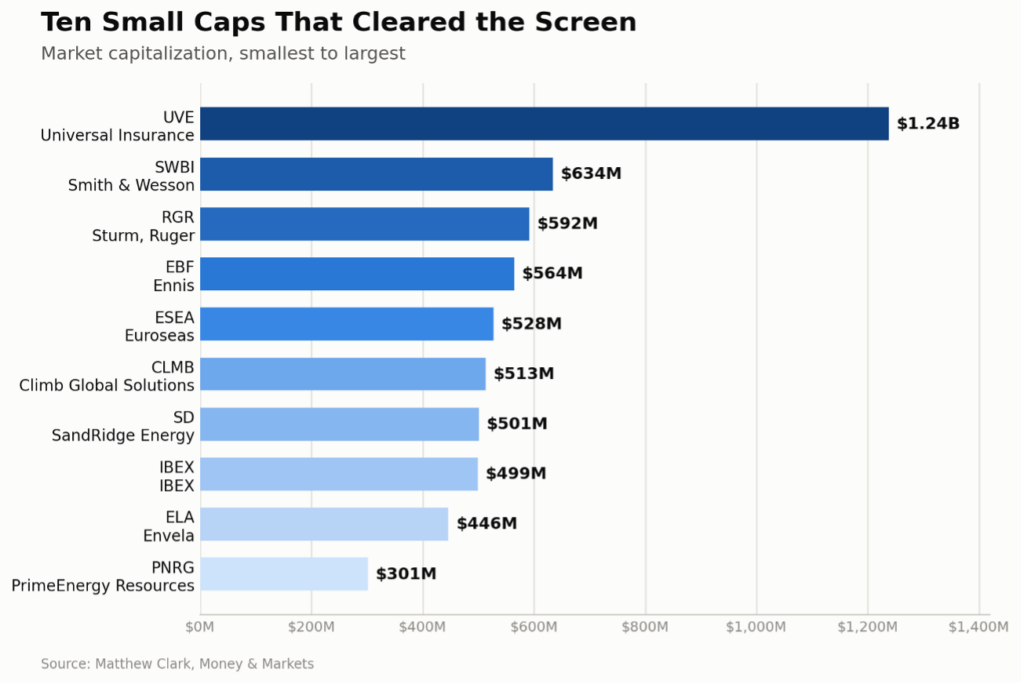

Two of them are worth pulling out of the lineup.
Euroseas (ESEA): The Cheapest Quality In The Batch
If you want to see what this screen is built to find, look at Euroseas (ESEA).
Euroseas is a Greek shipping company. It owns and charters out a fleet of feeder container ships, the mid-sized vessels that move boxes between regional ports. It is about as unglamorous as investing gets. And the numbers are stunning.
Its Quality score is 97, and its Value score is 99, both near the very top of my entire universe, small-cap or not.
Its five-year average return on equity is almost 58%. Its free cash flow margin is nearly $0.39 per dollar of sales. It pays a dividend of 4%. And the stock trades at under four times earnings.
Under four. The market average is roughly six times that.
So what is the catch?
Shipping is deeply cyclical. Those gorgeous returns were earned while charter rates ran hot, and a single-digit earnings multiple is the market’s way of betting those rates cool off.
The low price is not a free lunch. It is the market pricing in a downcycle that may or may not come as fast as it fears.
That does not scare me off. It just tells me how to hold it. Euroseas is a cash-rich, well-run business trading at a fire-sale price, and you get paid a fat dividend to wait.
But it runs on a cyclical clock, so it earns a spot as a value position, sized with respect, not a set-it-and-forget-it forever holding.
Universal Insurance (UVE):
Deep Value, Priced For a Storm
If Euroseas is the cheapest, Universal Insurance (UVE) is not far behind on the numbers that matter.
Its Value score is 97, near the top of this group, and it meets my Quality bar. When the Value and Quality factors both nod to the same insurer, I pay attention.
Universal is a Florida homeowners insurer. It writes property coverage in the most hurricane-exposed market in the country, which is exactly why it is cheap.
It trades around nine times forward earnings, earns a healthy return on equity, and generates real cash.
The risk is written on the label.
One bad storm season, or another turn in Florida’s messy insurance-litigation saga, and the numbers get ugly fast.
But the market knows all that, which is why a stock this strong on value, with real cash behind it, still sells at a single-digit multiple. If you can stomach the catastrophe risk, you are being paid well to take it.
Now, here’s my read on all of this…
The screen did its job. It handed me 10 profitable, cash-generating, low-debt businesses trading at prices the market reserves for junk. That mismatch is where small-cap money is made.
If I were putting two on the research bench today, it would be these two:
- Euroseas for the raw combination of quality and value scores, plus a fire-sale price, held with a cyclical discipline.
- Universal Insurance, for its rare pairing of a top-tier value score and real cash, held with eyes open to the storm risk.
Neither is a name to marry. Both are names to understand.
Do your own homework before you buy anything here. A screen is a starting line, not a finish line. But it is a very good starting line, and today it pointed at some real bargains hiding in plain sight.
Until next time…

Matt Clark, CMSA®
Chief Research Analyst, What My System Says Today
