



As I write this, today is shaping up to be a real doozy in the market.
Korean chipmaker Samsung released its quarterly earnings report, and while the company saw a massive 19-fold increase in operating profit, sales came in slightly below expectations.
This was enough to revive fears that the AI infrastructure spending boom was stalling.
Is the massive spending spree on AI hardware that has fueled this bull market truly reaching the end of the road?
The short answer is no.
It’s clear that spending isn’t slowing just yet. In fact, it remains stronger than ever.
The question is whether it’s strong enough to live up to the hype built into share prices.
That’s a different story… and it’s still far too early to say with certainty.
So, let’s see what insights we can glean from my system.
Today, we’re going to do a deep dive into the “other” tech sector. Some of the biggest names in technology aren’t classified as “tech stocks” in the S&P 500 Index. Alphabet (GOOGL), Meta Platforms (META) and Netflix (NFLX), for example, are all classified as “communications.”
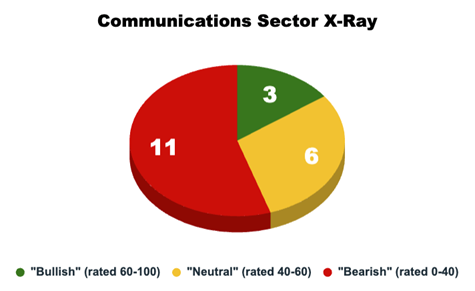

My Green Zone Power Ratings suggest investors should think twice before aggressively buying into the communications sector.
Of the 20 communications stocks in my coverage universe, only three rate “Bullish,” meaning a score of 60 or higher out of 100. (For those new to my system, “Bullish” rated stocks outperform the S&P 500 by double on average over the following year.)
Another six rate as “Neutral,” meaning my system would expect them to perform more or less in line with the broader market. And a majority, at 11, rate as “Bearish,” meaning my system would expect them to underperform the market.
The numbers for the sector as a whole don’t look great. But there are some potentially “Bullish” gems for us to sift through. Let’s keep digging to find them.
Where Do Communications Stocks Pick Up Points?
The Green Zone Power Rating system is a composite score based on six primary factors: momentum, size, volatility, value, quality and growth, each of which comprises several sub-factors. (As we are looking at large-cap constituents of the S&P 500, I don’t consider size when doing the sector X-ray.)
Let’s take a look to see where communications stocks pick up points.
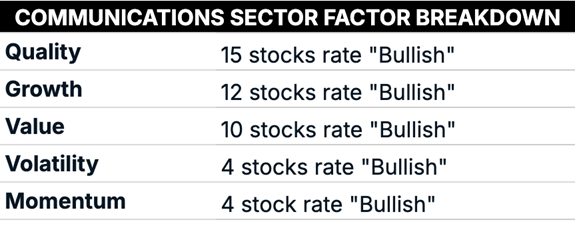

The single most “Bullish” factor is quality, which makes sense.
My quality factor favors highly profitable and “asset light” businesses. That describes Alphabet, Meta, Netflix to a T, as well as video game maker Electronic Arts (EA), dating site Match Group (MTCH), media giant Fox Corp (FOXA) and digital ad specialist the Trade Desk (TTD).
All of these companies generate their profits from “asset light” intellectual property.
At 12, a majority of the stocks also rate as “Bullish” on growth and exactly half rate as “Bullish” on value.
The bad news is the sector rates poorly on both volatility and momentum. Communications stocks tend to bounce around a lot, and most are currently out of favor.
Picking Apart the Communications Sector
Given that the communications sector is small, with only 20 stocks to review, I included the factor ratings for the entire sector. Let’s see how they shake out…
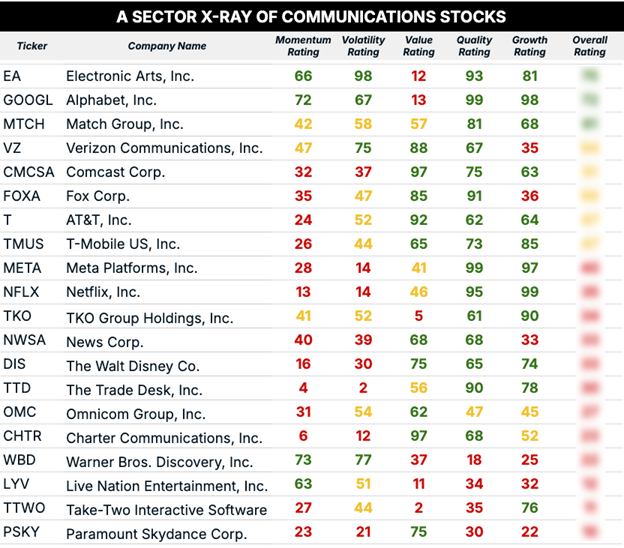

There isn’t a single stock that is “Bullish” across all factors, but Electronic Arts and Alphabet come close. Both rate as “Bullish” on everything but their value factors.
Along with Match Group, they are the only stocks on the list to boast an overall “Bullish” Green Zone rating.
Interestingly, two of the four stocks with “Bullish” momentum ratings – Ticketmaster owner Live Nation Entertainment (LYV) and media giant Warner Bros Discovery (WBD) both rate as “Bearish” on their overall Green Zone rating.
It’s also intriguing just how badly Meta rates. Despite having quality and growth ratings in the high 90s, the parent of Instagram and Facebook has an overall “Bearish” Green Zone rating, primarily due to its poor scores in momentum and volatility.
If you’re searching for a solid defensive play, Verizon Communications (VZ) is worth a harder look. It’s “Neutral” on momentum and on its overall Green Zone rating. But it rates well on its volatility, value and quality ratings and pays a 6.7% dividend.
To good profits,

Adam O’Dell
Editor, What My System Says Today
