



Let’s start with some good news…
Most of the S&P 500 Index’s industrial sectors were positive last week, and several skyrocketed higher.
The State Street Consumer Staples Select Sector SPDR ETF (XLP) was up a monster 5%, and the State Street Energy Select Sector SPDR ETF (XLE) was right behind it with a one-week gain of 4.9%.
Those are large moves for a single week, and they’re proof of the old saying that there’s always a bull market somewhere.
Unfortunately, it was a brutal week for technology. The State Street Technology Select Sector SPDR ETF (XLK) dropped by almost 8%, pulling the S&P 500 down with it.
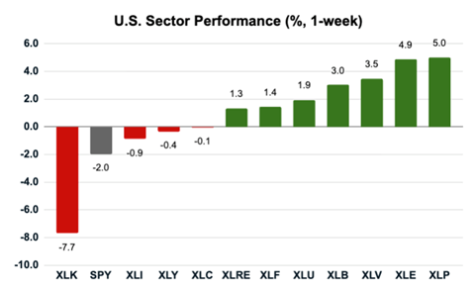

I’ve said all year that as goes the tech sector, so goes the S&P 500.
It’s basic math.
The tech sector and tech-adjacent sectors like communications make up almost half the index.
Meanwhile, let’s look at the weightings of the top-performing sectors from last week:
| Sector | Ticker |
Weight |
| Consumer Staples | XLP |
4.7% |
| Energy | XLE |
3.4% |
| Health Care | XLV |
9.1% |
| Materials | XLB |
1.8% |
Only the health care sector has a meaningful weighting. The rest make up less than 5% of the S&P 500, and materials make up less than 2%.
None of these sectors are big enough to pull the index higher when tech stocks are in freefall.
That’s bad if you’re buying and holding an S&P 500 index fund.
But if you’re an active trader, it creates an opportunity.
Think about it like this…
When investors sell their tech stocks, that money has to go somewhere. A lot of it may go to short-term bonds or may just sit in cash. But some of it rotates to other corners of the stock market.
It takes a lot of buying pressure to send a stock worth trillions of dollars, like Apple (AAPL) or Nvidia (NVDA), higher.
But when a sector like energy accounts for just 3.4% of the market, it doesn’t take much buying pressure to send stock prices higher.
Nvidia and Apple are each individually worth more than twice the value of the entire energy sector. (If you don’t believe me, check the math. Nvidia and Apple account for 7.5% and 7.2% of the S&P 500, respectively.)
So, what’s our takeaway?
Regardless of what happens in the tech sector or the S&P 500 more broadly, there will be opportunities for active investors.
Our job is to find those opportunities.
And that’s where my Green Zone Power Ratings excel.
Let’s see what my system says about where those opportunities might be.
What’s Next for Consumer Staples?
As I do every week, I ran my customary screen of the biggest movers in the sector that were still within 10% of their 52-week highs. The idea is to look for solid, market-leading stocks that are getting stronger.
Well, with inflation refusing to die and consumers struggling to cut costs, it’s been a rough year for staples stocks. Virtually none of them were anywhere near their 52-week highs, so I loosened that criteria.
Here’s what I came up with:
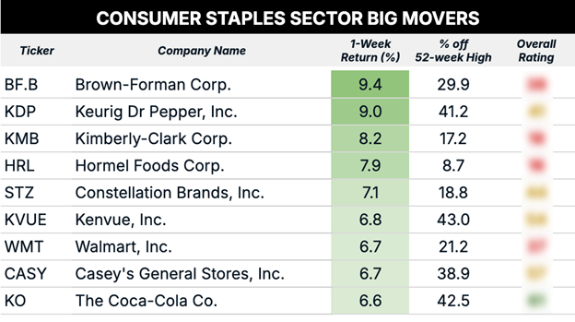

Unfortunately, there isn’t a lot to see here. The Coca-Cola Company (KO) is currently the only stock rated as “Bullish.”
If we do see continued weakness in tech, it’s entirely possible that consumer staples continue to rally.
As a defensive sector, investors tend to flock to them when the market is rocky and they have nowhere else to go.
That might make them a decent short-term trade.
But my system suggests now isn’t the best time to be adding major long-term positions in the sector.
Buying the Dip in Tech?
Last week was brutal for tech stocks. Wall Street is concerned that the massive amounts of debt being taken on to fuel the AI infrastructure boom simply aren’t sustainable.
Research firm Gartner recently put out a report claiming that as much as $3.5 trillion in AI infrastructure spending was at risk of impairment, meaning Big Tech will be writing it off at a massive loss.
That sounds scary, but it only tells half the story.
While Gartner is concerned that the companies building out and running the data centers will take a major hit, they don’t imply that the AI revolution is all smoke and mirrors.
In fact, Gartner expects the “asset light” AI product and service providers to take most of the benefit.
We saw something similar unfold during the Tech Wreck a quarter century ago.
Internet infrastructure companies overbuilt in the 1990s and took major losses in the early 2000s, with many ultimately going bankrupt.
But the infrastructure they left behind made the next generation of tech companies like Netflix (NFLX), YouTube, Uber (UBER) and countless others possible.
Great!
But what about today? Did last week’s drubbing unearth any potential bargains?
Let’s see what my system says.
I ran my customary screen of the sector’s biggest losers for the week that are still trading within 10% of their 52-week lows. The idea is to find beaten-down gems that look poised to recover.
Well, there aren’t a lot of tech stocks close to their 52-week lows…
After the monster run we’ve seen this year, that’s just about impossible. So, I loosened the criteria to include all stocks in the tech sector.
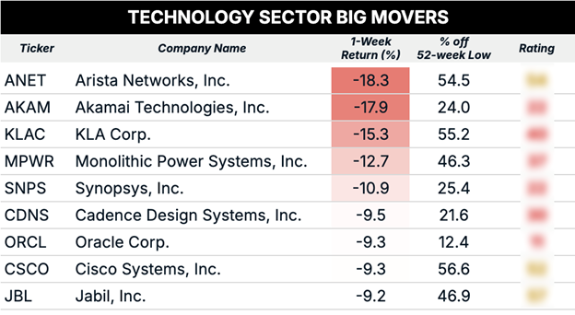

I have absolutely no doubt that a shakeout in AI stocks will create amazing long-term buying opportunities for us… eventually.
But for now, my system is telling us to steer clear of this particular group.
To good profits,

Adam O’Dell
Editor, What My System Says Today
