


Just looking at a chart, 2025 has been a terrific year for the stock market.
The benchmark S&P 500 broke out of its slump induced by tariffs in April, and it’s currently up more than 16% on the year.
However, that breakout following the “Liberation Day” fall was primarily driven by a small group of stocks.
So while it’s good news that the market rebounded from what could have been a significant fall, it’s also a little disconcerting to think the larger index has essentially been dragged out of its slump by just a handful of its 500 component stocks.
Additionally, if we strip out these market drivers, the state of the stock market doesn’t look nearly as rosy as you might think.
Let me explain…
This Rally Isn’t Nearly As Impressive As You Think
(Without the Magnificent Seven)
The small basket of stocks making up the most gains in the S&P 500 is referred to as the “Magnificent 7.”
These stocks include Google parent Alphabet Inc. (GOOGL), Amazon.com Inc. (AMZN), Apple Inc. (AAPL), Meta Platforms (META), Microsoft Corp. (MSFT), Nvidia Corp. (NVDA) and Tesla Inc. (TSLA).
Thanks to an intense interest in artificial intelligence and an increase in corporate spending on the trend, these seven stocks have been driving the market for some time now.
However, if you strip out these seven stocks and analyze the traction of the remaining 493 stocks in the benchmark, you see a much different picture relative to this rally:
Mag 7 Clearly Driving Market Gains
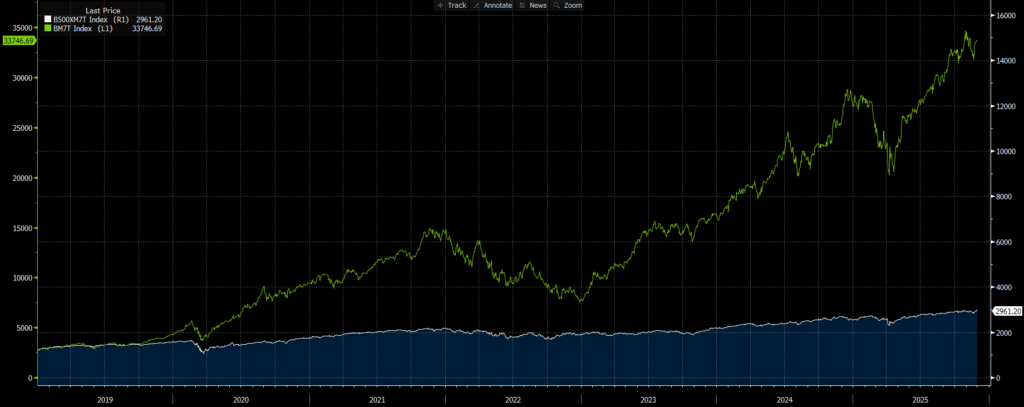

The green line in the chart above represents the gains of just the Magnificent 7. This amounts to a 1,008.4% gain since January 2019.
On the other hand, the white line in the chart is the movement of the remaining 493 stocks in the benchmark.
That gain is just 140.2% over the same time.
As you can see, the takeoff of the Magnificent 7 occurred in late 2022, spurred by the public release of OpenAI’s chatbot, ChatGPT.
This is when the large tech companies surged, thanks to their providing infrastructure and support to the new AI gold rush.
While this is good news for the broader market, it does present potential dark clouds on the horizon.


These seven companies now account for 33% of the S&P 500 gains since 2021.
This means, as these seven stocks go, so too does the market.
If these seven stocks suddenly start to decline, they will drag the rest of the market with them.
Let’s look at this another way…
AI Clearly Driving Market Gains
One big difference between these large tech stocks and smaller ones is the reliance smaller companies have on debt financing.
Small-cap companies are considerably more sensitive to interest rates than the so-called “Magnificent 7” stocks.
Big Tech Stocks Dominate Market Performance
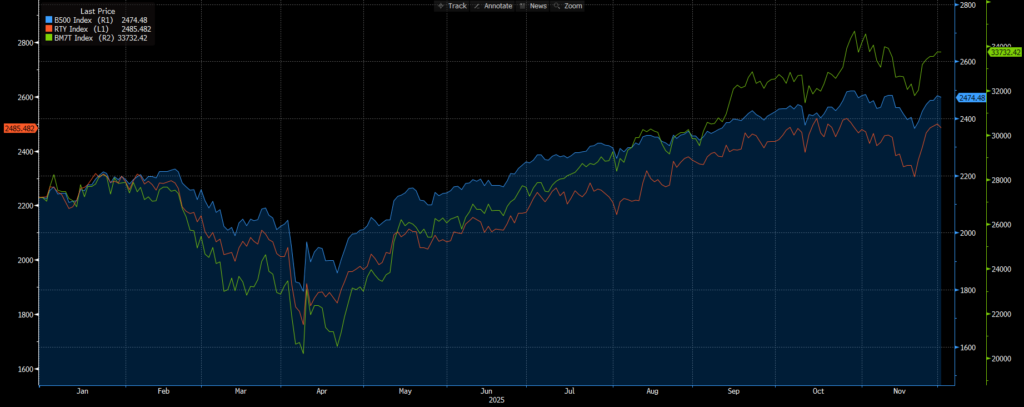
In the chart above, I’ve mapped out blue chip stocks (blue line) — represented by the S&P 500 — small-cap stocks (red line) — represented by the Russell 2000 — and the Magnificent 7 stocks (green line).
Since the beginning of the year, small-cap stocks have struggled to gain significant ground due to uncertainty surrounding the Federal Reserve’s interest rate cuts.
The Russell 2000 has only gained 11.5% since January 2025.
The S&P 500 has performed better, gaining 16.5% since the start of the year; however, the Magnificent 7 stocks are up 24%, outpacing both the benchmark and small caps.
The biggest fear on Wall Street is what the market would look like if the AI bubble were to burst.
It stands to reason that even a minor drop in Magnificent 7 stocks would spell doom for the rest of the market.
That’s problematic as these Big Tech stocks have been driven up to almost excessive valuations.
In fact, using Adam’s Green Zone Power Ratings system, I found that while the Magnificent 7 averaged an overall “Neutral” 54 out of 100, those same stocks earned a “High-Risk” 9 out of 100 on the Value factor.
The bottom line is that while the market run looks impressive on a chart, if you drill down to what is driving that run, things look a little worrisome.
If valuations come back to haunt these seven stocks, the rest of the market could be in for a rocky road ahead.
That’s all from me today.
Until next time…
Safe trading,


Matt Clark, CMSA®
Chief Research Analyst, Money & Markets