



Every earnings season runs on a little game.
A company tells Wall Street to expect a modest quarter. Analysts write that number down.
Then the company comes in a few pennies better, and the headline says “beat.”
Do it once, and maybe it’s luck. Do it four quarters in a row, and it’s a habit.
So, this week, I built a new screen to find the habit.
It looks for stocks that beat Wall Street’s earnings estimate in each of their last four reported quarters.
The latest beat had to count, too. My screen measures each surprise against how far off analysts usually are on that stock. A lucky penny doesn’t qualify.
Then I added three more filters.
Every stock had to be approaching its next report. It had to trade at least $5 million worth of shares per day. And it needed a strong score on Adam’s Green Zone Power Ratings system.
You’d think a list like that would be full of winners. It isn’t.
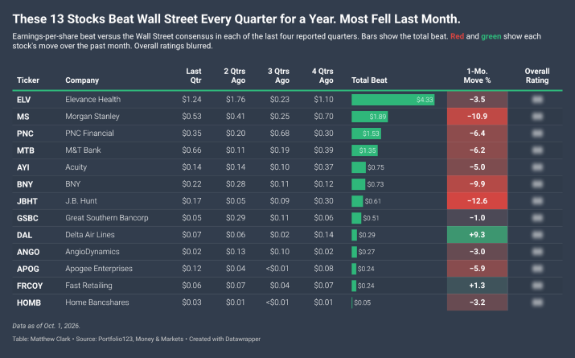
Only 13 stocks made it.
And 11 of the 13 fell over the past four weeks, with the average move being a 4.4% loss.
I don’t read that as a warning. I view it as a setup.
Meet the Lowball List

Start at the top.
Elevance Health (ELV) beat by a combined $4.33 a share over the past year. In three of those four quarters, it cleared the bar by more than $1.
Here’s the part I like.
Elevance’s earnings are down 4.2% over the past 12 months. It still beat every single time.
That tells you how low Wall Street set the bar.
Now look at who fills out the list.
Six of the 13 are financial stocks: Morgan Stanley (MS), PNC Financial (PNC), M&T Bank (MTB), BNY (BNY), Great Southern Bancorp (GSBC) and Home Bancshares (HOMB).
Over the past 12 months, those six grew earnings by an average of 22%. Morgan Stanley’s earnings are up 40%. BNY’s are up 31%.
And over the past four weeks, those same six stocks fell an average of 6.3%. Morgan Stanley dropped 10.9%. BNY dropped 9.9%.
J.B. Hunt (JBHT) follows the same pattern. Four straight beats. Earnings up 28% over the past year. The stock is down 12.6% in a month.
The lowball works on analysts.
Lately, it hasn’t worked on the stock price.
Why These Get My Attention
Here’s how I see it.
When a stock runs up into its report, the beat is already in the price. There’s nothing left to surprise anyone.
When a stock falls into its report, the opposite happens.
The price drops. Expectations drop with it. And a company with the beating habit walks into its report with a lower bar on both.
Look at the banks on price.
M&T trades at 11.3 times this year’s expected earnings. PNC trades at 11.7. Home Bancshares sits at 11.2. That’s cheap for companies that haven’t missed in a year.
And the analysts keep trimming anyway.
Truist recently cut its BNY price target to $172 from $178. This is the same BNY that earned $2.46 per share in July, beating a $2.20 estimate, and then raised its full-year revenue forecast.
We got a fresh read on Thursday.
Acuity (AYI) reported its fiscal fourth quarter. Adjusted earnings came in at $5.77 a share, up 11% from a year ago. Analysts expected $5.66.
That’s beat #5.
Mark Your Calendar
Remember, I built the screen to catch these stocks right before their next report. So the habit gets tested fast. Here’s when five of them report:
- Apogee Enterprises (APOG): Tuesday, October 6, before the open.
- Delta Air Lines (DAL): Friday, October 9, before the open.
- Morgan Stanley (MS): Wednesday, October 14.
- The Bank of New York Mellon (BNY) and PNC Financial Services (PNC): Thursday, October 15.
Here’s how I’d use the list.
Don’t chase a beat. These companies beat almost every time, so a beat alone tells you nothing new.
Instead, pay attention to what management says about next quarter and how the stock reacts.
A beat plus a raised outlook, landing on a stock that already fell 10%? That’s the setup I want.
Now, let’s examine next week’s earnings setups from Adam’s system.
I’ll dig into one stock from each side. And one name from the Lowball List shows up on the bearish side.
“Bullish” Earnings to Watch
These stocks are expected to beat their earnings per share (EPS) from the previous quarter. And if those expectations are met or exceeded, they could potentially trade higher.
For this screen, stocks must meet four criteria:
- 10 or more analysts cover the stock.
- The average analyst recommendation is a “Buy.”
- It BEAT analysts’ EPS estimates for the previous quarter.
- The average analyst estimate for the current quarter’s EPS is greater than the previous one.
Here are the four companies that made this week’s list:
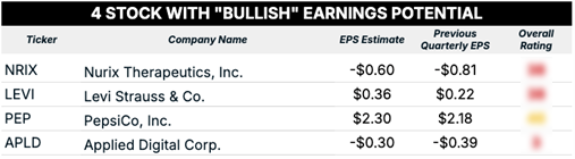

PepsiCo (PEP) reports Thursday, October 8, before the open. The estimate is $2.30 a share, up from $2.18 last quarter.
Here’s the number that matters.
A year ago, PepsiCo earned $2.29 in this same quarter. Wall Street expects it to report earnings growth of one penny.
One penny. Even as analysts see sales climbing to $25 billion, up from $23.94 billion a year ago.
Analysts spent September cutting.
Morgan Stanley cut its price target to $160 from $180. BNP Paribas went to $161 from $183. Jefferies and TD Cowen trimmed too. The stock closed at $128.15 on September 25.
Meanwhile, the business improved.
Last quarter, PepsiCo’s organic volume grew at its best rate since 2022. Management stuck with its call for 4% to 6% core earnings growth this year, before currency effects.
One caveat.
PepsiCo fell short of the earnings estimate in July, so it doesn’t have the Lowball habit. It has a low bar, not a guarantee.
Now, let’s check the bearish side…
“Bearish” Earnings to Watch
For our “bearish” earnings screen, we’re only looking for two things:
- 10 or more analysts must cover the stock.
- The average analyst estimate for the current quarter’s EPS is less than the previous quarter’s.
We want companies that are covered by a sufficiently large group of Wall Street analysts who collectively expect the company to report a quarter-over-quarter (QOQ) decline in earnings.
Here are two companies that passed this screen:


Delta Air Lines (DAL) reports on Friday, October 9, before the open. The estimate is $1.94 a share.
Yes, Delta made the Lowball List. Four straight beats.
So, why does Adam’s system flag this quarter as bearish?
Start with Delta’s own forecast.
In July, Delta told investors to expect $2.00 to $2.50 a share this quarter. Wall Street’s $1.94 estimate sits below the bottom of that range. Analysts already expect Delta to miss its own numbers.
And the reason is fuel.
Delta paid $3.93 a gallon for jet fuel in the second quarter. Its third-quarter forecast assumed a 20% drop to $3.15.
Now remember the Lowball List.
Delta jumped 9.3% last month, the best move on the entire Lowball List. The habit is already in the price.
Demand isn’t the problem.
Premium revenue jumped 17% last quarter, and 21 of 24 analysts call the stock a Strong Buy. This is a quarter problem, not a company problem.
But a four-quarter streak can’t make jet fuel cheaper.
What to Do Next Week
Here’s your plan.
If you’re looking at PepsiCo, Thursday morning is your moment. A one-penny bar for a company with improving volume is low.
Watch the North America numbers and whether management raises its full-year outlook. A beat plus a higher outlook is the setup the system wants.
If you own Delta, don’t add ahead of Friday. Check one number in the release: what Delta actually paid for fuel.
If it’s well above $3.15, the miss is due to fuel, and the stock is likely to give back some of last month’s gains.
And keep the Lowball List handy. Apogee kicks it off Tuesday morning. The banks follow on October 14 and 15.
A beat is a habit. A falling price is a discount.
When you get both at once, pay attention.
Have a great weekend, everyone.
Until next time…
Safe trading,

Matt Clark, CMSA®
Chief Research Analyst, What My System Says Today
