



For the first week since the war in Iran began, a sector other than energy led the market higher.
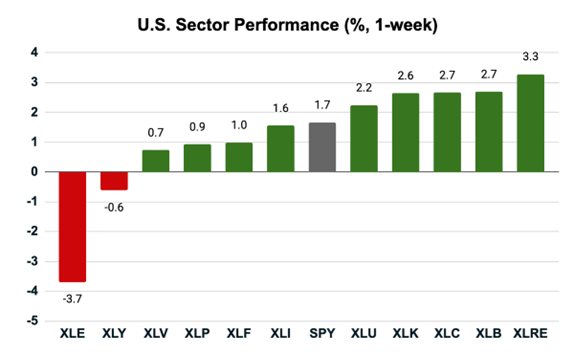
In fact, the State Street Energy Select Sector SPDR ETF (XLE) was the worst-performing sector last week, down 3.7%.
Most sectors were higher, with the State Street Real Estate Select Sector SPDR ETF (XLRE) leading the pack, up 3.3%. The S&P 500 Index was up 1.7% on the week, breaking its losing streak.
Last week, I made the comment that “as goes tech, so goes the S&P 500.” That held, as both the State Street Technology Select Sector SPDR ETF (XLK) and the tech-heavy State Street Communications Select Sector SPDR ETF (XLC) put points on the board.

So, what’s the story here?
Is the epic run in energy over? And after a brief commercial break, are we back to the “Magnificent Seven” show?
My system suggests otherwise…
The energy sector as a whole has rated phenomenally well on my Green Zone Power Ratings system for months. And as I have repeatedly said this year, the bull market in energy stocks started long before the war in Iran.
War headlines will have an outsized impact on energy shares for the foreseeable future. That’s a given. But the trends remain intact. Energy stocks have been moving higher all year, while technology has struggled to build momentum. It won’t be like that forever, of course. But that’s our reality for the moment.
Even after last week’s decline, XLE is up 33% this year. After a run like that, it’s perfectly normal to expect the market to pause to catch its breath. We should also remember that last week marked the end of a quarter, with all the typical end-of-quarter profit-taking and rebalancing.
For what it’s worth, the market also appears to be looking past President Donald Trump’s bombastic comments over the weekend and pricing in a relatively quick end to the Iran war.
Crude oil prices are stable this morning, and stock prices are modestly higher on news that the U.S. and Iran are discussing a 45-day ceasefire.
We’ll see.
I don’t give much weight to political rumors. I stick to my system, and I follow trends. And until something fundamentally changes, we should assume the bull market in energy and materials will remain intact.
Key Insights:
- Energy stocks took a hit last week, breaking their long winning streak.
- Quarterly rebalancing and hopes of a ceasefire in Iran are contributing factors.
- One week does not make a trend. We should ignore the headlines and stick to the system.
Real Estate on Top
Bond yields fell last week, and that was good news for the real estate sector.
Real estate investment trusts (REITs) are one of the most sensitive to changes in long-term interest rates because they tend to be highly leveraged, borrowing heavily to fund real estate purchases.
Every basis point of lower interest rates means higher profits. And apart from business fundamentals, REITs also compete with bonds as income investments. So, lower bond yields (and higher bond prices) usually mean higher REIT prices.
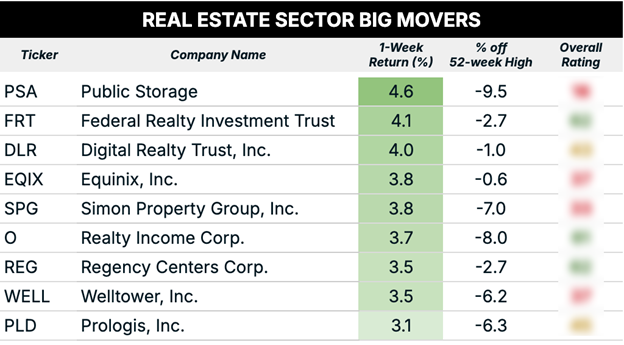
I ran my customary screen of the biggest movers in the real estate sector that were also still within 10% of their 52-week highs last week. The idea is to look for solid, market-leading stocks that are getting stronger.
Here’s what I came up with:

I probably wouldn’t recommend REITs as a short-term trade. If you’re looking to play interest-rate swings, there are better, more direct ways to do that.
I consider REITs as ideal long-term income investments that, if bought right, also offer the potential for great long-term returns.
Keep in mind, REITs are generally penalized on my Green Zone Power Ratings system. I built the system to analyze “normal” operating businesses, and the quirkiness of REIT accounting often causes them to score poorly on Green Zone’s fundamental factors – value, quality and growth.
That doesn’t mean that REITs are bad. It just means we need to analyze them a little differently and focus more on their technical factors like momentum, size and volatility.
Despite the “handicap” on fundamentals, Federal Realty Investment Trust (FRT), Realty Income (O) and Regency Centers (REG) all rate as “Bullish.”
All three of these REITs rate exceptionally strongly on volatility and, despite the quirky accounting working against them, growth as well.
A high volatility score indicates low volatility, meaning the stocks are stable and don’t bounce around all that much relative to the broader market. That’s a selling point in a volatile year like 2026.
Buying the Dip in Energy
Let’s get back to energy.
I ran my customary screen of the sector’s biggest losers for the week that are still trading within 10% of their 52-week lows. The idea is to find beaten-down gems that look poised to recover.
Well, after the run energy stocks have been on, there weren’t any stocks anywhere near their 52-week lows, so I had to relax the criteria.
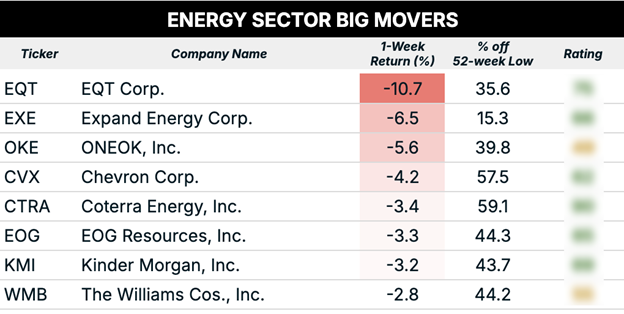

There’s a lot of “green” here. EQT (EQT), Expand Energy (EXE), Chevron (CVX), Coterra Energy (CTRA), EOG Resources (EOG) and Kinder Morgan (KMI) all rate as “Bullish.”
So if you’ve been waiting for a good potential entry point in any of these names… this might be the dip you were waiting for.
To good profits,

Adam O’Dell
Editor, What My System Says Today
