



AI may dominate the headlines. But the top-performing sector in 2026 isn’t technology. It’s gritty, old-economy energy.
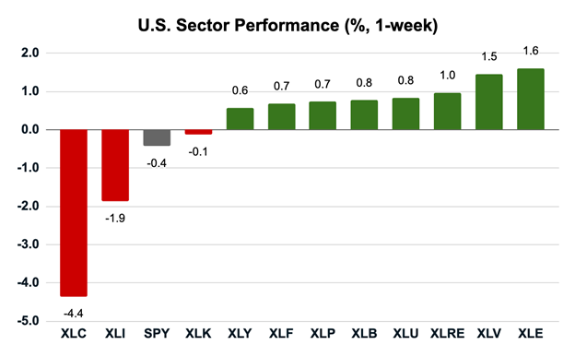
The State Street Energy Select Sector SPDR ETF (XLE) is up a staggering 55% this year, more than doubling the 27% gain posted by the State Street Technology Select Sector SPDR ETF (XLK).
And energy isn’t letting up. XLE led all sectors again last week, climbing 1.6%.
Meanwhile, tech and tech-adjacent stocks continued to struggle.
The communications sector – home to AI juggernauts Alphabet (GOOGL) and Meta Platforms (META) – took a thrashing last week, with the State Street Communications Select Sector SPDR ETF (XLC) falling more than 4%.
Technology wasn’t spared either, as the State Street Technology Select Sector SPDR ETF (XLK) slipped a modest 0.1%.

I’ve said all year, and I’ll repeat it again today: As goes tech sector, so goes the S&P 500 Index.
Technology and communications services together account for nearly half the index. That makes it extremely difficult for the S&P 500 to sustain a rally without participation from its biggest tech names.
But I’m not bringing this up to fret or wring my hands. You know me better than that.
I see an opportunity.
As I wrote last week, energy makes up a paltry 3.4% of the S&P 500. Microsoft (MSFT), Alphabet and Amazon (AMZN) are each individually worth more than the entire sector. Apple (AAPL) and Nvidia (NVDA) are each individually worth more than twice that.
In other words, even after energy’s remarkable run this year, it remains a tiny slice of the market.
And investors have been slow to catch on. From Wall Street’s biggest money managers to individual investors, energy remains underowned.
That creates an interesting setup. When a sector starts from such a low base, it doesn’t take a flood of new money to move the needle.
That sounds like a recipe for a prolonged bull market in energy stocks.
But we don’t have to guess. My system can help us separate the strongest opportunities from the rest of the pack.
So, what does it say about energy stocks right now? Let’s find out.
Is Energy’s Run Sustainable?
As I do every week, I ran my customary screen of the biggest movers in the sector that were still within 10% of their 52-week highs. The idea is to look for solid, market-leading stocks that are getting stronger.
Here’s what I came up with:
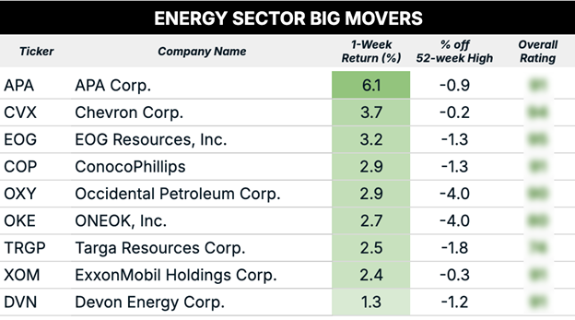

I don’t share the Green Zone Power Ratings here in What My System Says Today because I reserve those for my paid subscribers to Green Zone Fortunes. But I’ll peel back the curtain a little today to drive home just how “Bullish” my system is on this sector.
All nine stocks you see are green, meaning they rate as at least “Bullish” with a score of 60 or better.
Well, eight of the nine are rated as “Strong Bullish,” meaning they have a score of 80 or better. And seven have ratings of 90 or higher.
That’s about as “Bullish” as a sector can be.
On average, stocks that rate as “Bullish” on my system outperform the S&P 500’s performance by double. Stocks that rate as “Strong Bullish” outperform the index’s return by three times on average.
You know the rules…
There are no guarantees in this game.
But I can tell you unequivocally that my system expects continued market-beating performance from energy stocks.
What About Communications?
The past few weeks have been brutal for virtually every company scaling up on AI infrastructure.
Wall Street is concerned that the massive amount of debt being taken on to fuel the AI infrastructure boom simply isn’t sustainable. Or worse, they worry that for all of AI’s world-changing potential, the profits for the companies actually building out the infrastructure aren’t going to materialize.
It wouldn’t be the first time something like that happened.
Back in the 1990s, most of the companies that laid the fiber-optic cables that made the internet boom possible ended up taking massive losses or outright failing.
The benefits of their investment went to newer up-and-coming tech companies like Netflix (NFLX) and YouTube that were able to capitalize on the plummeting cost of bandwidth… and to consumers like you and me who continue to enjoy these services today.
Could the same thing happen with AI compute?
Maybe. It’s too early to say.
But could last week’s drubbing have created some opportunities for us?
Let’s see what my system says.
I ran my customary screen of the sector’s biggest losers for the week that are still trading within 10% of their 52-week lows. The idea is to find beaten-down gems that look poised to recover.
I relaxed that criteria for one important reason: I wanted to make sure we included Meta and Alphabet. Frankly, given their size and importance to the AI economy, they are the only communications stocks that truly matter.
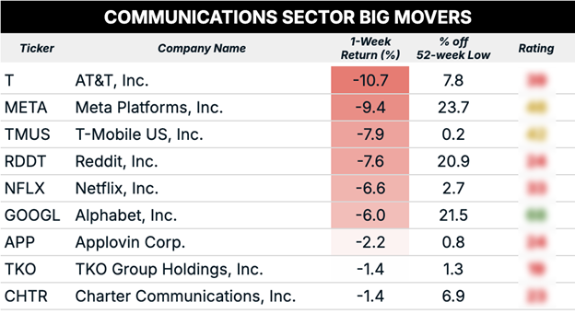

Last week’s selling hit Meta and Alphabet hard. The stocks were down 9% and 6%, respectively.
But clearly, they were not alone. Even “boring” utility stocks like AT&T (T) and T-Mobile (TMUS) got their heads smashed in.
There’s one “Bullish” rated stock on the list, and that’s Alphabet.
So, for all the general bearishness toward Big Tech today, my system suggests the recent sell-off is indeed a good opportunity to accumulate shares in this AI leader.
To good profits,

Adam O’Dell
Editor, What My System Says Today

P.S. The November 3 midterms could set the stage for a major shift in the market — and energy stocks may be among the biggest beneficiaries.
With energy already up huge this year, a post-election rotation into this space could create significant moneymaking opportunities for investors.
My colleague Grey Swan founder Addison Wiggin has outlined five moves to consider before Election Day, including how to position your portfolio and prepare for a potential market shock.