



This time last week, technology shares had just come off of one of their best weeks in recent history, up 7%.
But this past week was a different story…
The State Street Technology Select Sector ETF (XLK) finished the week at the bottom of the stack, down 5.6%, pulling the broader market down with it.
Meanwhile, the State Street Energy Select Sector ETF (XLE) came out on top, finishing the week up 2.5%.
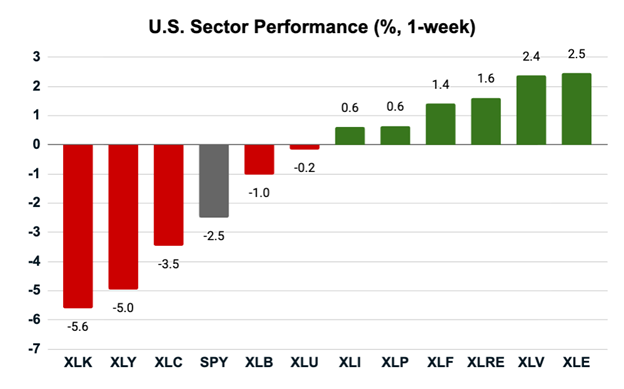

So, what’s the story here?
It comes down to three things…
To start, the economy is looking good right now.
A little too good, in fact.
An exceptionally hot jobs report last week effectively ruled out a rate cut by the Federal Reserve any time soon.
As reported by FedWatch, the futures market is pricing in a better-than-98% chance that rates remain unchanged following the June 17 meeting. It’s also pricing in a better-than-50 % chance that rates are 0.25% to 0.5% higher by October.
It’s hard to imagine a quarter-point difference in interest rates really changing the course of fate.
But it’s definitely a vibe shift.
Wall Street had been expecting a dovish Fed, particularly after the confirmation of President Donald Trump’s pick for Fed Chairman, Kevin Warsh. That’s not happening… and now the market is repricing.
The other factor that shook Wall Street’s resolve was a disappointing report by Broadcom (AVGO).
The chipmaker’s AI business is still growing like a weed, but it wasn’t enough to satisfy investors’ excessively high expectations.
As I noted last week, chip stocks had gone parabolic, as investors saw no end to demand. Broadcom threw a big, fat wet blanket on the fire.
The final factor was an escalation in the Iran war.
For all the hope of an imminent deal to reopen Hormuz and bring the energy markets back to something resembling normal, the Strait remains closed, with no credible timeline for a deal.
That was good for energy stocks, of course. But it sapped enthusiasm for most everything else.
So, how should we react to this news?
That’s a trick question, of course.
We don’t.
You know I don’t trade based on fleeting news headlines. I’ve never – not once in my decades of trading – met a successful investor who built their nest egg trading media noise.
I follow my system, letting the cold, hard facts do the talking.
Key Insights:
- Tech stocks pulled the market lower last week.
- Energy stocks retook the lead, blasting higher.
- As goes tech, so goes the market.
Ignore the War… And Buy Energy Anyway
I would never recommend buying energy stocks based on the ebb and flow of a Middle Eastern conflict. I’ve never seen that work, and the Iran war is a distraction.
I’ve been recommending energy stocks consistently for well over a year. My Green Zone Power Ratings system has consistently flagged the sector as “Bullish.”
It was doing so before the war… it continued to do so during the most extreme moments of it… and it is continuing to rate the sector as “Bullish” even as the war potentially morphs into a frozen conflict.
There will come a time when my system tells us it’s time to move on. But that time is not today.
I ran my customary screen of the biggest movers in the sector that were also still within 10% of their 52-week highs last week. The idea is to look for solid, market-leading stocks that are getting stronger.
Here’s what I came up with:
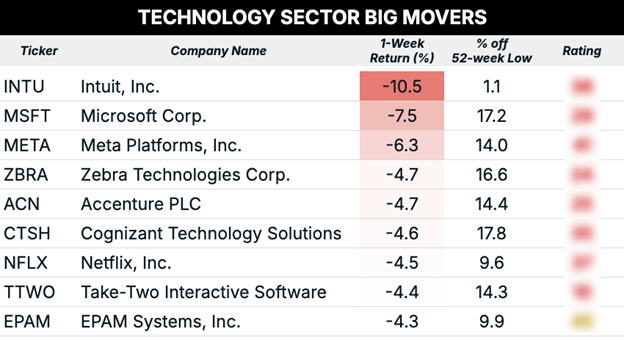

Look at the nine stocks that made the list. Every single last one of them rates as “Bullish” or “Strong Bullish.”
There’s something else they have in common too. With the exception of SLB (SLB), every other stock on the list gets the vast majority of its revenues from North America. These are primarily investments in American energy infrastructure.
American energy will be in high demand long after the war in Iran simmers down.
Buyers in Europe and Asia are now well aware of how fragile their Middle Eastern supplies are.
Now that the taboo has been broken, there is nothing to stop Iran from closing Hormuz again or from lobbing missiles at energy infrastructure in Saudi Arabia or the United Arab Emirates.
American energy is safer. And my system is continuing to flash unambiguously “Bullish” signals in the sector.
Is the Sell-Off in Tech Over?
As I’m writing this, several major tech names are up big today.
For example, Intel (INTC) is up 12%, more than erasing its losses from last week. Marvell Technologies (MRVL) is up 14%. Micron Technology (MU) was up 11%. And even Nvidia (NVDA) – the biggest stock by market cap in history – is up close to 2%.
So, what’s the story?
Was last week’s sell-off a healthy correction after an unsustainably fast ascent? Or was it a major warning sign?
It might actually be a little bit of both. While the growth in revenues and earnings is very real and very impressive, investor expectations are also incredibly high… and meeting those lofty expectations may simply not be realistic.
Let’s see what my system says.
I ran my customary screen of the sector’s biggest losers for the week that are still trading within 10% of their 52-week lows. The idea is to find beaten-down gems that look poised to recover.
Well, after the massive run this year, finding tech stocks within 10% of their 52-week low was a bit of a challenge, so I loosened that criteria. Here’s what I came up with:
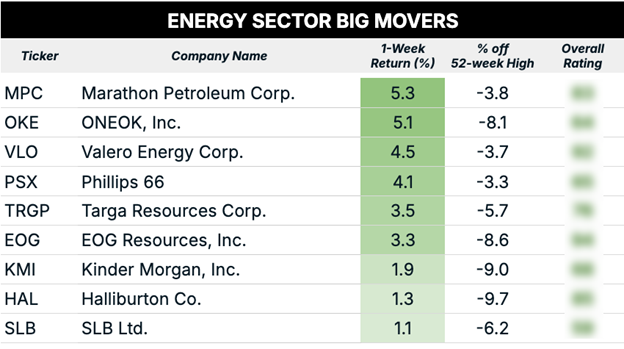

Interestingly, two of the biggest decliners last week were Microsoft (MSFT) and Meta Platforms (META), with both hyperscalers pouring gargantuan sums of money into AI infrastructure.
This goes back to the point I’ve been making all year. Given the size of the technology sector, as goes tech, so goes the market. Every major market-tracking index fund is essentially a tech fund today. When a behemoth like Microsoft or Meta takes a hit, you’re going to see it show up in the S&P 500.
I wouldn’t tell you to avoid tech altogether.
This is where the action is, and I’m still finding plenty of opportunities in my Infinite Momentum Tech Titans portfolio.
But it’s telling that not a single stock on the list above has a “Bullish” rating. This is clearly a market where it pays to be selective.
By all means, stay invested in quality tech names. But you should also hedge your bets by investing in other “Bullish” rated sectors like energy.
To good profits,

Adam O’Dell
Editor, What My System Says Today

P.S. The biggest money in the SpaceX IPO may not come from owning SpaceX itself. History shows that some of the market’s greatest fortunes were made by owning the critical suppliers underneath the giants.
That’s why I believe one little-known American company — trusted by defense contractors and important enough that even Elon Musk chose to license its technology rather than build his own alternative — could be one of the most compelling opportunities of the post-SpaceX IPO era.
So, on Thursday, June 11, I’m going LIVE to reveal the company best positioned to benefit — one that could become the biggest winner of my career.