



Technology shares have been ripping higher over the past two weeks.
That’s good. As I’ve said repeatedly this year, it’s virtually impossible for the S&P 500 Index to enjoy a sustained rally without strong participation by the tech sector. As the largest sector component, as goes tech, so goes the S&P 500…
But should we jump in? Or is the strength in tech stocks mostly just short-covering and market noise?
Let’s do a deep dive and find out!
A Peek Under the Hood
Let’s get the bad news out of the way first.
The tech sector does not rate well on my Green Zone Power Ratings system.
So, despite the surge of the past two weeks, we should tread carefully here.
The good news is, there are moneymaking opportunities out there if you know where to look. Great opportunities. We just need to be selective.
Only 9 of the 76 stocks in the rate as “Bullish,” meaning they have a score of 60 or higher. Meanwhile, 22 more rate as “Neutral.” And nearly 60%, at 45, rate as “Bearish.”
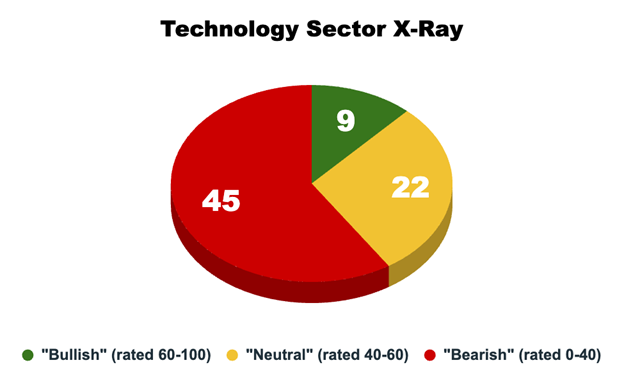

A “Bearish” Green Zone rating doesn’t guarantee that a stock immediately falls in value. Garbage stocks can enjoy great short-term runs. And in a market like today’s – where the trading is based primarily around optimism that the worst of the Iran war is behind us – fundamentals matter a lot less.
But, again, that’s a short-term dynamic. Over the long term, stock prices follow earnings and sales growth. You cannot expect a stock with poor underlying fundamentals to outperform for very long.
So, with that in mind, let’s dig a little deeper to see what factors are driving the ratings of the tech sector.
Where Do Tech Stocks Pick Up Points?
The Green Zone Power Rating is a composite score based on six primary factors: momentum, size, volatility, value, quality and growth, each of which is composed of several sub-factors. (As we are looking at large-cap constituents of the S&P 500, I don’t consider size when doing the sector X-ray. This is even more relevant for the tech sector, which is dominated by megacap names.)
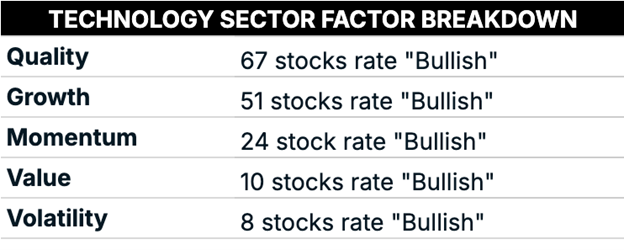
I’m not surprised at all to see quality as the most “Bullish” factor for tech stocks. In fact, 67 out of 76 stocks – fully 88% of the total – have quality scores of at least 60.

The quality factor is a composite of various measures of profitability, balance sheet strength and asset turnover. And as a general rule, it tends to favor “asset light” businesses that can be massively scaled without a lot of ongoing capital spending.
That describes software, of course. But it also describes hardware design. Remember, Nvidia (NVDA) isn’t the world’s largest chipmaker. It’s the world’s largest chip designer. The gritty work of actually manufacturing its GPUs is handled through fabricators like Taiwan Semiconductor (TSM). And Nvidia rates a perfect 100 on its quality score, by the way.
Of course, this is an unusual time to be in the tech sector.
AI is upending the business models of many software companies. The fear on Wall Street is that the competitive moats that software companies have spent decades building might be swept aside in an instant by AI tools.
Why would a company spend millions of dollars on software licenses if it can build its own system in house, for next to nothing, using Anthropic’s Claude?
While some of these fears might be overdone, they do call into question how sustainable the high-quality scores are for software companies.
The same is true for the growth factor, too.
The tech sector rates highly on growth, with 51 stocks receiving a “Bullish” factor rating. But as the disclaimer on every mutual fund brochure reads, “past performance is no guarantee of future results.”
Those growth rates might not be sustainable for software companies if AI cuts into their sales.
What’s Working Today?
Let’s take a look at what’s working today.
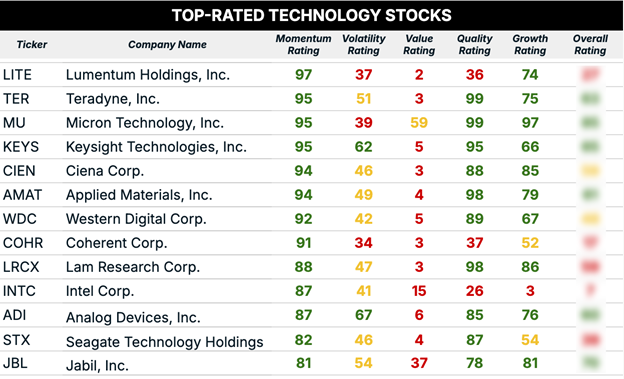
I ran a screen for the tech stocks with the highest momentum scores. Every stock on this list has a “Strong Bullish” rating on momentum, meaning it has a factor score of 80 or higher. (The composite Green Zone Power Rating, blurred here, is reserved for paid subscribers to Green Zone Fortunes.)
Here’s what I got:

One thing should be immediately obvious.
There are no pure software companies on this list. Every tech stock rated “Strong Bullish” on momentum is primarily in the hardware business, and any software they write would be systems software used to run their hardware.
Hardware is in… software is out.
That’s your biggest insight here, but let’s keep digging to see what else we can glean.
Despite the high momentum factors, there are quite a few “Bearish” rated stocks here. It’s not hard to see what’s driving this.
Tech stocks (and growth stocks in general) are rarely cheap, and literally every stock on this list but one rates as “Bearish” on value. Most also rate poorly on volatility. (Remember, a low volatility score means high volatility in the stock price. These are stocks that tend to “bounce around” a lot.)
You might be willing to tolerate a lower score on value or volatility so long as the stock rates exceptionally well on growth, quality and momentum. Just be sure to go in prepared because it’s likely to be a wild ride!
As I noted yesterday, some of these names will be familiar to my Infinite Momentum readers.
Micron Technology (MU), Lam Research (LRCX), Applied Materials (AMAT) and Western Digital (WDC) are all current positions in my Tech Titans portfolio. My system identified each as a momentum leader, and the results speak for themselves.
We entered Micron on June 27, and we’re up 250%. We entered Lam a month before Micron, and we’re up 265%.
We entered Applied Materials in September of last year, and it’s up a solid 106%. And even Western Digital – which we entered in February – is up a solid 31% at a time when the market has been trading lower.
That’s the entire goal of Infinite Momentum.
It’s not about chasing headlines — it’s about identifying the names institutions are quietly piling into before the biggest gains show up.
That’s why we’re constantly scanning for the next wave of momentum leaders before they make their biggest moves.
It only takes one or two of these names to change your entire year. So if you’re searching for the next Micron or Lam before it explodes higher, that’s the edge we’re aiming to deliver every week in Infinite Momentum — and why now is a good time to be paying attention.
These aren’t lucky picks. They’re the result of a system built to track institutional momentum in real time.
Remember, if you’re waiting until moves like these show up in headlines, you’re already too late.
To good profits,

Adam O’Dell
Editor, What My System Says Today
