


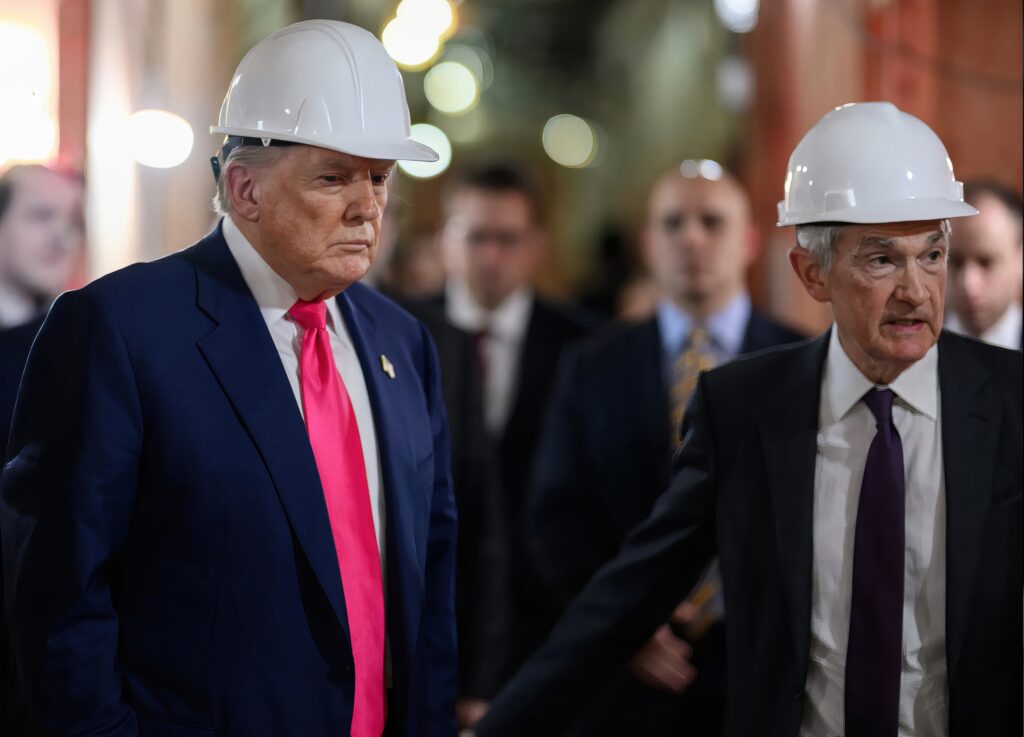
This week’s meeting of the Federal Open Market Committee (FOMC) will be the last one that Jerome Powell oversees as Chairman of the Federal Reserve.
With Powell’s eight-year term now coming to an end, we’re left to wonder how things might change as Trump’s new appointee, Kevin Warsh, takes the helm. What does the change in leadership mean for the economy, and how can we expect the markets to respond?
Let’s dive into it:
Video transcript:
I’m Andrew Zatlin. Welcome to Moneyball Economics. In fact, welcome to the last week of April, which means welcome to the last Federal Reserve Board meeting under the chairmanship of Jerome Powell.
That’s right. In two months’ time, Jerome Powell is out. We’ll have a new sheriff in town. A guy named Warsh is most likely, and he’s dovish. He seems to be a lot more open to rate cuts.
So does that mean we can expect to see rate cuts on the horizon?
No, my friends, not at all. I
f you are the marketplace right now, you have positioned yourself for no rate cuts through July. No rate cut this week. Fast forward to the next Fed meeting in June, there’s a 5% chance of a rate cut. You go to July, it goes to 15% chance of a rate cut.
And the reason that the markets have positioned for no rate cuts for the foreseeable few months is because they’re looking at the economic data that the Fed’s looking at and they’re not really seeing justification for rate cuts.
See, the Fed always takes a wait and see approach, the economic data. We’ve got some inflation kicking in. We’ve got a strengthening jobs market. And for the foreseeable future, that inflation should stick around. What I want to talk about though is there’s still a continued hope for a rate cut on the horizon the second half.
What are the implications right now for the stock market if we don’t see a rate cut today and we end up not seeing on the second half? To understand that, let’s take a look briefly at the economic data that’s coming in that the Fed’s seeing now and is likely to see over the course of the next few weeks and months.
Right off the bat, the Fed’s supposed to look laser-like at what’s going on in the jobs market and what’s going on with inflation. We look at the jobs market, it’s pretty good news, right?
Jobs claims, low, hovering around 210,000 plus minus, historically correlated to a strong and strengthening economy. You look at payrolls. Two of the last three months have been really strong. So there’s nothing in the labor market that signifies urgency, a compelling reason to cut rates to get hiring underway.
We look at inflation, and that’s where the real concerns are. That’s where the story is for the next couple of months.
Inflation was moving down to levels where the Fed might be open to a rate cut until we got to March, until we got to the Iranian conflict, which pushed up fuel prices dramatically. And that situation hasn’t changed. April, same level of high oil prices. And as we know from March, both the producer and consumer inflation moved up. It’s rippling through the economy. And if it’s rippling through the economy at the producer level, that’s earlier in the whole cycle.
That means factories and everyone are having to raise their prices, which means you come back next month and consumers are experiencing those higher prices. So we’re in a regime for the next couple of months, as long as this issue with Iran lasts, we’re going to have to wait a couple of months for things to normalize when it ends.
Well, it hasn’t ended.
It’s almost May, so the markets are assuming we’re going to see inflation in May and likely June. July is also up for grabs. Okay. Well, the key thing here is the markets have positioned for the next few months to be no interest rate cuts. And they’re looking at the economic data and assuming there’s not going to be much variation.
So if they’ve already made their bets for the next few months, if in fact the Fed meetings are not that important and that the expectation is interest rates are going to be where they are for a few months, that’s good news for the stock markets. Because now you’re not going to see a lot of volatility coming in as the big investors, the big hedge funds have to reposition accordingly because something’s happening with interest rate cuts.
As a result, we’ve got stability in the stock markets from a very important factor. And that means the stock markets are going to be that much more sensitive to actual earnings growth and what’s going on in the underlying economy.
Are consumers spending? Can we expect that money to go through the economy? Are companies in fact doing well? Will they start to hire more?
All this positive sentiment will drive the stock market forward and upward. Look at the second half though. Remember, July, there’s a 15% chance.
There’s a chance out there of rate cuts happening in July, and that expectation of rate cuts isn’t going away because remember, rate cuts not happening is driven by what’s going on with the Iran conflict. That ends and all of a sudden the market may say, “Oh, we can expect a rate cut because now inflation’s going to recede again.” My point here is the markets don’t understand what’s going on right now in the core economy.
Let’s go back to my view…
My view is that we basically hit the last leg of the COVID cycle in the fourth quarter last year, that we’ve been transitioning out of a period where companies have had to streamline. They’ve had to lay off workers, they’ve had to reduce some of their spending. And now we’re entering what I call the Trump cycle where we’re in an expansionary trajectory.
Well, during that transitionary phase, a lot of economic data tends to conflict until we get to a converging signal. Once you get that converging signal, you can invest accordingly because you know where you are in the cycle. And right now the markets haven’t bought into that view. They don’t see an expanding economy this year, and that’s where there could be some surprise and a little bit of volatility in the markets going forward.
But I think the better signal though is to face that the economy, as it strengthens, will lead to a stock market that grows. It’s always happening.
It’s throwing out more money, more profits, more potential. And in fact, this week, pay attention to some of the economic data coming out this week and next week, because I think this is where the markets are going to have to start to kind of sort of adjust.
I believe economic data coming out is finally going to be converging on that strong signal. I think that what we’re going to be seeing is this week, GDP is going to come out and it’s going to be a little bit better than expected.
We’re going to get something that points to consumer spending called personal consumption expenditures. I think that’s going to look pretty good. And then next week we’re going to get payrolls. I think that’s going to look pretty good.
And so between this week, no rate cut and two months out when we see the Fed again, I think we’re going to start to get this steady drumbeat of the economy’s doing just fine and better than the markets expect to see.
So we get to June, then all bets are off because then the market might say, wait a second, the chance of a rate cut at all this year is gone. We might even have to start positioning for a rate hike, all this excitement.
Bottom line, we’re watching the economy expecting things to be really super positive. That’s really good for stocks and that’s good for us because we are in it to win it. Zatlin out.

Andrew Zatlin
Editor, Moneyball Economics