



Last week’s market was shortened due to the Thanksgiving holiday, but that doesn’t mean it was uneventful.
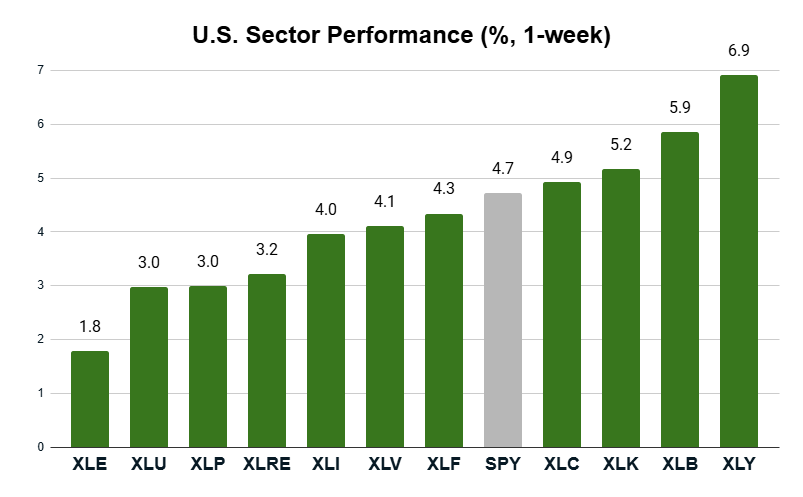
After a month that saw investors rotating into defensive sectors like healthcare, stocks came roaring back last week. All 11 sectors were positive last week, though some of the most economically sensitive sectors led the pack.
Consumer discretionaries broke their three-week losing streak and jumped to the top of the list, returning 6.9%. But technology and materials weren’t far behind, returning 5.2% and 5.9%.
Perhaps most impressively of all, even one of this year’s biggest laggards – energy – still managed to return a very respectable 1.8%.

As for the reasons, the Federal Reserve played a role. Looser monetary policy is the proverbial “rising tide that lifts all boats,” and dovish comments from key voices on the rate-setting committee suggested that a rate cut might be back on the table at their next meeting two weeks from now. The futures markets are now pricing in an 87% chance of a 0.25% cut and, clearly, stocks are loving it!
Short covering also likely played a role. After seeing nice gains on shorts in the go-go growth sectors for much of October and November, some short sellers likely opted to book the gains and move on to the next opportunity. Remember, when a short seller closes a position, he or she does so by buying shares of the stock. That buying pressure can really ignite a rally, as it did last week.
But more than anything, bullish sentiment is back. After several rough weeks, investors decided it was time to buy the dip.
So, should we follow them?
I don’t suggest backing up the truck just yet. A single week – particularly a holiday-shortened one – doesn’t make a trend.
But more fundamentally, I don’t spend much time worrying about “the market,” and I certainly don’t try to aggressively time it. That’s a fool’s errand, and I’ve never seen it consistently work.
I also don’t try to divine the Fed’s next interest rate move. I have no advantage in that game, so there’s no way to stack the odds in our favor trying to do so.
Instead, I let the data do the talking. I use my six-factor Green Zone Power Ratings system to identify quality companies with growing businesses that are reasonably priced and trending higher, and then I pick the best of the best from that pool.
So, with all of that as an introduction, we’re going to do a deeper dive into the consumer discretionary and energy sectors today.
Key Insights:
- All 11 sectors were higher last week, showing broad participation in the rally.
- The most aggressive “growthiest” sectors performed the best.
- It may be a mistake to read too deeply into a single, shortened week.
The K-Shaped Economy
We’ll start with consumer discretionaries.
I screened for the biggest winners of the week that are now trading within 10% of their 52-week highs.
One of the biggest trends of the past few years is the emergence of the so-called “K-shaped” economy. That is … wealthier Americans have seen their situations improve, but middle— and working-class Americans have not.
The wealthy are better positioned to handle sticky inflation. And as asset owners, we’ve also benefited from rising stock and real estate prices.
But then there’s the rest… Younger people in particular have really struggled. Nothing drives this home harder than Chipotle’s (CMG) earnings report last month. The CEO said its burritos were now a luxury that working Americans aged 35 and under could no longer afford.
We see the rosier, upward-pointing half of the “K-shaped” dynamic playing out in the recent performance of luxury-oriented consumer discretionary stocks …
Ralph Lauren (RL), owner of the Polo brand among others, tops the list this week. The stock exploded higher by 12% last week and rates a “Bullish” 69 on my Green Zone Power Ratings system.
Meanwhile, much of today’s bullish screen is dominated by travel companies like Expedia (EXPE), Wynn Resorts (WYNN), Marriott International (MAR) and Hilton Worldwide Holdings (HLT).
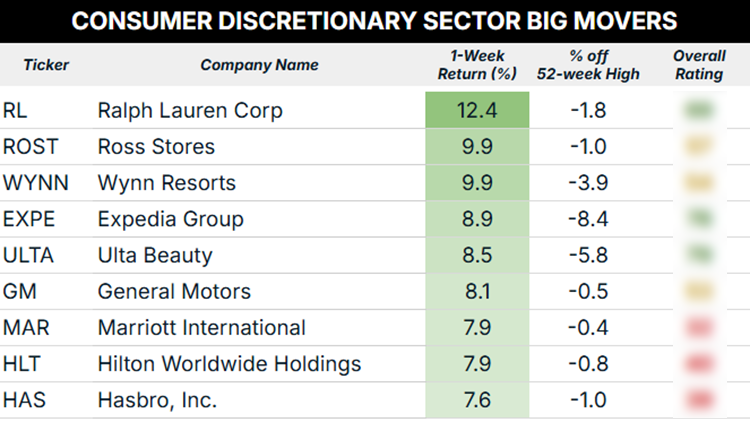

I see one familiar face making the cut. Two weeks ago, I highlighted Ross Stores (RST) in a sector X-ray of consumer discretionaries and wrote:
Shoppers flock to discount chains like T.J. Maxx or Ross when their budgets are tight. With inflation still stubbornly high and the labor market looking a little shaky, this is exactly the kind of environment these chains are made for. Both stocks have been trending higher for months.
Ross no longer rates as “Bullish” in my Green Zone Power Ratings system, but it’s close. It’s on the high end of “Neutral,” and it rates particularly well on its volatility and quality factors.
Energy Looking Strong
I’ll remind you that we didn’t see any negative-performing sectors last week. All 11 were positive, including energy.
But all the same, let’s see if there are any bargains to be found in the laggards.
Normally, I would run a screen of the worst-performing energy stocks last week that are within 10% of their 52-week lows. Alas, that was impossible this week. To start, only one was negative… and only one was within 10% of a 52-week low.
Instead, we’ll simply look at the energy stocks that rose the least last week to see if anything pops off the page.
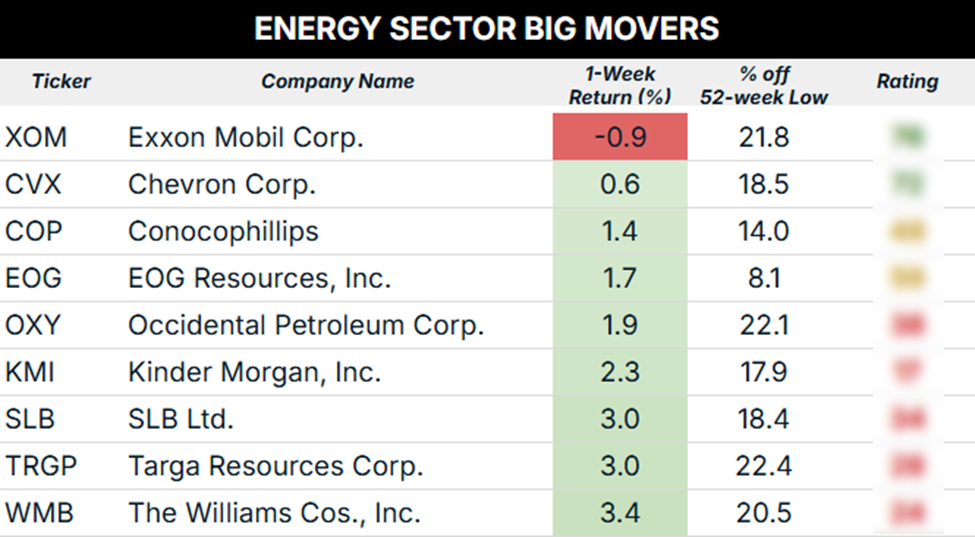

One thing is immediately clear. These energy stocks, in general, don’t rate very well on my Green Zone Power Ratings system right now. Of the nine stocks on the list, only two rate as “Bullish.”
Of course, those two also happen to be the two largest and best diversified supermajors, ExxonMobil (XOM) and Chevron (CVX). Both rate particularly well on their volatility, quality and value factors. That’s something to keep in mind if the selling resumes in high-flying tech stocks.
To good profits,

Adam O’Dell
Editor, What My System Says Today
