


If you thought last week’s news about the capture of Venezuelan president Nicolas Maduro was a shocker, this week’s news may one-up it.
News broke last night that the Department of Justice is opening a criminal probe into Federal Reserve Chair Jerome Powell.
The DoJ served the central bank with grand jury subpoenas, threatening a criminal indictment of Powell over alleged mismanagement of the bank’s office renovations.
Powell responded that the move was designed to pressure the Federal Reserve to lower interest rates, and that is also the general consensus on Wall Street.
I won’t opine over the DoJ’s motivations or on whether or not Powell has broken any laws. My expertise is in taking the data and finding profitable ways to trade on it.
But what could this feud between the White House and the Fed mean for the markets?
The market impact this morning is muted. The S&P 500 and Nasdaq are roughly flat.
So… is this a big deal or not?
There are a couple things to keep in mind.
First, it appears that Wall Street isn’t taking the legal wrangling seriously. By the time the investigation goes anywhere, Powell will already be out of office, as his term is set to expire in May. Wall Street seems to be taking the view that this is mostly for “shock and awe” but doesn’t have any real substance.
Secondly, there is a timing mismatch between the risks and the opportunities.
The risks of the Fed losing its independence – higher inflation and less confidence in the dollar – are decidedly long-term problems. We might not see the negative impacts for years. The impacts are very real and potentially very destabilizing. But given Wall Street’s focus on the immediate short-term, they are someone else’s problem at some unknown date in the future.
Meanwhile, the immediate short-term impact could be … bullish. As we saw in 2020 and 2021, stocks tend to do really well when the Fed is pumping massive amounts of liquidity into the market. And that’s the most likely scenario now that Trump appears hell-bent on controlling the Fed.
So, how do I plan to trade all of this?
By following my system, of course.
So with that in mind, let’s take a look at last week’s action.
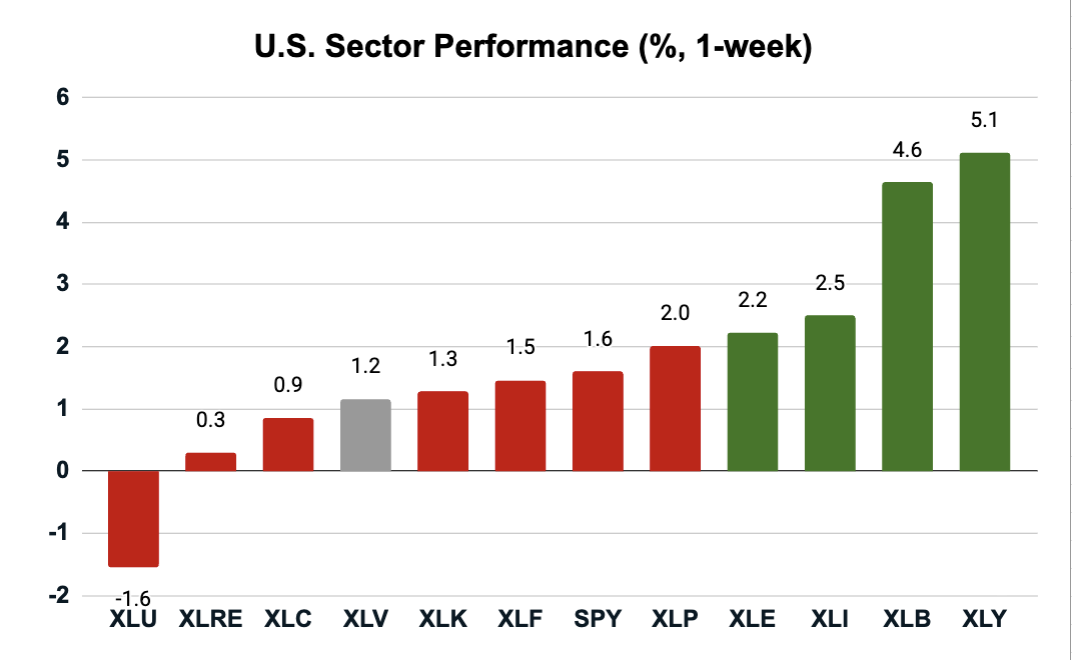

All sectors but one were higher last week, and most were up sharply. The State Street Consumer Discretionary Select Sector SPDR ETF (XLY) was up 5.1% followed by the State Street Materials Select Sector SPDR ETF (XLB), which was up 4.6%. This shows that, for all the chaos, Wall Street is still very bullish as 2026 hits its stride.
The only loser this past week was the The State Street Utilities SPDR ETF (XLU).
We can interpret this a couple different ways.
Utilities are traditionally the most conservative sector. So, a bullish week for consumer discretionaries and materials and a bearish week for utilities would fit a narrative of an optimistic Wall Street that expects growth ahead.
But…
Remember that this isn’t your grandfather’s utilities sector. Utilities have been following technology shares higher for the past few years as they are both part of the AI infrastructure trade.
And it’s worth noting that, while positive, both the the State Street Technology SPDR ETF (XLK) and the State Street Communications SPDR ETF (XLC) lagged the broader S&P 500.
Could this signal a change in leadership?
Maybe. I’ve been writing for months that I expect the “Big Tech” trade, led by the Mag 7, to fade this year.
For now, we’ll continue to monitor. And let’s do a deeper dive on last week’s sector leaders and laggards.
Key Insights:
- Instability at the Fed is a real risk, but it is a long-term one.
- Wall Street is starting the year extremely bullish.
- We may be seeing a shift in leadership away from the tech/AI trade.
Consumer Discretionaries on Fire
I ran my customary screen of the biggest movers last week that were also still within 10% of their 52-week highs. The idea is to look for strong, market-leading stocks that are getting stronger.
Well, I found some big movers, for sure. Used car dealer (and former meme stock) Carvana (CVNA) was up a massive 15.7% last week, and Aptiv PLC (APTV) wasn’t far behind, up 13%.
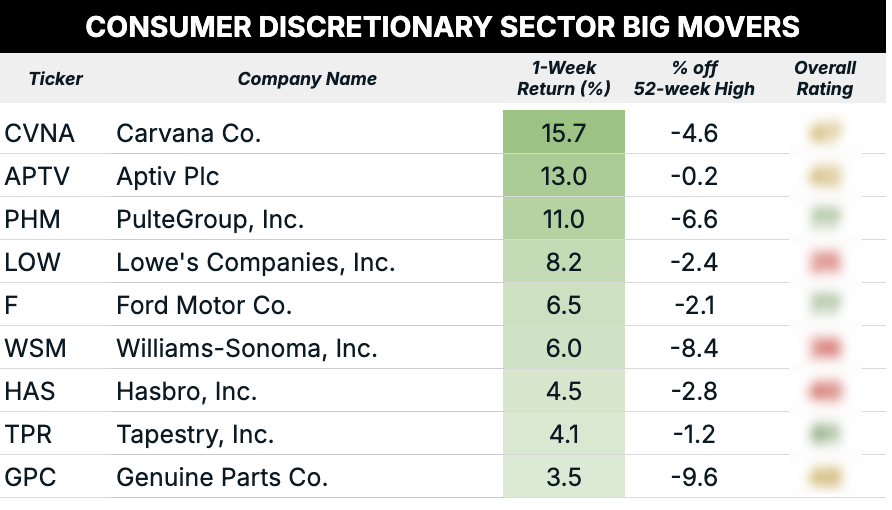

Unfortunately, there’s not a lot on this list that I really consider prime candidates for long-term investments right now. The only stocks rating as “Bullish” on my Green Zone Power Ratings system are homebuilder PulteGroup (PHM), automaker Ford Motor Company (F) and Tapestry (TPR), the owner of the Coach and Kate Spade fashion brands.
Pulte may be worth a deeper dive. If interest rates really are moving lower, that’s bullish for homebuilders. Home buyers are extremely interest rate sensitive, and every basis point lower makes homes potentially more affordable.
Now, let’s see if any bargains have popped up after the recent slide in utilities.
Utilities Still Running Hot
Normally, I’d run my weekly screen of stocks that have fallen hard and are still within 10% of their 52-week lows. The idea is to find stocks that have been beaten-down and might be good candidates for buying the dip.
Well…
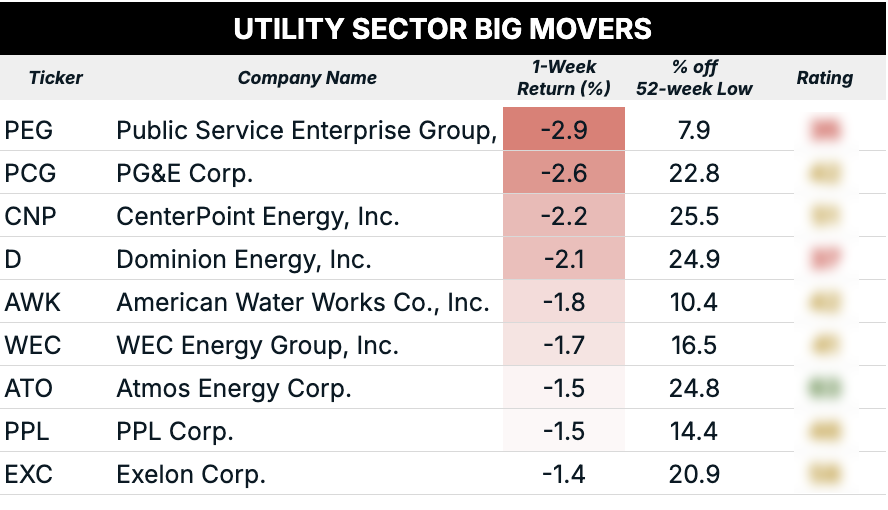
After the runup in utilities prices over the past year, there are very few stocks still close to their lows. So, I relaxed the criteria to give us a larger list.

So, how should we interpret this?
Utility stocks have been trending lower since October but remain well above their 52-week lows. That suggests it’s likely far too early to consider buying the dip. We’d clearly be fighting the tape, and that’s almost always a bad idea.
And really, what’s the hurry? Of the entire list, only one stock rates as “Bullish” on my Green Zone Power Ratings system, natural gas supplier Atmos Energy (ATO).
Utilities appear to be stuck in a no-man’s land in which growth investors are starting to turn cautious on AI infrastructure investment yet the stocks aren’t cheap enough to attract value investors. For now, it makes sense to stay away.
To good profits,

Adam O’Dell
Editor, What My System Says Today
