


Picture two used pickup trucks on the same lot.
Same year. Same miles. And the dealer tells you that both will need new transmissions in about two years.
One truck has a crowd around it. The dealer keeps bumping the sticker.
The other sits at the back of the lot. It costs about half as much, and the seller throws in a bigger gas card.
You know which truck the crowd wants.
You also know which one you’d drive home.
That’s Merck (MRK) and Bristol-Myers Squibb (BMY) right now.
Two Drug Giants Crossed Paths in March
Every week, Adam’s Green Zone Power Ratings system scores about 3,000 U.S. stocks from 0 to 100. It grades each one on six factors: value, quality, growth, momentum, volatility and size.
The higher the score, the more of the market a stock beats.
I pulled a year of scores for these two…

A year ago, neither stock was worth your time.
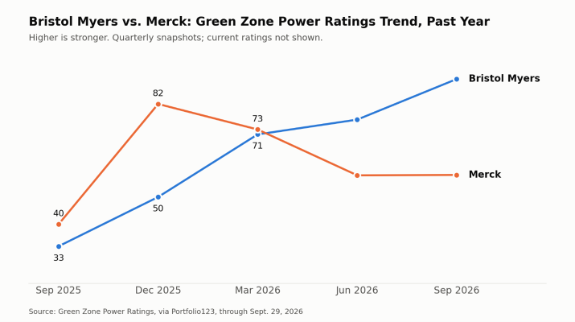
Bristol-Myers scored 33. Merck scored 40.
Then Merck took off.
By December, it hit 82. Bristol-Myers sat at 50.
That was Merck’s high point. Its score has fallen or stalled at every checkpoint since.
But Bristol-Myers never stopped climbing.
In fact, by March, it had pulled even, 71 to Merck’s 73.
It has climbed at every checkpoint since.
Today, it sits well ahead.
Here’s the part that should make you stop.
Merck’s stock is up about 40% since January. It trades near its 52-week high.
The price went up, but the score went down.
When price and score rise together, a rally has something under it. When they split, the price is running on hope.
One Factor Decides This Fight
Here’s how the two stack up across the six factors.

Let’s start with what’s even.
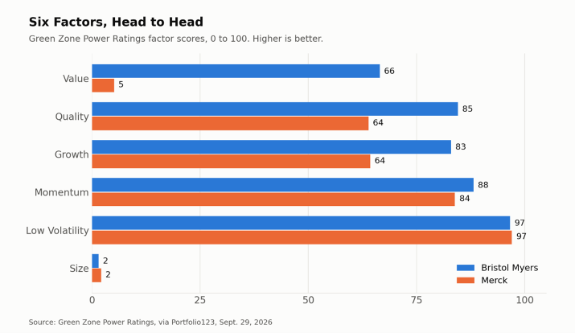
Both stocks score 97 on low volatility. Both are giant companies, so both score near zero on size. Momentum is close, 88 to 84.
The market likes both of them.
So this is a fair fight.
The Green Zone Power Ratings system isn’t just picking the calmer stock or the smaller stock.
Bristol-Myers wins on quality, 85 to 64. It wins on growth, 83 to 64.
And it crushes Merck on value, 66 to 5.
That one gap accounts for most of Bristol-Myers’ lead.
I Checked the System’s Math
A score of 5 on value is extreme. When our system flags something that extreme, I always check the work by hand.
Here’s what I found.
Merck bought two smaller drug companies this year, Cidara Therapeutics and Terns Pharmaceuticals.
When a drug company buys another one for its experimental drugs, it has to write off most of the price right away. So, Merck took about $6 a share in charges.
That wiped out most of its 2026 profit. Wall Street now expects about $2.71 a share. At $148, that’s 54 times earnings.
Keep in mind, the system can’t tell a one-time write-off from a real collapse. It simply reads the number on the page.
Still, after stripping those charges out, the verdict didn’t change.
Even on clean numbers, Merck costs almost twice as much.
Add back every dollar of the charges, and Merck earns about $8.70 a share this year. That puts it at about 17 times earnings.
Bristol-Myers expects to earn $6.95 per share, so it trades at about 9 times earnings. Analysts expect Bristol-Myers’ profit to slip to $6.56 next year.
Even then, it costs less than 10 times earnings.
Bristol-Myers pays you more to wait.
Its dividend yields 3.9%. Merck’s yields 2.3%.
And both trucks need the same transmission.
The 2028 Wall
Here’s the objection you’re already thinking. Bristol-Myers is cheap because it has a patent problem.
That’s true. Its blood thinner, Eliquis, and its cancer drug, Opdivo, both lose U.S. patent protection in 2028.
Generic copies will take a bite out of both.
But Merck has the same problem, and it’s bigger.
Keytruda brought in $8.4 billion last quarter, accounting for about half of Merck’s sales. Plus, the original version of Keytruda also loses its U.S. patent in 2028.
Both companies are preparing to adapt to this shift.
Merck is moving patients to a new under-the-skin version of Keytruda. Bristol-Myers is leaning on newer drugs, which generated $7.6 billion in revenue last quarter – up 15% year over year.
Both face the same wall. Only one is priced for it.
What to Do Now
If you want one massive drug stock, the Green Zone Power Ratings system says Bristol-Myers. You get better factor scores, a rising trend, a price under 10 times earnings and a 3.9% dividend.
If you own Merck after a 40% run, you don’t have to sell it. But don’t add to it here. You’d pay nearly twice as much for each dollar of profit, and you’d face the same 2028 wall.
Take one habit away from this…
Before you buy any hot stock, check whether its score is rising with its price. If the price climbs and the score falls, you’re buying the truck with the crowd around it.
That’s all from me today.
Until next time…
Safe trading,

Matt Clark, CMSA®
Chief Research Analyst, What My System Says Today

P.S. There’s a lot for investors to think about right now — where stocks go from here, how the AI boom will play out and what today’s market uncertainty means for the economy and your portfolio.
We want to know what you think.
If you have a minute, take our quick survey here and tell us what you’re thinking. Your answers will help us get a better read on where investors stand right now.