



The New Bulls are going global again.
For the second consecutive week, a disproportionate number of non-U.S. stocks are registering as newly “Bullish” on my Green Zone Power Ratings system. And this time, Japanese stocks stand out in particular.
Japan boasts some of the world’s best engineering and manufacturing companies. Chronic labor shortages also helped make the country an early adopter of robotics.
If investors start souring on capital-hungry American tech companies, might Japanese stocks be worth a harder look?
Maybe. We’ll get to that in a moment.
First, let’s dig into the New Bulls from the S&P 500 Index…
S&P 500 New Bulls
I ran my usual screen for S&P 500 companies that popped up as “Bullish” this week, and this is what I came up with:
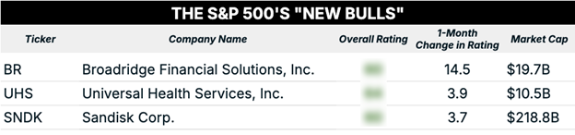

Sandisk Corp (SNDK) making the cut is noteworthy, as chip, memory and other AI infrastructure stocks have taken a pounding of late.
Sandisk is no exception, dropping about 30% since late September. The shares are down over 40% from their June highs.
So, what’s the story? Why are the shares getting beaten up?
Simple.
Investors today aren’t really buying “Sandisk.” They’re buying the AI infrastructure trade, of which Sandisk is a key part.
Right now, that trade is going into reverse.
Wall Street is concerned that AI spending is unsustainable, and we’re seeing the baby thrown out with the bathwater.
I believe these fears are overblown, and my system suggests that Sandisk is “Bullish” at current prices.
A correction of 40% can be taken in stride when a stock is up hundreds of percent in less than a year. Even after the correction, the shares are still up almost 500% year to date.
Sandisk rates a near-perfect 99 out of 100 on its quality factor and a 90 on its growth factor. Despite the recent sell-off, its tremendous run over the past year has helped the stock earn a solid momentum rating of 65.
But SanDisk’s story doesn’t end there.
It’s also a core holding in my Infinite Momentum Tech Titans portfolio — a model designed to keep us moving toward the market’s strongest opportunities.
I like to compare Infinite Momentum to a relay race. Every four weeks, we pass the baton to a fresh set of 10 stocks with the potential to sprint ahead of the broader market.
And tomorrow, it’s time for our next handoff.
I’ll be rerunning the model and revealing the latest lineup LIVE at 1 p.m. ET here. While I won’t know the official picks until the model refreshes, SanDisk is one stock I’ll be watching closely.
And you don’t need to wait for that refresh to see where momentum is building…
New Bulls Outside the S&P 500
Now, let’s look at the newly “Bullish” stocks outside of the S&P 500…
I ran a screen for the top 20 stocks with the largest score increases over the past month, and this is what popped up:
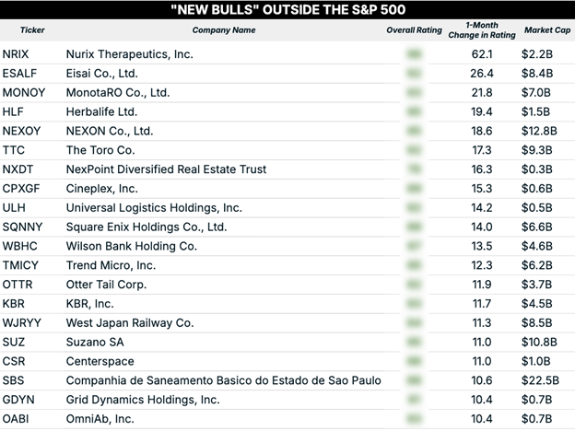

Japanese stocks were overrepresented in last week’s list of New Bulls, and we have several Japanese companies making the cut again this week.
I’ll go over a few I found noteworthy.
Eisai (ESALF) is a Tokyo-based pharmaceutical company focused mainly on neurology and cancer. It is best known for Leqembi, an Alzheimer’s treatment developed with Biogen, and the cancer drug Lenvima.
Given that Japan has an aging and shrinking population with the unique challenges that this entails, it makes sense to see Japanese pharmaceuticals focusing on ailments of old age like Alzheimer’s.
Monotaro (MONOY) is a Japanese online retailer of maintenance, repair and operations supplies, such as tools, safety gear and factory parts, sold mostly to small and mid-sized businesses.
U.S. industrial distributor W.W. Grainger owns a majority stake.
Monotaro rates as “Bullish” or “Strong Bullish” on its volatility, quality, and growth factors, and the stock has trended higher over the past four months.
The cloud, cybersecurity and, frankly, technology in general have been dominated by the United States for the past 30 years.
Yet Tokyo-based cybersecurity software company Trend Micro (TMICY) is making some noise, popping up on our New Bulls list this week.
Trend Micro sells protection for business computers, cloud systems, networks, and email, as well as consumer antivirus products.
The stock rates poorly on its growth factor. But it rates a stellar 94 out of 100 for quality and a “Bullish” 62 out of 100 for volatility, and the shares have trended higher throughout 2026.
Given the large number of Japanese companies popping up as “Bullish” these days, the broader Japanese market might deserve a real look.
The iShares MSCI Japan ETF (EWJ) has doubled in dollar terms since bottoming out in October 2022. The WisdomTree Japan Hedged Equity Fund (DXJ), which strips out the exchange rate risk of the yen, has more than tripled over the same period.
If or when investors eventually sour on the U.S. tech trade, Japan’s more traditional industrial economy may provide a distinctly non-techy alternative.
Japan wasn’t the only country punching above its weight.
Two Brazilian companies also made the list this week.
It appears that Brazil may have a change of government following its October 25 presidential election, and Brazilian stocks have been rallying in anticipation.
Let’s examine the two that popped up as “Bullish.”
Suzano (SUZ) is the world’s largest producer of eucalyptus pulp, which is used to make paper, tissue and packaging. It also makes paper and tissue products itself.
The stock is remarkably cheap, with a value factor rating of 97, and also rates exceptionally well on quality with a rating of 75.
Companhia de Saneamento Basico do Estado de Sao Paulo (SBS) is the water and sewage utility for the state of São Paulo, Brazil. It is one of the world’s largest sanitation companies and was privatized in 2024.
Not surprisingly, given it’s a utility, it rates a “Strong Bullish” 86 on its volatility factor. We expect utilities to be “boring.”
Yet “boring” is the last word I would use to describe this stock, as it also rates an 86 on growth and a 64 on momentum.
Utilities may be a slow-growth business in America.
But in an emerging market like Brazil, where living standards are rising and a growing middle class is using more basic services, the growth is clearly there.
To good profits,

Adam O’Dell
Editor, What My System Says Today
