


Let’s start with some good news…
It looks like we’re not going to war over Greenland… nor will we be reigniting the trade war, which has been mostly quiet for the past six months. In his speech at the World Economic Forum in Davos, President Trump ruled out using force to take Greenland and set aside his tariff threats for now.
As I wrote on Tuesday, I believed the “TACO” script would play out, and that’s exactly what happened. While President Trump doesn’t often listen to expert opinion, preferring to trust his own gut in most situations, he does listen to Mr. Market. Stocks and bonds both sold off aggressively on the tariff news, and that was enough to warrant a change of course.
Does that mean the crisis has passed?
Probably. Though it’s a mistake to waste precious mental bandwidth thinking about it.
I’m able to keep a level head in a profession known to give healthy young men heart attacks because I simplify the investment process down to a system of objective trading rules. Sure, the market throws me curveballs. That’s part of the game. But because I have well-defined rules in place, I don’t have to stress out about it. I follow the system knowing that, over time, I’m going to come out on top. And importantly, I sleep well at night.
That’s the essence of my Green Zone Power Ratings system. It objectively rates stocks based on six primary factors – momentum, size, volatility, growth, value and quality – and it objectively assigns a numeric score. Stocks scoring 60 or higher are rated as “Bullish,” and my research has found that “Bullish” rated stocks outperform the market on average by two to three times.
Today is Thursday, and you know what that means!
I ran my customary screen of stocks that newly rate as “Bullish” on my Green Zone Power Ratings system.
As I wrote last week, I’ve noticed a distinct trend taking form in 2026. The stocks popping up as newly “Bullish” have a distinct old-economy flavor to them. My system has been suggesting that a sustained change in market leadership favoring smaller and non-tech stocks is building, and the new data rolling in continues to support that conclusion.
So, let’s jump into it, starting with the newly “Bullish” members of the S&P 500.
S&P 500 New Bulls
With the reactivation of Venezuela’s oil fields still very much on investors’ minds, it’s not too surprising to see oilfield servicer Halliburton (HAL) making this list.
Halliburton rates particularly strongly on its value, quality and momentum factors, though it does tend to be a little volatile. When this stock moves, it really moves.
Also noteworthy is Teledyne Technologies (TDY). Teledyne is a maker of advanced sensors and cameras designed to operate in harsh environments.
While the first phase of the AI revolution focused mostly on chatbots (and the massive data and energy requirements needed to run them), the next phase will be centered more on physical applications like robotics and autonomous machines. That should create a long runway for Teledyne.
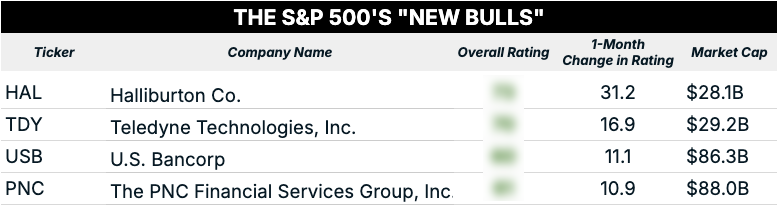

Rounding out the list are two household names in banking, U.S. Bancorp (USB) and PNC Financial Services Group (PNC). Banking stocks have been trending “Bullish” in recent weeks, as the economy seems to be in that perfect “Goldilocks” scenario where growth remains strong enough to keep profits flowing yet inflation remains just low enough to allow the Fed to lower rates.
New Bulls Outside the S&P 500
Let’s cast the net a little wider and look at the newly “Bullish” stocks outside of the S&P 500. I ran a screen for the top 20 stocks that saw the greatest jump in their score over the past month.
It’s a diverse group… and without a lot of household names.
Once exception is Dr Martens PLC (DRMTY), the English maker of the iconic boots seen at rock concerts around the world. Also making the cut was Fevertree Drinks PLC (FQVTY), the maker of popular bottled cocktails, mixers, tonic waters and soft drinks. The company’s Blood Orange Gin Spritz has been a hit at poolside and seaside bars.
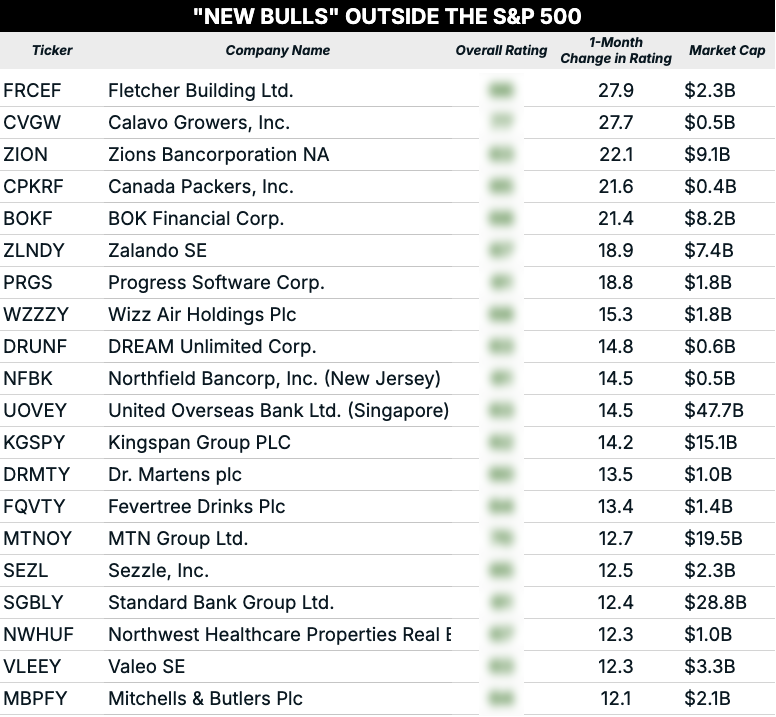

Another company that caught my eye was “buy now, pay later” innovator Sezzle, Inc. (SEZL).
Sezzle is different from a classic high-interest credit card. When you buy something on Sezzle, you pay 25% at the time of sale and then 25% every two weeks in installments. So long as you pay on time, there are no fees or interest. The company makes money by charging the merchant, not the shopper.
Sezzle is ideal for younger customers that might not have much of a credit history or for shoppers who want to avoid the temptation of a revolving credit card.
As I’ve written extensively over the past few months, the economy has never been stronger… if you’re wealthy or a high-income earner. But large swaths of the population are still really struggling with the lingering effects of inflation. Sezzle is a play on ordinary Americans finding new ways to get by in what continues to be a rough environment.
To good profits,

Adam O’Dell
Editor, What My System Says Today
