


Picture a class of 22 students.
One student’s grade counts for 42% of the class average. The other 21 split the rest.
That one student bombs the test. The class average drops. The headline writes itself: “Class Fails.”
But look at the report cards. Seventeen of the 22 students did better than last time.
That’s the AI trade right now…
One Stock, 42% of the Grade
I track a basket of 22 companies that sell the AI buildout. The chipmakers. The chip-equipment makers. The networking companies. The data centers. The firms that supply the power and the cooling.
Nvidia (NVDA) makes up about 42% of that basket by market value.
Then came a rough stretch, even by Nvidia’s standards. On November 9, the stock fell 4.3% after the board opened an investigation into CEO Jensen Huang. On November 12, Huang resigned. Finance chief Colette Kress became interim CEO. The stock fell as much as 14.3% that day before it closed down 4.3%.
From the November 6 close through Monday, Nvidia fell 16.3%. That’s dead last among all 22 stocks.
Now watch what happens when I measure the basket three ways.
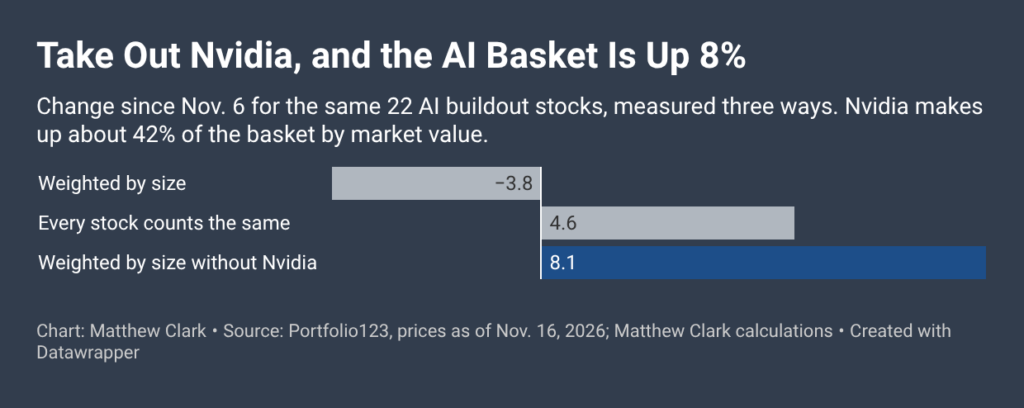

Weighted by size, the basket is down 3.8%.
Count every stock the same, and it’s up 4.6%.
Take Nvidia out, and the rest of the basket is up 8.1%.
So the AI trade didn’t break. One stock did.
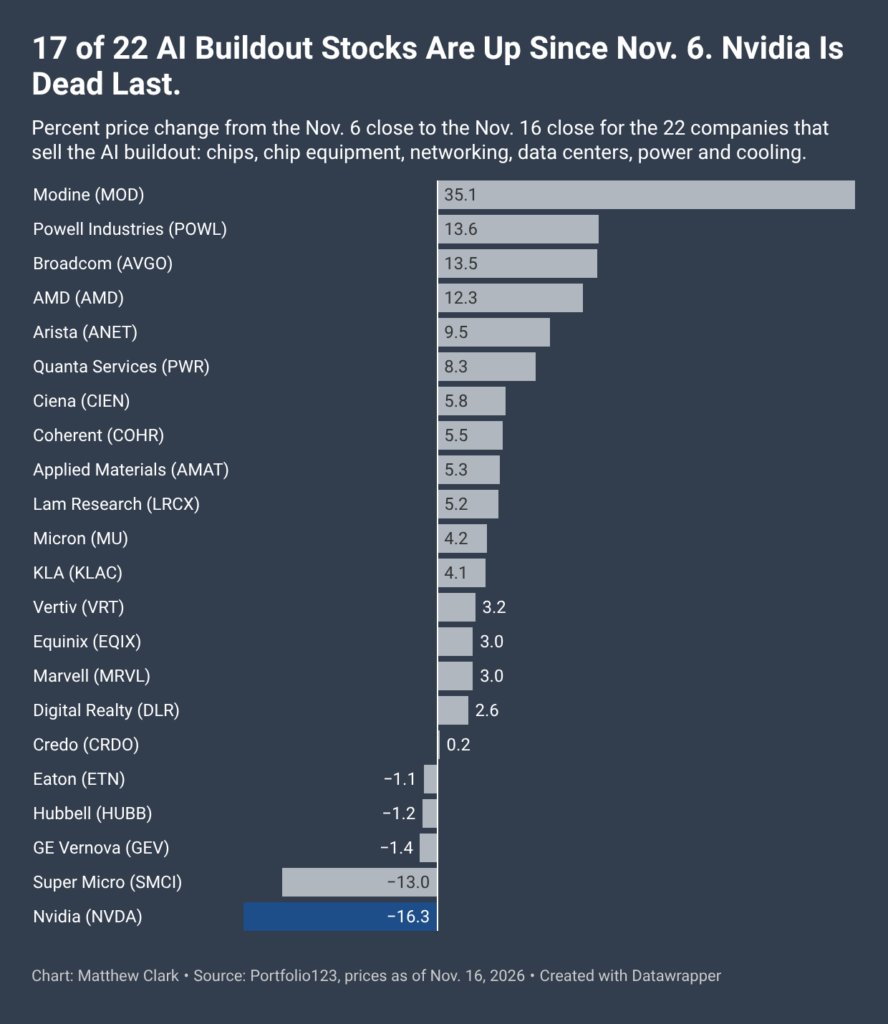

The money didn’t leave AI. It moved down the hall. From the November 6 close through last Thursday, Nvidia lost about $493 billion in market value. Over the same stretch, Broadcom (AVGO) and Advanced Micro Devices (AMD) added about $561 billion between them.
And it spread past the chips. Modine (MOD), which sells cooling systems for data centers, is up 35%. Powell Industries (POWL), which builds electrical gear for big power users, is up 13.6%. Quanta Services (PWR), which builds power lines, is up 8.3%.
What the System Sees In Nvidia
Adam’s Green Zone Power Ratings system grades every stock on six factors. Three of them tell this story.
Start with the business. Nvidia scores 99.9 on Growth and 99.9 on Quality. You can’t do much better than that. The system has no problem with what Nvidia sells.
Now the stock. Nvidia scores 18.5 on Momentum. That’s second-lowest in the 22-stock basket. The trend is broken.
Then look at the analysts.
I track how analysts change their earnings estimates for next year over the past four weeks. I count every raise and every cut. The score runs from -100, where every change was a cut, to +100, where every change was a raise.
Nvidia sits at +20. That’s still more raises than cuts. But the average across the basket is +54. And seven of the 22 stocks sit at a perfect +100.
So Wall Street isn’t giving up on Nvidia. It’s just getting more excited about everyone else.
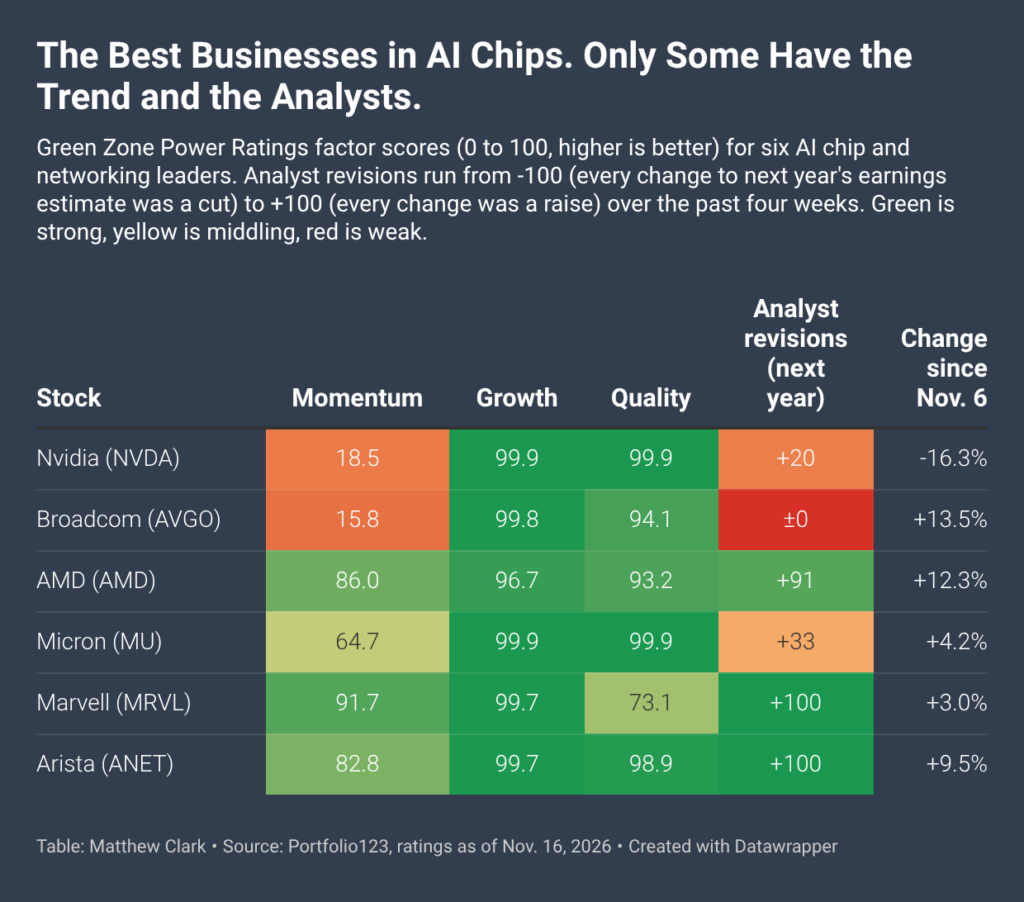

Look at the Growth column. Every name scores 96 or higher. These are all great businesses.
The difference is in the next two columns.
Broadcom is the hot stock, up 13.5% since November 6. But it scores 15.8 on Momentum, and its next-year revisions sit at zero. The system isn’t chasing it.
Two names have it all: a top business, a strong trend and analysts raising their numbers. AMD. And Arista Networks (ANET).
To be fair to Nvidia, this isn’t a “sell” call. Before its report, the stock traded at about 12 times expected earnings for the next year. That’s the cheapest it’s been since 2012. A great business at a low price can turn fast.
But it’s no longer the only way to own AI. And right now, it isn’t the best one.
The Stock I’d Check Out Instead
Arista Networks Inc. (ANET) makes network switches that connect AI servers within data centers. Every new cluster of chips needs a faster network to tie it together. Arista sells that network.
The system loves it. Arista scores 99.7 on Growth, 98.9 on Quality and 82.8 on Momentum. And its revision score is a perfect +100. Over the past four weeks, every analyst who changed a next-year estimate raised it.
The numbers back that up. On November 3, Arista reported third-quarter sales of $3.66 billion, up 58.5% from a year ago. CEO Jayshree Ullal called it the company’s fastest growth since it went public. Adjusted earnings came in at $1.20 a share. Analysts expected $1.08.
Then it raised its 2026 sales forecast to $13.3 billion. That’s the fourth raise this year. It also put out a first look at 2027: about $18.5 billion in sales. Wall Street had been at about $16.4 billion.
And the stock has held up. Since October 6, when Nvidia peaked, Arista is down 13.2%. Nvidia is down 34.7%. Since November 6, Arista is up 9.5%.
Now the caveats.
Arista isn’t cheap. It scores just 3.0 on Value. You’re paying up for that growth.
It isn’t calm, either. It scores 26.4 on Low Volatility, so expect big swings.
And Nvidia sells networking gear too. It has already won AI networking business from big cloud customers. That’s a real competitive threat.
But a company growing sales 58%, raising guidance four times in a year, with every analyst revision pointing up? That’s the kind of setup the system wants.
Which leaves us with one final question…
What Should You Do Now?
Start with what you already own.
If you hold a big index fund or a Nasdaq fund, you own a lot of Nvidia. That’s fine. Just know that your “AI exposure” may really be “Nvidia exposure.”
Next, if you want to add AI, spread it out. Use the table above. Look for names that score highly on Growth and Quality, as well as on Momentum and analyst revisions. Right now, that’s AMD and Arista. Arista is the one I’d look at first.
Then watch one thing today. After Nvidia’s report, does the rest of the basket follow Nvidia, or does it keep doing its own thing? For the past week and a half, it’s been doing its own thing.
Nvidia built the AI trade. It doesn’t own it anymore.
Until next time…
Safe trading,

Matt Clark, CMSA®
Chief Research Analyst, What My System Says Today
