


There’s a simple truth about the ongoing conflict in Iran … a truth that virtually everyone in the media seems to be avoiding…
Because it doesn’t fit the media narrative. And it can dramatically transform your understanding of the conflict, the forces at play, the stakes involved — even the media as a whole.
So obviously, I’ve got to share it here with you today in Moneyball Economics.
Click below to start the video and dive in:
Video transcript:
Welcome to Moneyball Economics. I’m Andrew Zatlin and I’m coming to you from the road today.
Right now, if you go online or you turn on your TV, the number one topic is bound to be the Iran war.
And after a month of this war, as an economist, I wanted to ask the question … what has been the impact? How has the economy responded to this war? And the answer is for the US economy, for the US consumer, for the US business, the Iranian war was not meaningful.
That’s right.
The economy moved on.
Now, that kind of is a surprise against the backdrop of all of this media hype that’s been going on that would lead us to think that the Iranian war was the most impactful thing ever for the United States. And the answer is … it wasn’t.
If you were the average American and you turned off your TV and you didn’t go online, you wouldn’t even know that there was a war underway except for the fact that there was higher oil prices.
But even there, oil prices shot up and they’ve come almost right back down. When we look at the economy, in fact, this is where it gets interesting because most of the mainstream conventional economists out there have been preaching the story that we are facing stagflation. And to be clear, stagflation means exactly that economy’s not moving along, but we’ve got inflation.
And today I want to speak to you looking at those two data points, what’s going on with inflation, what’s going on with the economy? And the answer is, again, mainstream economists are absolutely wrong.
There is no stagflation. This economy is moving forward. It is so strong that even the impact of higher oil prices from the Iranian war, there was no economic slowdown. There was no economic shutdown. Things have just been snapping back to normal.
Let me talk about that. Today we got inflation coming out, the consumer inflation CPI data.
And you know what? It was even lower than expected.
When we talk about inflation, remember there’s this highly volatile section. About 20% of the way they measure CPI comes from food inflation and energy inflation. Okay. Yeah, there was inflation in energy for obvious reasons. Oil prices did shoot up 25, 30%. Food prices, well, they were flat.
The way we want to talk about inflation and the way that it matters to economists and to the Federal Reserve when they’re talking about interest rate cuts is they ignore those volatile parts. They ignore food and energy. And they look at the remaining 80% of the economy. They call it the core CPI. And here it gets interesting.
Core CPI came in at 2.6%. It’s going down.
And all the major components that go into measuring inflation, again, getting softer, getting softer. Remember, the longest time, the Federal Reserve has been concerned about inflation.
And that concern was largely because we had high rents, inflation, we had high shelter costs, and those have been coming down as well. In fact, within that core, the reason it was at 2.6% even that high was, well, oil prices did come in.
Even though we strip out oil at the top level, let’s face it, people who need to buy a lot of gas have to raise their prices. And so airlines, for example, airlines fees went up because oil prices went up and they consume a lot of gasoline. Point being, if we’re talking stagflation, didn’t really see any inflation whatsoever. It was actually kind of soft.
Going forward, if oil prices stay where they are, come down even more, inflation’s going to go down more as well. So for all the economists out there who have been talking stagflation, no, you’re wrong. You don’t understand what you’re talking about.
For people who felt that the Iranian war would devastate the US consumer, US consumers absorbed it and they moved along.
Let’s talk about businesses though. How did businesses respond to this massive shock to the economy? Massive with a lowercase M. The answer is they ignored it. They moved on. This is a chart showing year over year hiring for S&P 500 companies.
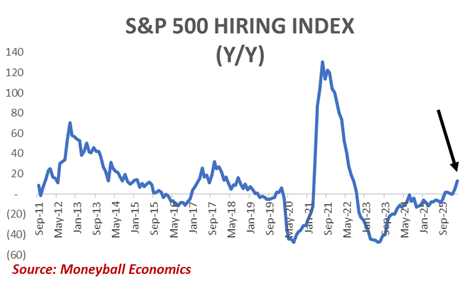

This is my data, my proprietary data. And as you’ll note, in the month of March, hiring shot up. You see, coming into this year, American companies understood that this was going to be a bullish year for the economy, and they are preparing for that by hiring people.
And it’s not just one sector over another. This is broad-based. All sectors are ramping up. They’re hiring. They expect this year to be economically stronger than last year. So again, let’s revisit that stagflation story. Economy not growing.
Inflation growing. And what are we seeing? Inflation not growing coming down and the economy growing.
Stay tuned, folks.
We’re going to have a banner year this year and it is going to go into the form of the stock market going up. You should expect this stock market in the second half to ramp up pretty strongly, and you should be prepared for that because the economy’s going to be ramping up pretty strongly as well.
We’re in it to win it.
Zatlin out.


Andrew Zatlin
Editor, Moneyball Economics