



In mid-September, I spent two days building something new into Adam’s system: a kill switch.
I wired it into three of our screens.
Each one hunts for a different kind of rate trade: banks, dividend payers and growth stocks.
But before any of them hands me a single name, it checks the bond market first.
If interest rates aren’t moving in the trade’s favor, the screen comes back empty.
No names. No trade.
When I ran all three for the first time, every one came back blank.
That wasn’t because there were no good stocks to buy.
Behind the bank screen’s kill switch alone, more than 140 banks passed every other test I threw at them.
The system just said: not yet.
Three days later, it looked like “not yet” might mean “not for a long time.”
On September 21, the bond market measure that drives my bank screen hit its worst reading of the year.
Then it turned.
Fast.
Last Thursday, the switch finally flipped.
For the first time since I built it, my bank screen handed me names.
Seventy-two of them.
And before I show you what the system found, I want to know what you think. Take our quick survey and tell us where you think the banking sector is headed.
Here’s why the bond market opened the door… and why I think these banks are worth a look.
Why Banks, and Why Now
Banks make money in a simple way.
They borrow short term (your checking and savings accounts) and lend long term (mortgages and business loans).
Their profit lies in the gap between those two rates.
One of the cleanest ways to measure that gap is the 10-year Treasury yield minus the 2-year Treasury yield. When that spread widens, bank margins tend to widen with it.
Wall Street calls it a steepening yield curve.
My Steepener Banks screen only turns on when that gap is wider than its own six-month average.
In other words, I’m not just looking for a wide spread.
I’m looking for a spread that’s moving in banks’ favor.
On September 21, that gap was just 0.20 percentage points, its flattest reading of 2026.
Then the bond market went through two weeks of whiplash, capped by Friday’s weak jobs report.
By October 1, the gap had more than doubled to 0.46.
That pushed it back above its six-month average of 0.42, and the screen switched on.
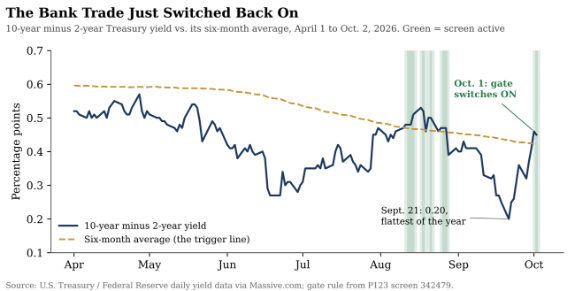

You can see the green bars in August.
The gate flickered on and off a few times, then shut down in September.
That’s important.
You see, the switch isn’t designed to stay on forever. And what happened in August and September gives us a clue about what could happen next.
More on that below.
72 Banks Made the Cut
Once the gate opened, Adam’s system went to work looking for highly rated banks that trade enough volume to get in and out easily and trade above $5 a share.
Seventy-two made the cut.
Here’s what jumped out at me: almost none of them have gone up lately.
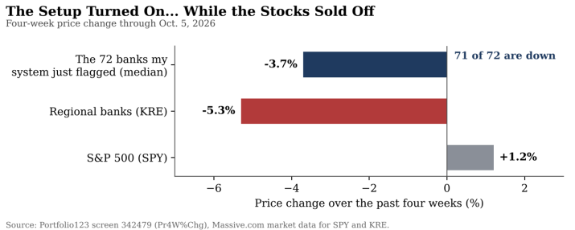

Over the past four weeks, the S&P 500 Index has been up 1.2%. Regional banks, as a group, are down 5.3%.
And 71 of these 72 banks are down too, with a median decline of 3.7%.
So, the setup improved while the stocks got cheaper.
That’s exactly the kind of disconnect I like to see.
As a group, they’re not expensive either. The median bank on the list trades at 12 times earnings and 11.3 times this year’s projected earnings.
And those earnings aren’t standing still.
They grew a median 26% over the past year.
Three Names That Stand Out
Here are three of the highest-rated banks on the list. First, the basic numbers.
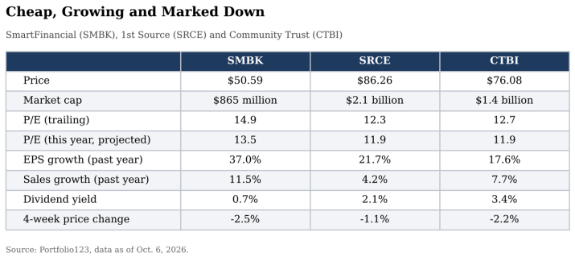

Now let’s run them through a factor X-ray. Here’s how each one scores on the six factors behind Adam’s ratings.
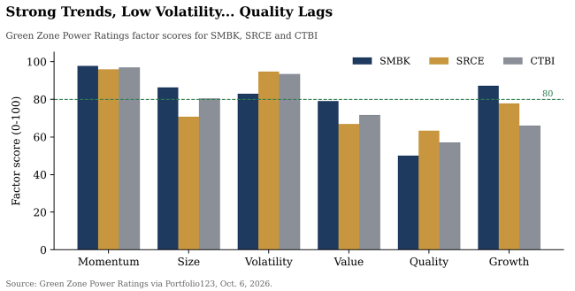
A few things jump out.
First, Momentum. All three score 96 or better.
That might sound strange after a rough month. But Momentum looks past the last few weeks to the bigger trend.
A score that high says that the trend is still intact.
To me, the past month looks like a pullback, not a breakdown.
Second, Volatility. All three score above 80.
These are steady stocks, not wild swingers.
Third, Quality is the weak spot across the board.
Part of that is just how banks are built. They borrow for a living, so any quality measure that penalizes debt will always look tougher on a bank than on a software company.
I don’t read too much into it, but it’s still worth mentioning.
Now the individual names.
SmartFinancial (SMBK) is the growth story. It scores 98 on Momentum and 87 on Growth, the best of the three on both.
Earnings skyrocketed 37% over the past year on 11.5% sales growth. At $865 million, it’s also the smallest, as reflected in its Size score of 86. The trade-off is Quality, at 50.
1st Source (SRCE) is the steady one. Its 95 Volatility score is the best of the group, and the stock held up best over the past month, down just 1.1%.
The $2.1 billion Indiana lender trades at under 12 times this year’s projected earnings and posts the highest Quality score of the three, at 63.
Community Trust (CTBI) is the income pick. It pairs a 97 Momentum score and a 94 Volatility score with a 3.4% dividend yield, the highest of the three. Earnings grew 17.6% over the past year.
The Two Trades Still Switched Off
The other two rate screens are still dark. And they aren’t close.
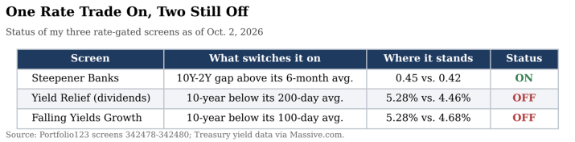

The 10-year yield needs to drop by about 0.6 percentage points before the growth screen turns back on, and by more than 0.8 percentage points before the dividend screen turns back on. That would take a real shift in the bond market.
So for now, the bank trade is the only rate trade Adam’s system will touch.
One Honest Warning
Not all steepening is created equal.
The best kind for banks is when short-term rates fall. That lowers what they pay depositors.
Right now, the curve is steepening mostly because long-term rates are rising. That still helps on new loans.
But it also lowers the value of the bonds banks already hold on their books.
And remember those green flickers in August. This gate has turned on and off before. One good week isn’t a trend. I’ll be watching to see if it holds.
But here’s the bottom line.
The bond market just moved in banks’ favor. Adam’s system found 72 highly rated names, and nearly all of them have gotten cheaper over the past month.
That’s a list worth keeping an eye on.
Until next time…
Safe trading,

Matt Clark, CMSA®
Chief Research Analyst, What My System Says Today
