



As I wrote yesterday, technology stocks have been ripping higher, pulling the market along to new all-time highs.
On the surface, that’s good.
Given that tech stocks make up close to half of the S&P 500 Index, it’s unrealistic for the market to sustain a rally without major participation from the sector.
But as I pointed out yesterday, some of the best-performing tech stocks of the past few weeks are also some of the junkiest. And the market rally today is “thin.”
As the S&P 500 hit new all-time highs last week, only about half of the index’s stocks were above their 50-day moving averages, and trading volume was conspicuously low.
So, is the rally sustainable? Or is it a “crap stock rally” that we should avoid?
To help us answer that, let’s do a deep dive into the second-best-performing sector last week, consumer discretionaries. The move in the State Street Consumer Discretionary Select Sector ETF (XLY) was a blistering 6.7%.
For all the talk about AI capital spending, the American consumer – good ol’ Homer Simpson himself – accounts for fully 70% of the economy.
So, how is Mr. Simpson doing?
Let’s do a deep dive to find out.
A Peek Under the Hood
At first glance, it looks like Homer is struggling.
Only eight of the 48 stocks in the sector rate as “Bullish,” meaning they have a score of 60 or higher, and 12 more rate as “Neutral.” Nearly 60%, at 28, rate as “Bearish.”
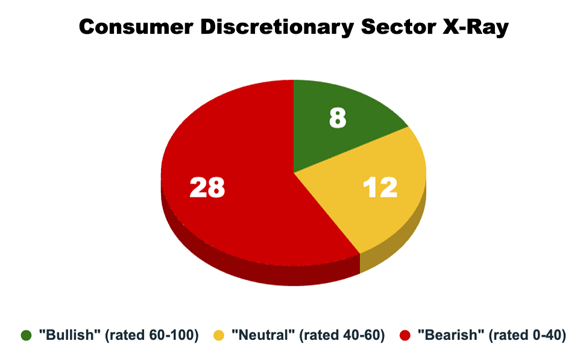

As a whole, consumer discretionaries don’t rate well.
That’s consistent with the narrative of the past several years: persistently high inflation has eroded purchasing power, and fears of AI disruption may be prompting Americans to spend more carefully.
And we can add to this the phenomenon of the “K-shaped” economy, in which the highest earners seem to be doing fine even as middle- and working-class consumers are really struggling.
We’ll dig into the K-shaped economy shortly.
First, let’s dig a little deeper to see what factors are driving the ratings of the consumer discretionary sector.
Where Do Consumer Discretionaries Pick Up Points?
The Green Zone Power Rating is a composite score based on six primary factors: momentum, size, volatility, value, quality and growth, each of which is composed of several sub-factors. (As we are looking at large-cap constituents of the S&P 500, I don’t consider size when doing the sector X-ray.)
Quality is undoubtedly the most “Bullish” factor for consumer discretionary stocks. In fact, 40 out of 48 stocks – fully 83% of the total – have quality scores of at least 60.
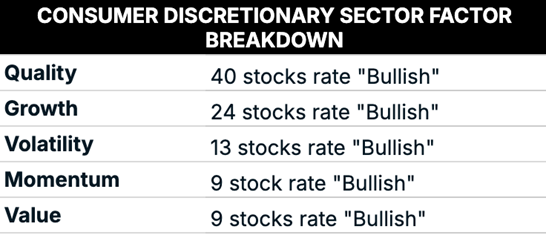

The quality factor is a composite of various measures of profitability, balance sheet strength and asset turnover.
Branding plays a major role here. Building a brand is hard. It often takes years (if not decades) and a large advertising budget to create real name recognition.
But once a company has a strong brand in place, it becomes a powerful intangible asset that enables it to charge a premium for its products.
How do you assign a value to McDonald’s (MCD) golden arches or to Disney’s (DIS) Mickey Mouse ears?
Accountants have been arguing about that for decades, but it’s safe to say that their branding is a major driver of their long-term success and has enabled them to weather many a storm. (Both McDonald’s and Disney rate as “Bullish” on their quality factors, by the way.)
Surprisingly, quite a few consumer discretionary stocks rate as “Bullish” on growth, too. At 24, it’s half the sector.
For all of Homer Simpson’s struggles of late, it seems that he’s still spending his money somewhere.
Bullish Consumer Discretionary Stocks
Let’s take a look at the stocks currently rated as “Bullish.”
I ran a screen for the consumer discretionary stocks with Green Zone Power Ratings of 60 or higher. (The composite Green Zone Power Rating, blurred here, is reserved for paid subscribers to Green Zone Fortunes.)
Here’s what I got:
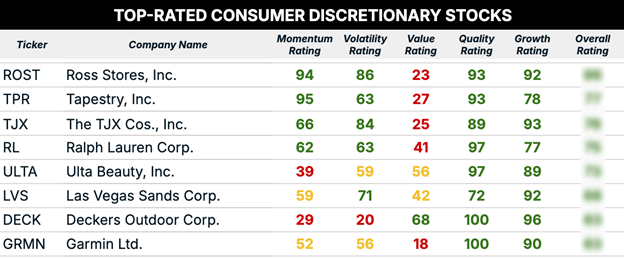

Two stocks should look very familiar to longtime readers of What My System Says Today. I’ve been writing about “off-price” retailers Ross Stores (ROST) and the TJX Companies (TJX), parent company of T.J. Maxx and other stores, for months.
The K-shaped economy is real, and both of these stocks benefit by serving the massive number of Americans looking to save money.
Shoppers flock to discount chains like T.J. Maxx or Ross when their budgets are tight. With inflation still stubbornly high and the labor market looking a little shaky, this is exactly the kind of environment these chains are made for. Both stocks have been trending higher for months.
It was true then, and it’s even truer today.
Both continue to rate as “Bullish” and rate particularly well on momentum, volatility, quality and growth.
To good profits,

Adam O’Dell
Editor, What My System Says Today
