



Take a $400,000 home loan.
On September 3, the average 30-year mortgage rate was 6.71%. Your monthly payment for principal and interest: $2,584.
By October 8, the rate had climbed to 7.4%.
Same house. Same loan. Now, you’re paying $2,770.
That’s an additional $186 a month. About $2,229 a year. And you haven’t changed a single thing about the house.
Here’s what most people miss. Your stocks just got a bigger bill, too.
The Number Behind Every Price
Mortgage rates follow one number: the 10-year U.S. Treasury yield.
On October 8, it hit 5.35% — its highest level since 2002.
Think of that yield as the price of borrowing money across the economy.
It helps determine what you pay for a mortgage, what companies pay to finance their businesses and how much investors are willing to pay for stocks.
Here’s why that last part matters.
When investors can earn a roughly 5% yield on U.S. Treasurys, they have less incentive to take on the risks of owning stocks unless those stocks offer enough potential upside to justify it.
That puts pressure on valuations. And the higher Treasury yields climb, the harder stocks have to work to compete.
The Fed raised rates on September 16. Its next meeting is October 28.
But you don’t have to wait for the central bank to make a move.
The bond market is already repricing risk. And that shift could determine where the next opportunities emerge…
Cash Won… Debt Lost
I wanted to see who’s paying the bill. So I ran two screens through Adam O’Dell’s Green Zone Power Ratings system.
The first set of companies spotted had more cash than debt. I call them Rate-Proof. The second batch found companies with heavy debt and profits that barely cover their interest. I call them Rate-Squeezed.
Then I checked how the top 10 stocks on each list did over the past four weeks. That’s the stretch when the 10-year climbed to its high.
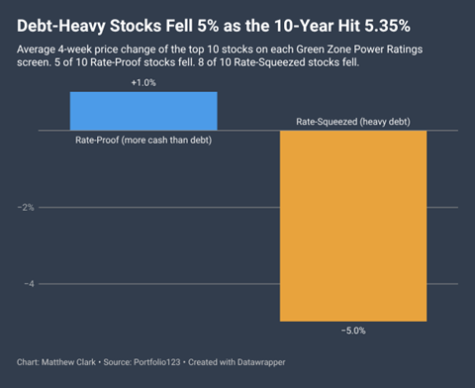

That’s a six-point gap in one month. The big difference between the two lists is the balance sheet.
Take a look…
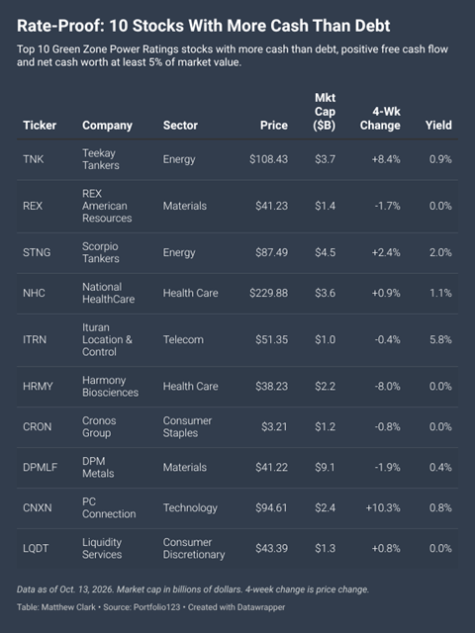

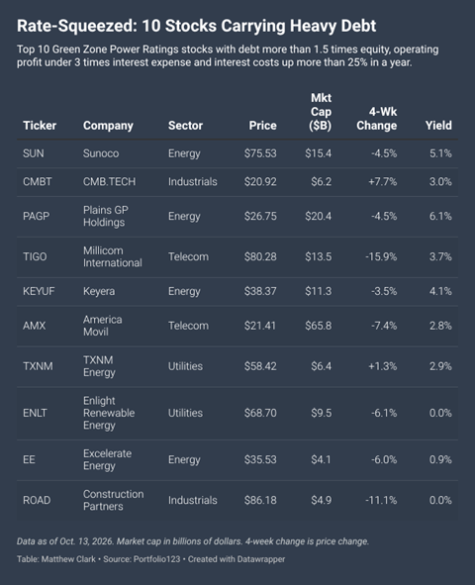

One note before you buy off the first list. A few of those names, like the two oil tankers and DPM Metals (DPMLF), are flush with cash partly because their markets are hot right now.
Cash is cash. But a hot cycle can cool.
That’s why I want to show you two companies in the same business.
Same Industry… Same Shock… Opposite Results
Telecom is the only industry on both lists.
On the Rate-Proof side sits Ituran Location & Control (ITRN). It tracks cars and trucks over wireless networks. Insurers use it to find stolen vehicles. Businesses use it to run their fleets.
On the Rate-Squeezed side sits Millicom International (TIGO). It runs mobile and cable networks in Latin America under the Tigo brand.
Both sell connections.
Over the past four weeks, Ituran slipped 0.4% and Millicom dropped 15.9%.
Here’s why…
Ituran has more cash than debt, by a mile. It holds $103.7 million in cash and owes just $4.2 million. That leaves about $100 million in net cash.
That’s nearly 10% of the company’s stock market value, sitting in the bank. When rates rise, that cash earns more.
Millicom owes $11.9 billion. It holds $891 million in cash. Its debt equals about 88% of its stock market value.
Over the past year, it paid $907 million in interest.
And that interest bill is the problem.
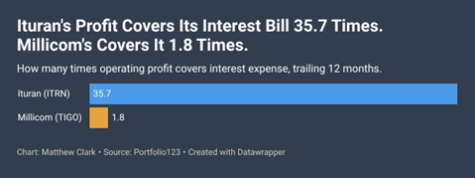

Think about what 1.8 times means. For every $1 Millicom pays in interest, it earns about $1.80 in operating profit.
When rates climb, old debt gets replaced with new debt at higher rates. That thin cushion gets thinner.
Ituran’s interest bill could grow tenfold, and its profit would still cover it more than triple.
What the System Sees
Here’s how the two stack up on the six factors Green Zone Power Ratings tracks.
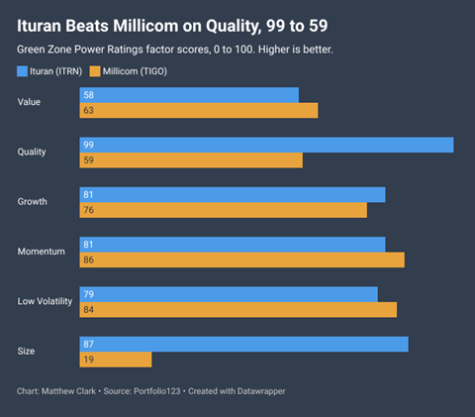

To be fair, Millicom isn’t weak across the board. It edges out Ituran on value, momentum and low volatility. Momentum looks back further than one month, so it still reflects Millicom’s run before this drop.
But look at quality.
Ituran scores 99. Millicom scores 59.
Quality is where the system checks factors such as profit margins, cash flow and debt. That’s the exact gap the bond market just punished.
Ituran also wins on size, 87 to 19. Smaller stocks tend to beat bigger ones over time, and Ituran is about one-thirteenth the size of Millicom.
Then there’s the price.
Ituran trades at about 16 times earnings and pays a 5.8% dividend. Millicom trades at about 20 times earnings, even though its earnings per share fell about 30% over the past year. Its dividend yields 3.7%.
So Ituran costs less, and it pays you more to own it.
What To Do Now
If you want one connected-services stock, the Green Zone Power Ratings system says Ituran. You get a top-tier quality score, a cash pile that earns more as rates rise and a 5.8% dividend.
If you own Millicom, don’t add to it before the Fed meets on October 28. A company with interest coverage less than 2X can’t handle many more rate surprises.
Then run this check on every stock you own. It takes two numbers, and you’ll find both in a company’s latest quarterly report.
First: does the company hold more cash than debt?
Second: how many times does its operating profit cover its interest bill? If the answer is under three, you own a Rate-Squeezed stock.
You can’t do much about the rate on your mortgage. But you can choose which side of the 5% price tag your stocks sit on.
Until next time…
Safe trading,

Matt Clark, CMSA®
Chief Research Analyst, What My System Says Today
