



Over the weekend, we heard two prominent voices calling for a slowdown in AI development.
That alone isn’t particularly new or exciting.
AI naysayers have been around decades longer than the technology itself.
What made this outcry strange is that it came from the companies behind the two leading AI models, ChatGPT and Claude.
We’ll start with OpenAI’s Sam Altman.
On Sunday night, Altman wrote:
There are two ways AI progress could go very badly and that we must avoid.
First, we could lose control of the future to AI. This is unacceptable; we are unapologetically on Team Humanity, and AI must always serve people. To ensure that, we need ways to ensure that alignment and safety techniques stay ahead of progress in model capabilities.
Second, we could end up in a world with too much concentration of power. If an extraordinarily powerful AI is used by one person or company to impress their worldview onto everyone else, the results could be extremely dystopian.
Altman’s comments came one day after Anthropic founder Dario Amodei publicly called to slow down AI development, “pacing the rate of capabilities advancement so that risk prevention has time to keep up. We must slow the pace at which we improve the capabilities of AI models.”
The timing here is interesting.
Are Altman and Amodei truly concerned that they are losing control over their own tech… and fear the consequences?
Or… could it be that both are keenly aware of the gargantuan sums of money they are spending trying to one-up each other, and this is all a really cynical attempt to limit competition in the interest of boosting profitability ahead of their respective IPOs?
Frankly, your guess is as good as mine. I have no inside information here on which to base an opinion.
But whatever the reasons behind the statements, I can tell you that they spooked Wall Street.
Today’s stock prices, particularly in the tech sector, only make sense if you believe that the hyperscalers will continue to dump ungodly amounts of money into new AI infrastructure.
If that spending slows – either due to legitimate fears that the “Terminator” is coming true or to major AI developers simply looking to reduce their compute spending – then Mr. Market has a real problem.
Tech stocks are down today as investors weigh that possibility. But it didn’t seem to bother them much last week. In fact, the State Street Technology Select SPDR ETF (XLK) was the top-performing sector, up 0.9%.
Energy stocks were also higher primarily due to the Iran war taking a turn for the worse. The State Street Energy Select SPDR ETF (XLE) finished the week up 0.8%.
All other sectors finished in the red.
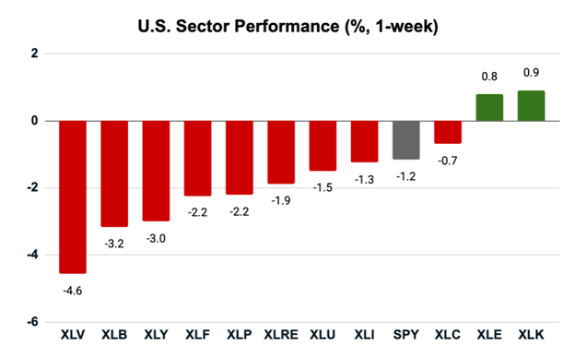

Health care stocks got hit particularly hard. The State Street Health Care Select SPDR ETF (XLV) was down nearly 5%.
The weakness in health doesn’t appear to be tied to any single headline, though sticky inflation certainly hasn’t helped. The weakness looks a lot more like profit-taking, as health care has been a particularly strong sector over the past couple of months.
Today, we’re going to take a look at both the technology and health care sectors to see whether last week’s moves have created any buying opportunities.
Does the Tech Sector Still Have Legs?
As I do every week, I ran my customary screen of the biggest movers in the sector that were still within 10% of their 52-week highs. The idea is to look for solid, market-leading stocks that are getting stronger.
Here’s what I came up with:
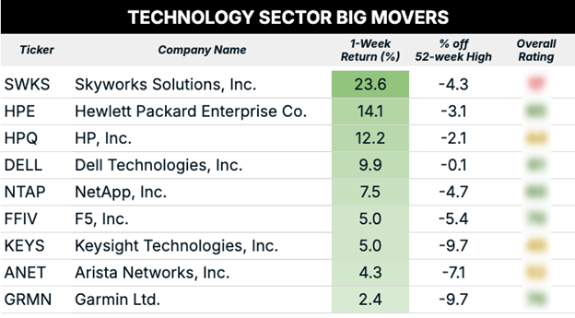

We had five big gainers from last week within 10% of their 52-week highs that rank as “Bullish” on my Green Zone Factor Ratings: Hewlett Packard Enterprise (HPE), Dell Technologies (DELL), NetApp (NTAP), F5 (FFIV) and Garmin (GRMN).
There is a clear tie that binds them. Apart from Dell, a major player in AI infrastructure, none of the others have much connection to AI.
They certainly aren’t “AI stocks.”
Still, I believe the AI infrastructure trade still has plenty of room to run.
Altman and Amodei may talk about slowing down development, but I don’t see that as realistic in the winner-take-all world of the tech economy. It may be a brutal and expensive arms race, but it’s one that neither can afford to lose.
All the same, you shouldn’t bet your entire portfolio on AI. It makes sense to diversify into stocks that aren’t all beholden to the same underlying megatrend.
That’s just common-sense risk management.
Any Value in Health Care?
Health stocks have had a great run since June, due in part to normal sector rotation at a volatile time of year. Unfortunately, the sector had a major reversal last week and finished nearly 5% lower.
After a rough week like that, might there be some opportunities?
Let’s take a look.
I ran my customary screen of the sector’s biggest losers for the week that are still trading within 10% of their 52-week lows. The idea is to find beaten-down gems that look poised to recover.
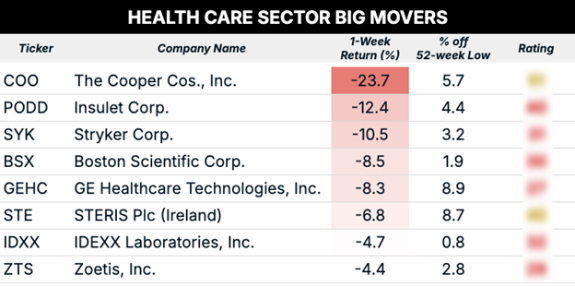

Unfortunately, the pickings are slim.
Of the stocks that got beaten up last week, none would appear to be good candidates for dip buying. Not a single stock on the list rates as “Bullish” on my system.
To good profits,

Adam O’Dell
Editor, What My System Says Today

P.S. It starts with two golf courses in Florida. But follow the paper trail, and the story suddenly leads somewhere very different…
A secret ticker. The Trump family. And a proposed merger with a national defense company. Those pieces probably don’t sound like they belong in the same story, but that’s exactly what caught Moneyball Economist Editor Andrew Zatlin’s attention.
On Monday, Zatlin will connect the dots, reveal the ticker at the center of the deal and explain why the expected September 30 transaction could create a huge moneymaking opportunity for investors who are paying attention.