



The most crowded trade on Wall Street just got a lot cheaper.
For the better part of two years, tech investors were paying nose-bleed prices — forward price-to-earnings (P/E) ratios pushing 40X for the S&P 500 Index’s biggest information technology names.
Now, in a matter of months, that premium has collapsed. We’re talking about a valuation reset not seen since the COVID crash of 2020.
That’s not a footnote. It’s a signal.
Here’s what the chart tells us: from 2022 through early 2025, the market was willing to pay an extraordinary premium for tech earnings growth.
AI hype, cloud dominance, semiconductor supercycles — investors loaded up and kept buying. The spread between tech valuations and the broad market widened to levels that, frankly, made a lot of serious analysts nervous.
Now, that spread is snapping back. Hard.
The 10 largest names in the S&P 500 Information Technology index — companies like NVIDIA (NVDA), Apple (AAPL), Microsoft (MSFT), and Broadcom (AVGO) — are suddenly trading at multiples that look a lot more like 2019 than 2024.
That’s a meaningful shift.
And if you’ve been sitting on the sidelines waiting for a better entry point into the best businesses in the world, the market may just be offering you one.
The fundamentals haven’t changed. The earnings growth story is still intact. What changed is the price tag — and in investing, price is everything.
Ratings System Separates Wheat From Chaff
But here’s what the headline number misses: not all tech is cheap for the same reason — and not all of it is worth buying.
That’s where our Green Zone Power Ratings system comes in.
Instead of guessing which names deserve a second look, we let the system do the work.
I ran all 10 of the S&P 500 Information Technology index’s largest constituents through the model. What came back tells a pretty clear story…
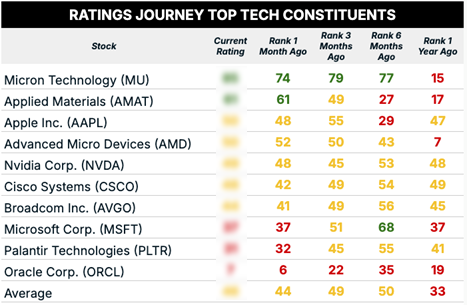

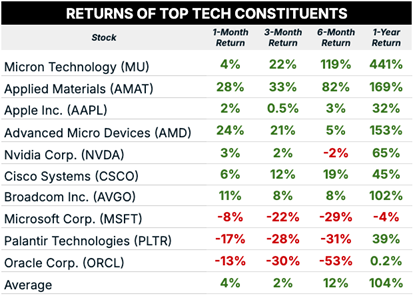
Micron Technology (MU) sits at the top of the list with a current “Strong Bullish” rating. And the performance data backs it up.
MU has returned 441% over the past year and 119% over the last six months alone.
What’s notable is where that rating was a year ago: near “High-Risk”. The system spotted the turn early, and investors who followed it were rewarded.
Applied Materials (AMAT) is the other name that jumps off the page. A current “Bullish” rating, a one-year return of 169% and a six-month return of 82%.

The momentum is real, and the ratings have climbed steadily — from “Bearish” a year ago to “Bullish” today. That’s not luck. That’s a trend.
AAPL, Advanced Micro Devices (AMD), NVDA and Cisco Systems (CSCO) all cluster solidly in the “Neutral” range.
NVDA is the interesting case here. Despite its celebrity status as the face of the AI trade, the stock is actually down 2% over the past six months and rates in the middle of the pack. The hype got priced in. The system has been telling us that for a while.
AMD tells a different story — up 153% over the past year and currently rated “Neutral” as well. It’s not screaming “buy” right now, but the trend is improving.
Not All Names Are Good Names… For Now
Now, some of these names you recognize, but avoid right now.
MSFT rates “Bearish” — and has been stuck there for a year.
It’s down 4% over the past 12 months and off 29% over the past six.
For one of the most valuable companies on the planet, that’s a rough stretch.
The market is repricing its AI premium, and the ratings model has been waving a yellow flag the entire time.
PLTR and Oracle Corp. (ORCL) rate “Bearish” as well.
Oracle is down 53% over the past six months and has gone essentially nowhere over the past year. Whatever the bull case is, the data doesn’t support it.
A year ago, the average Green Zone Power Rating across these 10 names was “Bearish.”
Today, it’s neutral but trending in the right direction.
The valuation reset we mentioned earlier is doing exactly what it’s supposed to: separating the stocks that deserve to trade at a premium from those that don’t.
The broad sell-off pulled everything down together.
But the recovery won’t work that way. It never does.
Until next time…
Safe trading,


Matt Clark, CMSA®
Chief Research Analyst, Money & Markets