



I’m not going to beat around the bush.
My system has identified one sector that stands far above the rest. In fact, it’s the most “Bullish” sector I’ve seen in years – and one of the strongest signals my Green Zone Power Ratings system has ever produced. It’s not technology.
It isn’t the AI hyperscalers.
And while it’s benefiting from the AI boom, that’s not the primary reason it ranks so highly.
I’m talking about energy.
Of the sector’s 20 stocks, 17 rate as “Bullish,” meaning a score of 60 or higher out of 100. (For those new to my system, “Bullish” rated stocks outperform the S&P 500 Index by double on average over the following year.)
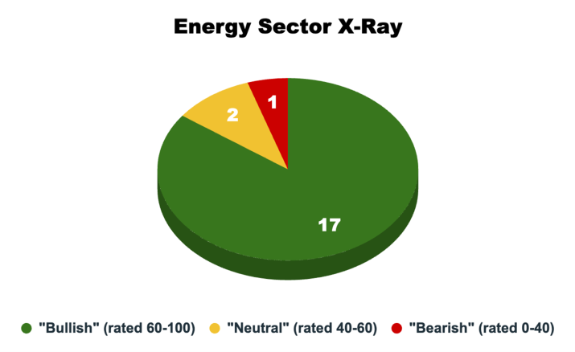

Another two rate as “Neutral,” meaning my system would expect them to perform more or less in line with the broader market. And only one stock in the entire sector rates as “Bearish,” meaning my system would expect it to underperform the market.
That’s not just broad participation – it’s overwhelming consensus from my system. Signals this strong don’t come along very often. If my Green Zone Power Ratings system could speak, it would be screaming from the mountaintops that energy stocks were a buy.
The war in Iran has had an outsized impact on energy prices and on the daily swings in energy stock prices. When the conflict escalates, prices go higher. And when it looks like tensions are easing, they fall.
Ignore all of that daily drama.
That’s just noise.
Energy stocks were already trending higher – and popping up as “Bullish” on my system – long before the first shots were fired in the Persian Gulf.
Whether the conflict intensifies, cools off, or drags on for months, my system continues to point in the same direction.
So, let’s dig into the data and see exactly why energy remains one of the most compelling opportunities in today’s market.
Where Does Energy Pick Up Points?
The Green Zone Power Rating system is a composite score based on six primary factors: momentum, size, volatility, value, quality and growth, each of which comprises several sub-factors. (As we are looking at large-cap constituents of the S&P 500, I don’t consider size when doing the sector X-ray.)
So, where is energy picking up the most points?

The short answer is: everywhere.
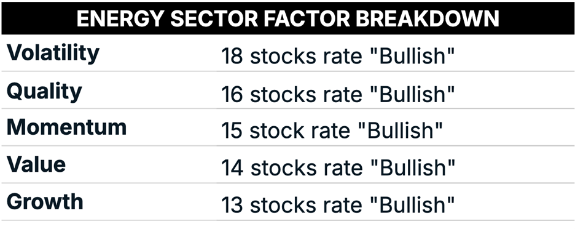
A majority of energy stocks rate as “Bullish” on each of the individual factors. There’s literally not a single factor in which energy stocks rate poorly.
The most “Bullish” factor is volatility. Eighteen out of the sector’s 20 stocks rate as “Bullish” on volatility. (The more “Bullish” a stock’s volatility score, the less volatile it is.)
As I wrote last week, AI stocks are officially in a bear market. Is this a garden-variety cyclical bear, or is it the start of something bigger that will spread to the rest of the market?
It’s too early to say. But if we are heading for a period of higher volatility, then the energy sector’s strong volatility ratings suggest that energy stocks will hold up far better than the average S&P 500 company.
Energy stocks rate well on quality, which is somewhat surprising.
My quality factor is a composite that rates a stock’s profitability, balance sheet strength and capital efficiency.
“Capital light” businesses like software developers tend to rate well here. “Capital heavy” businesses like energy firms tend to rate poorly.
You can’t run an energy company from a laptop in a college dorm room. You need a massive investment in equipment and machinery.
Yet energy stocks continue to post impressive quality scores because their profitability has become so strong that it more than offsets the industry’s heavy asset base. If there’s a relative weak spot, only 13 out of 20 rate as “Bullish” on growth.
That’s completely normal.
Keep in mind, the oil and gas industry dates back to the early days of the Industrial Revolution. These are mature businesses in a mature industry.
Most have spent decades refining their operations and generating steady cash flow rather than chasing explosive expansion.
What’s Working Today
Given today’s high ratings in my system, I believe the proverbial monkey throwing darts at the stock page of the Wall Street Journal could build a winning energy portfolio. But let’s focus our attention on the stocks that are already trending higher.
I ran a screen for the stocks rating as “Bullish” on their momentum factors, and here’s what my system gave me:
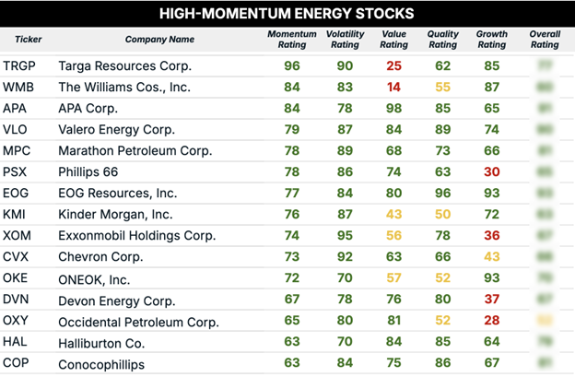

While supermajors like ExxonMobil (XOM) and Chevron (CVX) made the list, the highest-momentum energy stocks are domestic-focused infrastructure plays.
Of the top six, two – Targa Resources (TRGP) and Williams Companies (WMB) – are pipeline operators, and three – Valero Energy (VLO), Marathon Petroleum (MPC) and Phillips 66 (MPC) – are oil refiners.
This makes sense. The global energy markets are in a state of chaos due to the wars in Iran and Ukraine. The energy stocks rated the highest on momentum avoid those messes. They transport or refine drama-free American crude.
Of course, my Infinite Momentum model was quick to pick up on this trend. Eight weeks ago, it was allocated to the regional energy company HF Sinclair Corporation (DINO).
We’re already up a quick 31%, and my system sees more upside to come.
To good profits,

Adam O’Dell
Editor, What My System Says Today

P.S. The market is entering a period where leadership is changing fast. AI is driving unprecedented demand for electricity, critical minerals remain in short supply and geopolitical tensions continue to reshape energy markets.
That’s why Grey Swan Founding Director Addison Wiggin and Grey Swan Contributor Shad Marquitz launched Grey Swan Resource Investor yesterday to help you understand what’s supplying the next generation of global growth.
If you missed the LIVE presentation with Addison, you can watch the replay here.