


Hello, and welcome back for another Moneyball Wednesday!
We’ve got a really big event coming up tomorrow, folks.
It’s our first-ever Moneyball Happy Hour — starting TOMORROW, Thursday 14 at 3PM EST — and you’re invited…
I’ll be hosting this live, free event alongside my analyst and co-editor Matt Clark, and we want YOU to show up with your very best cocktails and questions. Which stocks have you been looking into lately? Which megatrends do you think we should spend more time covering?
This is going to be an open and informal session where we’re free to take “deep dive” into the subjects that matter to you. So save the date now, and keep an on your inbox for my invitation tomorrow.
NOTE: We’ll be hosting this live, free event at 3PM tomorrow on Zoom (if you haven’t already downloaded Zoom, you can get it HERE).
Now, let’s dive into today’s video.
Click below to get started:

Video transcript:
I’m Andrew Zatlin. Welcome to Moneyball Economics.
Moneyball Economics is the intersection between the economy and investing.
It’s where you can come and learn about what’s going on in the economy around us and how that is going to affect the stock and bond markets.
Well, before we jump into that, I want to make sure that you’re joining me this Thursday at three o’clock East Coast time! I’m going to be hosting our very first virtual happy hour. So come on down. It’s a happy hour.
Feel free to bring a drink. I’m a whiskey man myself. Maybe I’ll be there to toast you.
The other reason we’re calling it happy hour because it’s the end of the week, end of the day. And quite frankly, because I want to kick my feet up, let my hair down and do a deeper than usual dive into topics of interest. Not topics that interest me per se, but what’s top of mind for you?
In addition to that drink, I want you to bring questions.
I spend all week talking to fund managers. I know what’s interesting to them. I want to know what’s of interest to you.
Also, because we’re doing this live and we’re doing it over Zoom, please make sure that you’ve already downloaded Zoom. All right, let’s jump into what’s going on in the economy because we got confirmation last week in the payroll numbers that indeed this is a bull year. I’ve been saying that for some time.
I’ve been saying that 2026 was poised for serious growth and guess what? It’s underway. In fact, back in March when the markets were melting down, I was begging with you. I was pleading with you to go ahead and buy the dip that you need to be long and strong with this market. I hope you did and I hope your portfolio recognizes that move.
Why though was I so bullish back then and why am I so bullish today? It’s because I’m data driven.
It’s what the data tells me, not just the data that’s out there, but the data I harvest as well. And you should be saying to yourself that one. So are all the other experts, right? And my answer is no. And the proof of the pudding was last week with payrolls.
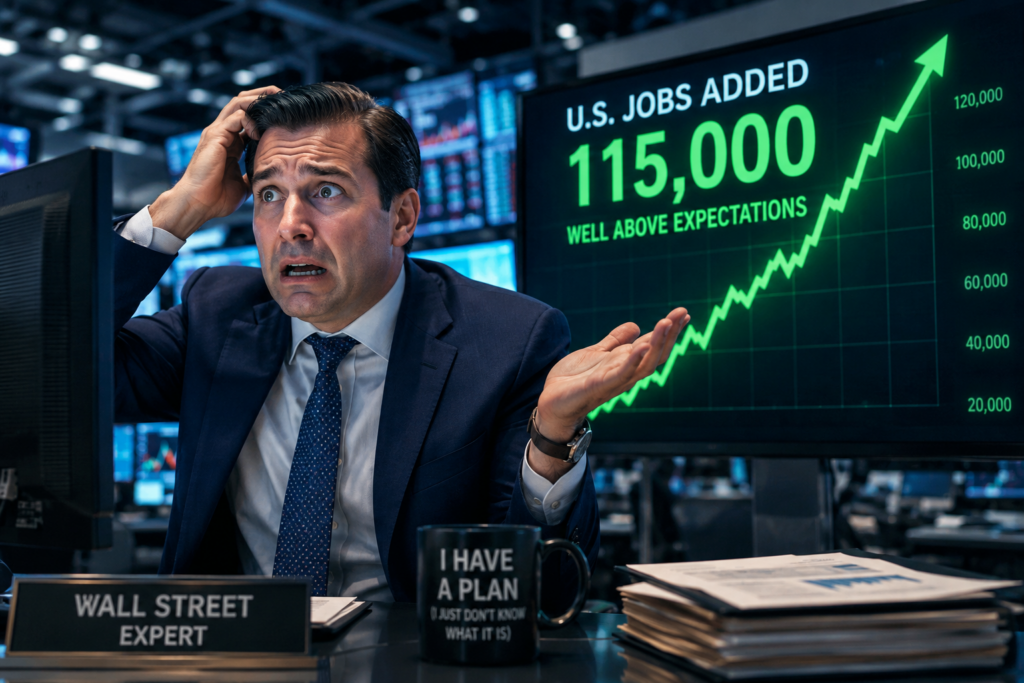
So 80 economists came out with a forecast of 70,000. I’m one of the 80, but my forecast was a lot higher. I said it was going to be 133,000 and it came out at 115,000. There were only four of us who were even close. Meanwhile, 70,000, well, that means that half of the people out there, 40 out of the 80 some odd economists thought it was going to be a terrible number. In fact, about a dirty dozen of them thought it was going to be 10 or lower, even negative.
Most of the experts out there are not data driven.
They’re not paying attention and they don’t understand what’s going on around us.
They don’t understand that we are now ramping up into a Trump cycle that we have successfully left behind the downside of the end of the COVID cycle.
And the proof of that is in the numbers that came out Friday. So let’s talk about that. 115,000. That’s a good number. It’s not breaking the glass at all, but it’s a Goldilocks number. Strong enough to finally put the end to any hope of a rate cut, but weak enough not to justify a rate cut. A very Goldilocks number, 115,000, not too impressive.
Well, I’m here to tell you it’s incredibly impressive when you pull back the curtain … and that’s what we want to do today.
See, when you pull back the curtain, what you find out is we just saw some of the strongest numbers we’ve seen in 13 years.
Remember, that 115,000 number, that’s a massaged number. That’s basically saying we every April get a certain amount of jobs being created. We want to adjust out what we should expect to see in April and just talk about the net new and exciting. And that net new and exciting was 115,000 or so you’re told.
The reality is when you look at the raw data, it’s a lot more interesting and a lot stronger. Okay. Every April, 900,000 to a million jobs get added. This April, we were close to that million number. In fact, this April was the strongest April since 2022.
And I’m talking about the non-seasonally adjusted raw numbers. This is the strongest number since 23, 24, 25, the strongest number in almost five years in the month of April. Now, some folks might come out and say, “Yeah, but that was April and storm and blah, blah, blah.” Okay.
Well, let’s take a look at year to date through April.
Let’s look at, for example, what happened in the manufacturing space. Same story. We have one of the best year to date numbers since 2022. We had more manufacturing jobs added than we’ve had since 2022. We’re talking the non-seasonally adjusted numbers.
Now, what’s going on? Well, quite simply, we have been in a tailspin. If you go back in time to January 2023, you go all the way out for three whole years to December 2025, manufacturing payrolls have fallen month in, month out.
But then you get to this year and they’ve started to climb. Not a lot, but they’re climbing. The only question right now for the manufacturing space isn’t the strength. It’s the scale of the strength and how long the duration. Because quite frankly, you could say, “Well, this is just eventually we were going to bottom and this is just the result of the supply chain shock being dealt with a year after Trump introduced tariffs.” Maybe, but let’s go back in time.
The reason it started to collapse in 2023 was because sales started to slow down, manufacturing started to slow down. This is the reverse side of what happened with COVID when everything ramped up. Everything ramped down. Starting last year, we did have some supply chain madness and we’re a year after that. And the question then is in terms of scale and duration, degree and duration, the question really comes down to this.
Is this merely a normalization? Is this really just the response to going too deep with payroll cuts because of the supply chain shocks that were initiated by tariffs? Or as I believe, are we witnessing onshoring? Are we witnessing manufacturing come on shore?
Because if we are, then this has a lot higher to run and a lot longer to run. Let’s talk about the second key signal that came out in the data. If the manufacturing sector is improving, firming up, that’s good, but manufacturing has been kind of standalone.
That’s just more of a comment about what’s going on in manufacturing.
Temp workers is a comment about what’s happening across all businesses. All businesses rely on temp workers and temp workers are going to grow or shrink depending on demand out there in the broader economy. The temp worker payrolls year to date, let’s not pick a single month, year to date, but also month in, month out, the raw non-seasonally adjusted data, this has been the best year for temp workers since 2013.
We’ve had more jobs created for temp workers this year, January, February, March, and April than we have any other year since 2013. And you know why 2013 is important? Because that’s the year when things really started to really take off in the broader economy following the great recession. I firmly believe that this Trump cycle we’re in has a lot of legs and the temp worker demand is signifying that companies are growing and they need to expand their workforce.
That means we can expect growth across the board, not just in manufacturing. You need to be bullish. A lot of this stuff isn’t going to show up until the second half because again, consensus doesn’t acknowledge it until it’s right in front of their face.
They don’t know how to read the data.
We do.
We’re going to see strength in the second half. That’s part of why we’re already seeing the markets go up. Earning season was a blast and we’re going to have another and another and another. Be prepared, be long and strong, folks, because we’re in it to win it.
Zatlin out.
See you Thursday.

Andrew Zatlin
Editor, Moneyball Economics