


It’s nasty out there in bonds…
Longer-term yields that affect everything from auto loans to mortgage rates have been grinding higher. And because bond prices and yields move in opposite directions, rising yields mean falling bond prices.
A host of factors — including the war in Iran, snowballing government debt and fears over excessive AI spending in the private sector — have weighed on bonds.
The iShares 20+ Year Treasury Bond ETF (TLT) – a popular proxy for long-term bonds – is down about 15% over the past year, with most of that damage coming since the end of June.
When bonds get hit, it’s common for bond substitutes like high-yield dividend stocks to feel the pain as well.
So, after the bloodbath in bonds, might there be some juicy opportunities in income stocks?
Let’s take a look.
This week, instead of doing a standard sector X-ray, we’re going to do things a little differently.
We’re going to do an X-ray of the highest-yielding stocks in the S&P 500 Index. I screened for all stocks in the index with a dividend yield of at least 4%, and here’s what I found:
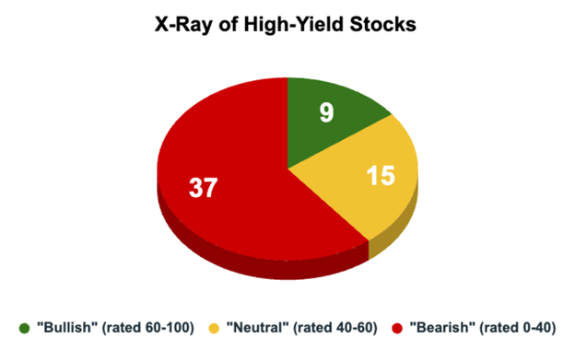

It shouldn’t be too surprising that most of the chart is red.
As I said, it’s been a rough market for anything that tends to be priced like a bond.
Of the 61 highest-yielding S&P 500 stocks, only nine rate as “Bullish,” meaning they score 60 or higher out of 100. (For those new to my system, “Bullish” rated stocks outperform the S&P 500 by double on average over the following year.)
Another 15 rate as “Neutral,” meaning my system would expect them to perform more or less in line with the broader market.
And 37 high yielders – fully 60% of the total – rate as “Bearish,” meaning my system would expect them to significantly underperform the market.
But that’s not necessarily bad news.
In fact, it gives us a much smaller haystack to search.
Out of the 24 “Bullish” and “Neutral” rated stocks, we should be able to find a few gems.
So, let’s keep digging!
Where Do Dividend Stocks Pick Up Points?
The Green Zone Power Rating system is a composite score based on six primary factors: momentum, size, volatility, value, quality and growth, each of which comprises several sub-factors. (As we are looking at large-cap constituents of the S&P 500, I don’t consider size when doing the sector X-ray.)
So, where do high-yield dividend stocks pick up the most points?
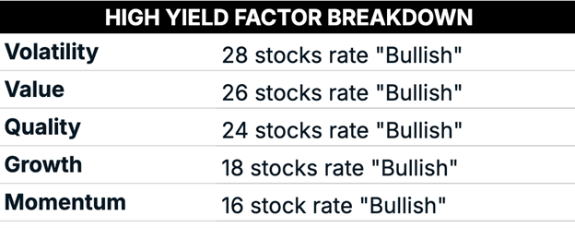

The sector rates well overall on its volatility and value factors, as 28 stocks rate as “Bullish” on volatility (a high volatility score indicates low volatility in the stock), and another 26 rate as “Bullish” on value.
This is exactly what I would have expected to see.
High-yield stocks tend to be buoyed by their dividends.
You see, since investors tend to buy them for the income, they’re less concerned if earnings per share growth beats or misses estimates by a couple cents.
Similarly, high-yield stocks are by definition value stocks. The dividend yield is a common valuation metric. The higher the yield, the cheaper the stock, all else equal.
The high yielders aren’t exactly slouches on the other factors, though… 24 rate as “Bullish” on quality and another 18 rate as “Bullish” on growth.
Surprisingly, given how badly bonds have sold off, 16 rate as “Bullish” on momentum.
They’re clearly bucking the trend here.
High-Yield Gems
Let’s dig into some of the individual high yielders to see if any potential opportunities stand out. I screened for the top 20 highest yielders, and this is what I found:
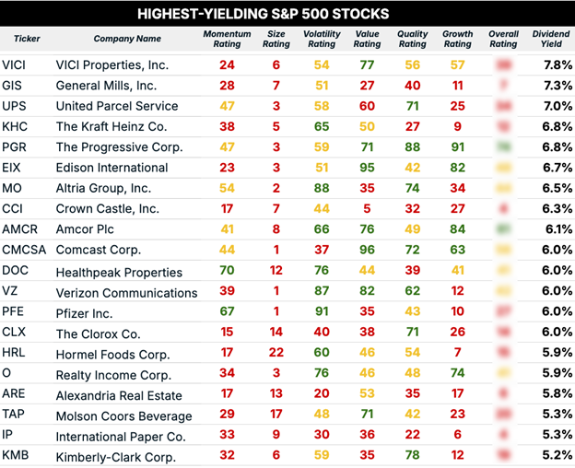

Many of the highest yielders rate as “Bearish,” and that’s understandable.
Often, the very highest-yielding stocks tend to have problems… and the market may even be pricing in a dividend cut.
For example, General Mills (GIS), which yields a monster 7.3%, has been struggling for years, along with most packaged food companies.
Inflation and changing consumer tastes have hurt sales and profits, leading the company to keep its dividend unchanged this year rather than raise it.
A dividend cut isn’t imminent.
But unless the company turns things around fairly quickly, it can’t be ruled out.
Among these top 20 yielders, we have only two “Bullish” stocks, insurer Progressive Corp (PGR) and specialized packaging maker Amcor (AMCR). Progressive and Amcor sport juicy dividend yields of 6.8% and 6.1%, respectively.
Keep in mind, Progressive pays a variable dividend that can change dramatically from year to year.
Meanwhile, Amcor tends to be a steadier payer and raises its payout by about 2% per year. It also rates well on its volatility factor, suggesting it wouldn’t be a bad place to park money in the event of a broader bear market.
Overall, my system doesn’t love this list of ultra-high yielders. But if we’re willing to forgo a percent or two in yield, we have a lot more “Bullish” stocks to choose from.
In particular, I’d call out pipeline operator Oneok (OKE) and resort owner Host Hotels & Resorts (HST), which yield 4.8% and 4.2%, respectively.
Both rate as “Bullish” overall and specifically rate as “Bullish” on their momentum factors. These are solid dividend payers that are trending higher.
Remember, as I noted earlier this year, Host Hotels was about as close to AI-proof as you can get. And I could make the same case for Oneok…
As I wrote back in February:
The “HALO” trade – heavy assets, low obsolescence risk – is the key to avoiding an AI wipeout. AI can wreck a software business, a law or accounting firm or even potentially a doctor’s office. But it can’t replace heavy machinery, raw materials or energy.
It also can’t replace prized trophy assets like luxury hotels and resorts. AI may soon create an economy of massive, virtually unlimited material abundance. But it can’t make a paradise on the coast of Hawaii appear out of thin air.
It was true then and remains just as true today!
To good profits,

Adam O’Dell
Editor, What My System Says Today

P.S. We switched things up a bit in today’s issue.
Instead of our usual sector X-ray, we looked at some of the highest-yielding stocks in the S&P 500.
So, we want to hear from you: Did you like this approach?
Would you like to see more X-rays like this, or do you prefer our usual sector breakdowns?
Your feedback is very important to us, so if you would like to share your thoughts about today’s issue, click here. We read every response, and your insight helps us decide what to put in future issues.