


There’s an idea from 1865 that I can’t stop thinking about.
Economist and logician William Stanley Jevons noticed something counterintuitive happening with coal.
As steam engines became more efficient and burned less coal per unit of work, you’d expect overall coal consumption to drop. Instead, it exploded higher.
Why? More efficient engines made energy cheaper to use, encouraging people to deploy them everywhere. Efficiency didn’t reduce demand – it multiplied it.
This became known as the Jevons paradox: when a resource becomes more efficient to use, total consumption of that resource often rises rather than falls.
Now, replace “coal” with “human cognitive labor,” and you start to see why a lot of people are very excited — and why I’m cautiously along for the ride.
The Bull Case for AI and Jobs
The bull case on AI and employment goes like this: AI makes knowledge workers more productive, lowering the cost of goods and services, expanding demand and creating new industries and jobs.
History, the argument goes, is on their side — automation has always created more jobs than it destroyed.
Apollo Global Management’s chief economist Torsten Slok has been pointing to data that supports this, at least in the near term…
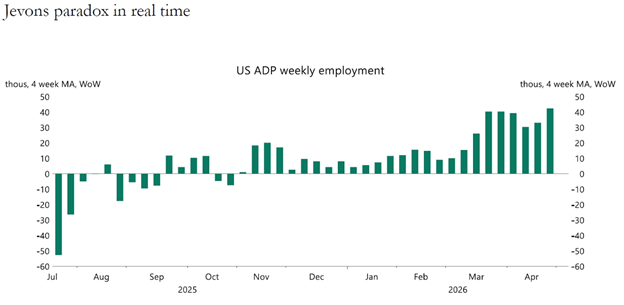

The first tracks ADP’s U.S. weekly employment data. After a rough stretch in mid-2025 — weekly numbers hitting nearly -50,000 at the worst point — the data staged a remarkable recovery.
By early 2026, it accelerated sharply, with March and April running 35,000 to 45,000 week over week. Whatever dragged on employment through summer and fall 2025, the labor market has shaken it off.
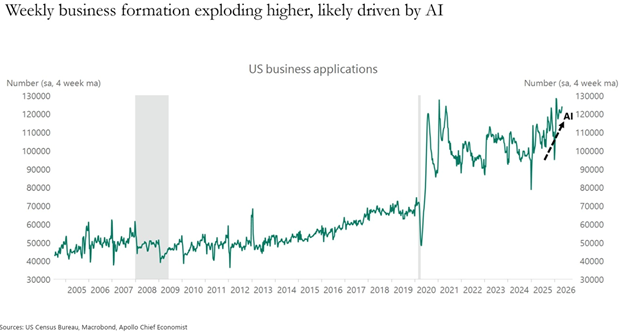

The second chart is harder to ignore. U.S. business applications have been on a long upward march since 2012, but around 2024, the line inflected sharply higher.
Apollo’s annotation says simply: “AI.” Weekly applications are now above 125,000 — well above any prior peak in the dataset since 2004.
The Jevonian interpretation writes itself: AI lowers the cost of starting a business, so more people start businesses, new industries emerge and new jobs get created.
On its face, that’s encouraging.
But a closer look reveals why I’m not ready to embrace the most bullish assumptions just yet…
Here’s Where I Am Skeptical
But here’s where I can’t quite drink the Kool-Aid.
The Jevons paradox works because expanded demand still requires more human labor somewhere in the chain.
The key assumption is that humans remain a necessary input. What happens when the efficiency gain applies to human labor itself — when AI doesn’t just make workers more productive, but begins to substitute for them outright?
The business formation data is fascinating, but it’s measuring applications to form businesses — not how many employees those businesses intend to hire.
My suspicion is that a meaningful chunk of this formation is due to solo operators now being able to do what used to require 20 people. That’s exciting. And it employs fewer people.
The Luddites were wrong about the timeline, but they weren’t wrong that their specific jobs were going away.
Lancashire weavers didn’t find comparable work in the factories that displaced them. Their children eventually did. Cold comfort if you’re the weaver.
Right now, we’re in a phase where AI primarily augments existing workers rather than replacing them — and the ADP numbers reflect that. But that not always going to be the case.
The inflection point where AI shifts from additive to substitutive in white-collar work hasn’t arrived yet. When it does, the question won’t be whether new jobs emerge. They will.
The question is who bears the cost of the gap, and how long it lasts.
What Our System Says About AI Stocks
So if you believe the AI wave is real — and the Apollo data gives you reason to — how should you think about investing in it?
The obvious play is something like the Global X Artificial Intelligence & Technology ETF (AIQ), which packages up the major AI infrastructure and software names into a single vehicle.
AIQ Earns “Bearish” Rating
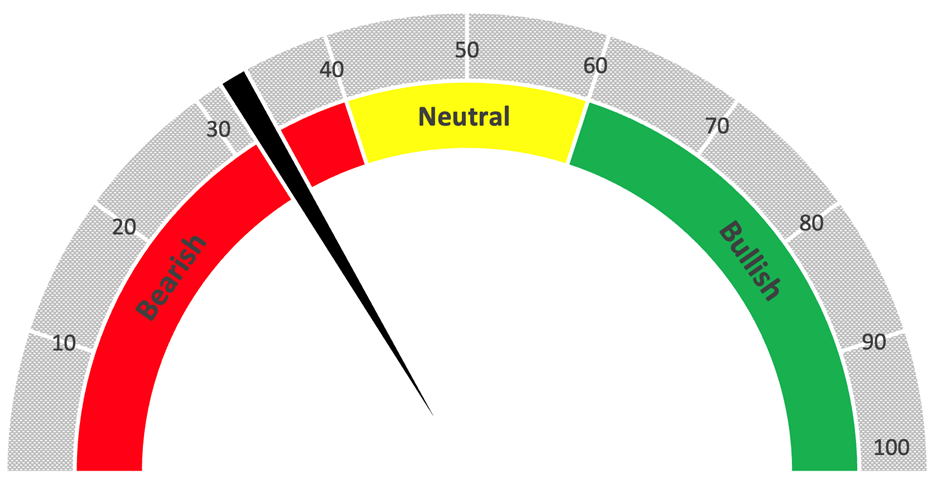

I ran the stocks held in AIQ through an X-ray using Adam’s Green Zone Power Rating. The result: AIQ rated: 32 out of 100. That puts it squarely in “bearish” territory.
That’s not a verdict on AI as a technology or a long-term theme.
It’s a read on where the ETF sits right now — momentum, technicals and the current risk environment.
Thematic ETFs like AIQ tend to front-run the narrative; by the time business formation charts are going parabolic and economists are writing optimistic reports, a lot of the easy money has often already been made.
A 32 rating says the risk/reward here isn’t favorable in the near term.
If you’re a long-term holder with conviction on the theme, that’s a different conversation.
But if you’re looking to enter a new position, our system says wait for a better setup. The story is compelling. The entry point, at this moment, is not.
That’s all from me today.
Until next time…
Safe trading,


Matt Clark, CMSA®
Chief Research Analyst, Money & Markets