



We might as well call 2026 the year of the “anti-AI” trade.
Investors aren’t worried that AI will be a flop. In fact, it’s the exact opposite of that.
They’re concerned that AI will work a little too well and disrupt large swaths of the white-collar economy.
In my experience as an investor, the more scalable and asset-light a business was, the better it tended to perform. Under this criterion, software is the perfect business.
It’s infinitely scalable, as the cost to reproduce code is literally zero, and extremely asset-light. A software company could be created in a dorm room or on a kitchen table with virtually no investments.
In 2026, that dynamic is being turned upside down. Suddenly, “new economy” companies are at risk of major disruptions, while “old economy” companies look like the better bet because they’re less likely to be made obsolete by AI.
If anything, they’re poised to benefit from AI’s productivity enhancements.
We’re seeing the HALO trade – heavy assets, low obsolescence –play out in the relative performance of the S&P 500 Index’s sectors.
The State Street Technology Select Sector SPDR (XLK), a collection of technology stocks in the S&P 500, is down nearly 4% due to a bloodbath in software stocks at risk of being made redundant by AI tools.
Moreover, the State Street Financial Select Sector SPDR (XLF) is down more than 7% as a result of fears that a more efficient AI-enhanced economy will whittle away the profits enjoyed by financial “middle men.”
Meanwhile, the sectors not easily disrupted by AI are roaring ahead.
The State Street Energy Select Sector SPDR (XLE) is up more than 23%… the State Street Materials Select Sector SPDR (XLB) is up over 16%… and the State Street Industrials Select Sector SPDR (XLI) is up a respectable 13%.
Now, let’s turn to industrials…
This is a broad sector that covers large swaths of the economy. It has been feeling the weight of the ongoing trade war and constantly shifting tariff policy. And as a resource-intensive space, it has felt the brunt of inflation over the past several years.
On the other hand, it’s also a sector that is mostly AI-proof – making it a HALO sector.
So, let’s do a sector x-ray and dig into the details.
A Peek Under the Hood
The HALO trade is still in its infancy…
It’s important to remember that fundamental data like earnings, profitability, etc., is backward-looking.
As I mentioned, the past several years of inflation and trade instability have been tough on the industrial sector.
That’s why we aren’t surprised that 28 out of the 67 stocks in this space rate as “Bearish” on my Green Zone Power Ratings system and another 16 rate as “Neutral.”
The good news is, we still have a solid 23 that rate as “Bullish.”
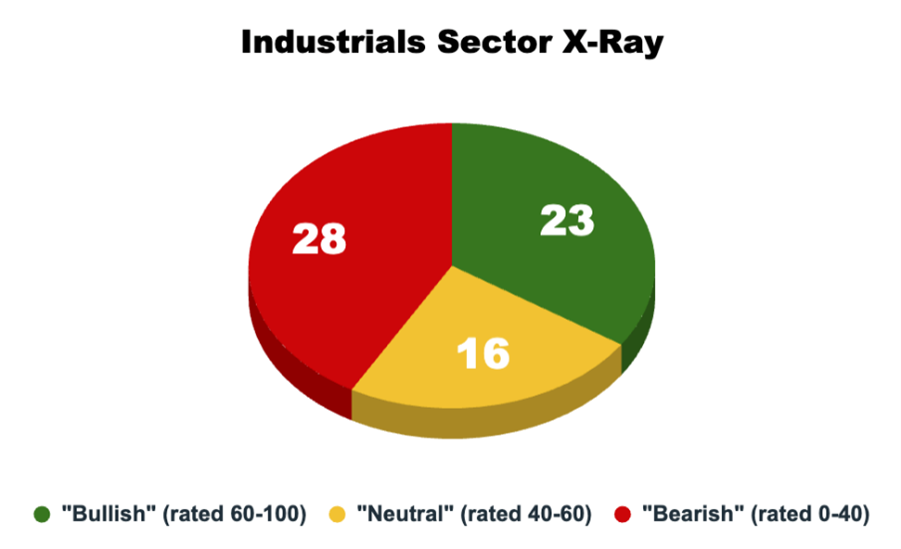

Let’s keep digging into my system to understand which factors are driving the ratings.
Where Do Industrials Pick Up Points?
Here’s something that really jumps off the page: 61 out of the 67 industrial stocks rate as “Bullish” on my quality factor.
My quality factor is a composite of several proprietary measures of profitability, balance sheet strength and capital efficiency.
Given the brutal competition and other low-cost producers in this sector, American industrial companies had little choice but to up their game. If you can’t compete on price alone, you have to deliver a better, higher-quality product.
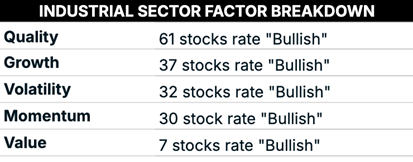

Industrials also tend to pick up points on my growth factor.
More than half rate as “Bullish” on growth, and another 32 rate as “Bullish” on volatility. (Remember, a high volatility score means that the stock exhibits low volatility. Its price doesn’t bounce around all that much.)
If the sector has a weakness, it would be valuation. Only seven stocks rate as “Bullish” on my value factor.
Top-Rated Industrials
Let’s take a look at some of the top-rated stocks in this sector.
Some of these names will look familiar, as they were the strongest performers from last week that I highlighted in yesterday’s issue.
HVAC and plumbing provider Comfort Systems USA (FIX), logistics expert Expeditors International of Washington (EXPD) and military shipbuilder Huntington Ingalls Industries (HII) all made yesterday’s list.
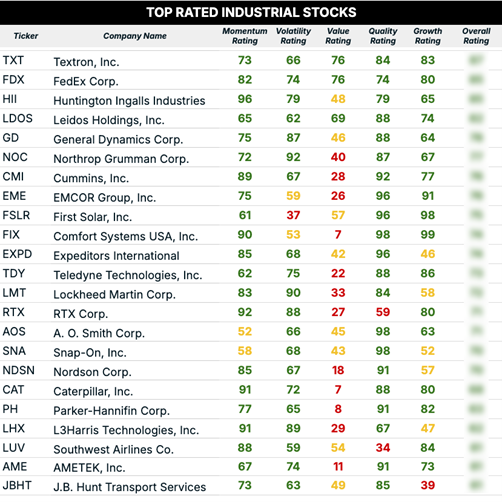

You’ll also notice some familiar defense industry leaders like Lockheed Martin (LMT), General Dynamics (GD), Northrop Grumman (NOC) and RTX Corp (RTX).
Another real standout was Caterpillar (CAT) – the premier manufacturer and seller of heavy-duty construction equipment. CAT shares are up a whopping 33% year to date and rate “Bullish” across momentum, volatility, quality and growth factors.
Caterpillar is the ultimate HALO stock. Its assets are about as heavy as you can get, and it’s at virtually zero risk of obsolescence from AI. ChatGPT can’t dig a hole.
And when autonomous machines do get to the point where they can run a construction site without human supervision, they’re still going to need Caterpillar’s heavy-duty machines to complete the job.
To good profits,

Adam O’Dell
Editor, What My System Says Today
