



OpenAI and Anthropic really rattled the market with their calls over the weekend to slow down AI development.
After all, so much of the bullish narrative of the past few years has centered on an ever-bigger investment in chips, power, memory and everything else that makes a data center possible.
Here’s the truth…
The pleas might have been due to legitimate concerns… or might have been a cynical play to limit competition.
Either way, AI development isn’t slowing down.
It can’t.
This is a winner-take-all market, so the major players involved have little choice but to continue spending.
So, the hyperscalers will keep on hyperscaling.
But we don’t have to stick to the status quo.
In fact, we’re going to do things a little differently today.
Rather than focus on a single industrial sector of the S&P 500 Index, we’re doing an X-ray of the “Magnificent Seven.”
This way, we can see whether the recent sell-off in tech has created any opportunities in the main stocks representing the AI boom.
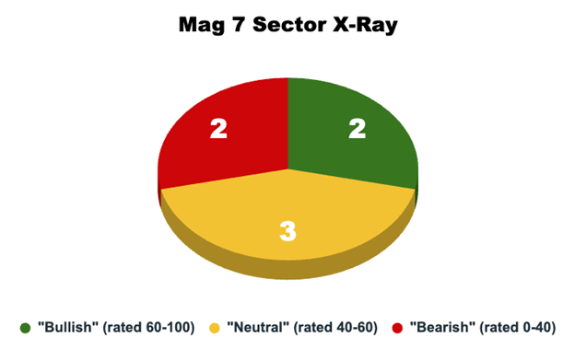

Looking at the Mag 7 from the top down, this doesn’t exactly look like a generational buying opportunity…
Only two of the seven rate as “Bullish,” meaning a score of 60 or higher out of 100. (For those new to my system, “Bullish” rated stocks outperform the S&P 500 by double on average over the following year.)
Another three rate as “Neutral,” meaning my system would expect them to perform more or less in line with the broader market. And the last two rate as “Bearish,” meaning my system would expect them to significantly underperform the market.
Let’s keep digging.
Where Do Mag 7 Stocks Pick Up Points?
The Green Zone Power Rating system is a composite score based on six primary factors: momentum, size, volatility, value, quality and growth, each of which comprises several sub-factors. (As we are looking at seven of the largest companies in the history of the stock market, we’ll ignore the size factor in doing this sector X-ray.)
So, where do the Mag 7 pick up the most points?
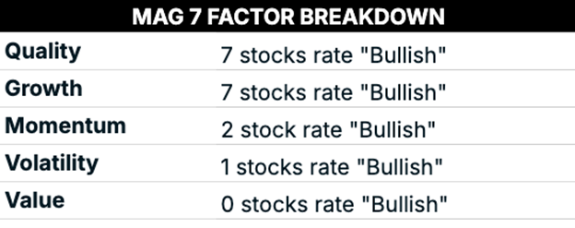

Impressively, all seven rate as “Bullish” on both their quality and growth factors.
Growth is self-explanatory.
Unless you’ve been living under a rock for the past five years, you’re well aware that these seven companies have been earnings compounding machines.
Remember, the tech sector that naturally favors a small number of dominant platforms.
The Mag 7 is comprised of the companies that own the platforms.
Quality is a little more nuanced, so let’s unpack that.
My quality factor is a composite based on various measures of profitability, balance sheet strength and asset turnover. It favors companies with high margins, low debt and an “asset light” business model.
The Mag 7’s exceptionally high quality ratings may be at risk.
To start, they’re a lot less asset-light than they used to be.
The massive investment in infrastructure is making them look downright asset-heavy… and they’re funding it with a massive wave of borrowing.
Collectively, they’ve borrowed about half a trillion dollars, with $200 billion of that coming over just the past two years.
Unless they’re able to quickly convert that investment into profits, high depreciation and interest costs will begin eroding profitability.
Let me be clear… These are still some of the highest-quality companies in the world. Six out of the seven boast “Strong Bullish” quality ratings over 80, and five have ratings in the high 90s.
Unfortunately, they performed poorly on the other factors. Only two rate as “Bullish” on momentum, one on volatility and none on value.
They’re great companies…
But right now, as a group, they aren’t leading the market higher. Their stock prices have gotten choppy, and they’re not cheap.
Breaking Down the Mag 7
Let’s break down the factor scores for each company to see what jumps off the page.
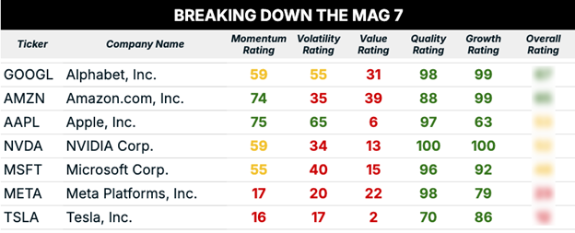

The two “Bullish” rated stocks of the group are Alphabet (GOOGL) and Amazon.com (AMZN).
Both are hyperscalers and owners of two of the three largest cloud computing platforms. They’re also actively developing and selling their own AI server chips.
In other words, both are absolutely critical to America’s AI infrastructure.
Apart from its infrastructure, Alphabet is also the developer of Gemini, one of the leading large language models, which competes directly with ChatGPT and Claude.
The company most directly at risk from a slowdown in AI development is Nvidia (NVDA).
Again, there’s been no indication that a slowdown is happening, and Nvidia’s last earnings report beat Wall Street expectations by a country mile.
But as a pure hardware maker, Nvidia lives or dies based on capital spending by the other six stocks on this list.
The Mag 7 are crucial because, as a group, they make up over a third of the S&P 500 index.
But that doesn’t mean they are the only game in town… or even the game you should be playing.
In my Infinite Momentum Tech Titans portfolio, I’ve been riding the AI boom higher while mostly sidestepping the Mag 7. In the latest trading cycle, the portfolio gained 9% in just four weeks, beating the pants off the Mag 7’s 6.4% return.
That’s the point: You don’t have to own the biggest AI stocks to profit from the AI boom.
You just have to know where the momentum is actually going.
To good profits,

Adam O’Dell
Editor, What My System Says Today

P.S. The biggest investment clues aren’t always found in flashy headlines. They’re buried in corporate filings, government contracts and seemingly unrelated companies. Moneyball Economist Editor Andrew Zatlin believes one such paper trail has led to a particularly unusual opportunity.
On Monday, Zatlin will host a presentation to lay out the evidence connecting a Florida golf-course company, a proposed defense merger and President Donald Trump. He’ll also reveal the ticker he believes could give investors a way to position ahead of the September 30 catalyst