



I ran a defensive screener this morning before my coffee had even finished brewing.
I knew what I was going to find.
Utilities. Consumer staples. The companies that make your toothpaste, your canned soup, and the boring dividend stocks your grandfather had tucked away and forgot about.
But that’s not what came back.
Instead, our system formulated a list of oil tankers, gold miners and drillers.
I checked the results again.
Then I checked them one more time.
Because that’s not what “defensive” is supposed to look like. At least, not according to Wall Street.
What Everyone Gets Wrong About “Safe”
Ask most people to name a defensive stock, and they’ll point you to the kind of business that sells you something, whether the economy is booming or falling apart. Power. Soap. Soup.
That’s the story we’ve all been told.
But it doesn’t show the full picture.
You see, “defensive” was never supposed to describe what a company sells. It was supposed to describe how the stock behaves.
Does it move less than the market when things get rough? Does it hold its value while everything around it is bleeding? Does it pay you to sit tight and wait out the storm?
That’s real defense. And it has almost nothing to do with whether a company makes napkins or pumps oil.
Wall Street sells you the sector because it’s easy to explain.
Our system doesn’t care about easy. It just focuses on the numbers.
What I Actually Asked For
So here’s what I told our system to go find this morning. Not “boring companies.” Not “safe sectors.” Just a specific set of traits that add up to a stock that protects your money and pays you while it does it.
I asked for companies that are:
- Big enough to survive a bad year — a market cap over $3 billion. No tiny names that vanish in a downturn.
- Calmer than the market — a five-year beta under 1, meaning the stock swings less than the market does. That’s the whole ballgame for defense.
- Actually growing — sales up over last quarter and up over the same quarter a year ago. Defense doesn’t mean standing still.
- Raising the dividend, and fast — payouts growing more than 10% a year for the last five years. I want a raise, not a promise.
- Cheap — a price-to-earnings (P/E) ratio under 30, and real earnings behind it.
- Paying me to wait — a dividend yield north of 1.5%.
Then I told it to show me only names that score in the top 20% across everything we track in the Green Zone Power Ratings system.
That’s a tall order. Most stocks fail on at least one count. A cheap stock usually isn’t growing. A fast grower usually isn’t cheap.
A calm, low-beta name usually doesn’t raise its dividend by double digits. Asking for all of it at once is how you separate the real thing from the pretenders.
Ten names cleared every hurdle.
Here’s What Came Back
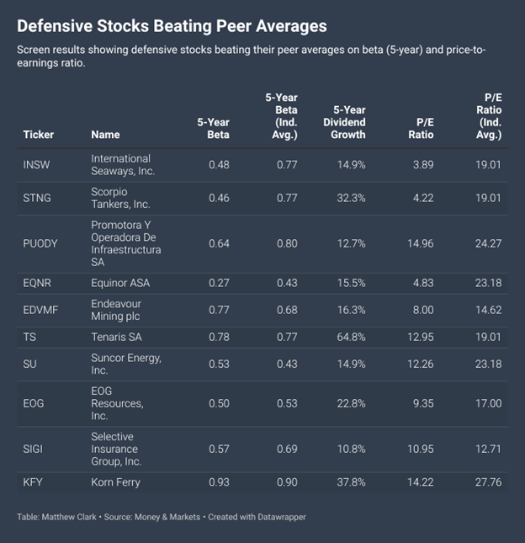

Look at that list for a second. Oil tankers. An offshore driller’s favorite pipe-maker. A gold miner. Two of the biggest energy names on the planet. An infrastructure operator. An insurer. A staffing firm.
Not one utility. Not one bag of chips.
And yet, every single one of them moves less than the market. Every single one of them trades cheaper than its own industry — and I don’t mean by a hair.
Look at International Seaways Inc. (INSW), the tanker company at the top. It trades at a P/E ratio of 3.89. The average for its peer group is a little over 19.
You’re buying a growing, dividend-raising business for roughly a fifth of what the rest of its neighborhood costs.
Equinor ASA (EQNR), the Norwegian energy giant, carries a beta of 0.27. That means when the market lurches, this stock barely flinches — it moves about a quarter as much. That is a fortress dressed up as an oil company.
And Tenaris SA (TS)? It has grown its dividend at nearly 65% a year over the last five years. That’s not a typo.
That’s a company shoveling cash back to shareholders while trading at a P/E ratio of 13, well below the peer average of 19.
This is the part that Wall Street’s sector labels will never tell you.
Why This Is Happening
There’s a reason the market keeps mispricing these names.
Everyone “knows” energy is risky.
Everyone “knows” tankers are boom-and-bust.
Everyone “knows” mining is a widow-maker.
So the crowd slaps a scary label on the whole group and prices these stocks like they’re one bad quarter from zero.
But our system doesn’t read labels. It reads behavior. And the behavior here is boring in the best possible way — low volatility, growing sales, fat and rising dividends and a price tag a fraction of the peer group’s.
The market is charging you a “scary sector” discount for stocks that are quietly acting like the safest thing in your portfolio.
That’s the opportunity. It always is. The best deals live in the corners that everyone else is too nervous to walk into.
What To Do With This
A word of caution, because I owe you that.
These are not your grandfather’s defensives. They score defensively right now — calm, cheap, and paying you — but underneath, most of them are cyclical businesses.
Oil moves. Gold moves. Shipping rates move. So treat these like the value plays they are, not like a utility you tuck away and forget.
Know your exit before you buy. Size your positions so no single name can hurt you. And run your own eye over every one of these before you commit a dollar — this list is where the work starts, not where it ends.
But start it. Because a screen like this is exactly how you find the stocks the crowd is too scared to own and too lazy to check.
Until next time…
Safe trading,

Matt Clark, CMSA®
Chief Research Analyst, What My System Says Today
