


I have some exciting news to kick-start your week.
According to an indicator with impeccable accuracy, we’re virtually guaranteed to have a raging bull market for the rest of the year!
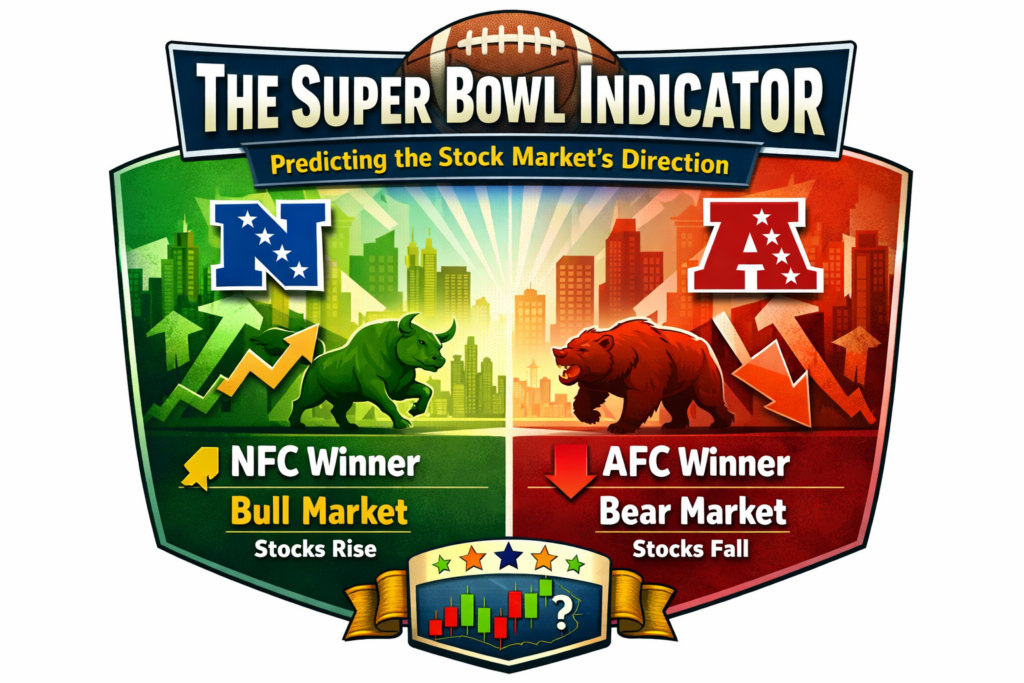
This week, the Seattle Seahawks – representatives of the National Football Conference (NFC) – beat the New England Patriots 29-13 in Super Bowl 60. And according to the Super Bowl Indicator, a win by an NFC team signals a bull market!
By now, it should be obvious that I’m joking.
I’ve built trading systems for more than 20 years now. And at the heart of every trading system is an identifiable market anomaly… one that we can exploit. But for a trading system to have any kind of durability, there needs to be a plausible reason for why the anomaly exists. If there is no plausible explanation for why a factor or set of factors works, then odds are that you’re just trading noise – finding false patterns in the data that don’t really exist.
For instance, let’s take another look at the Super Bowl Indicator.
Leonard Koppett, a sportswriter for The New York Times, “discovered” the Super Bowl Indicator in 1978. Koppett wasn’t serious, of course. It was created as a tongue-in-cheek joke, but he found that it had held true for 11 of 12 Super Bowl outcomes up to that point. And from 1967 to 2025, the indicator was accurate 71% of the time.
That’s highly impressive for a system that was made as a gag!
However, it’s only been accurate about 40% of the time since 2005. On a long enough timeline, you’d expect the indicator to be no better than a coin flip because there is no correlation linking the outcome of a football game to the stock market’s performance.
Now, let’s compare that to real factor investing…
My Green Zone Power Ratings system builds a composite score based on six primary factors: momentum, size, volatility, growth, value and quality. Each of these factors has been statistically proven to beat the market over time. But there is also an underlying logic as to why they beat the market.
Momentum stocks outperform over time because a rising stock price attracts new buyers, which helps push prices even higher in a virtuous cycle.
Smaller stocks outperform larger stocks over time because they have a longer runway for growth than large, well-established companies.
Low-volatility stocks command a premium over high-volatility stocks due to investors having a strong preference for safety. They also tend to have more stable underlying businesses.
I could go on and on, but you get the point. These factors outperform the market over time for reasons that pass a basic smell test. So instead of engrossing ourselves further in the unconnected worlds of football and trading systems, let’s jump into the market.
Last week was a wild ride. We saw technology stock earnings come in, AI leader Anthropic’s launch of its smartest model to date, and a continued repricing of assets after news of President Donald Trump nominating Kevin Warsh to be the next Federal Reserve chairman.
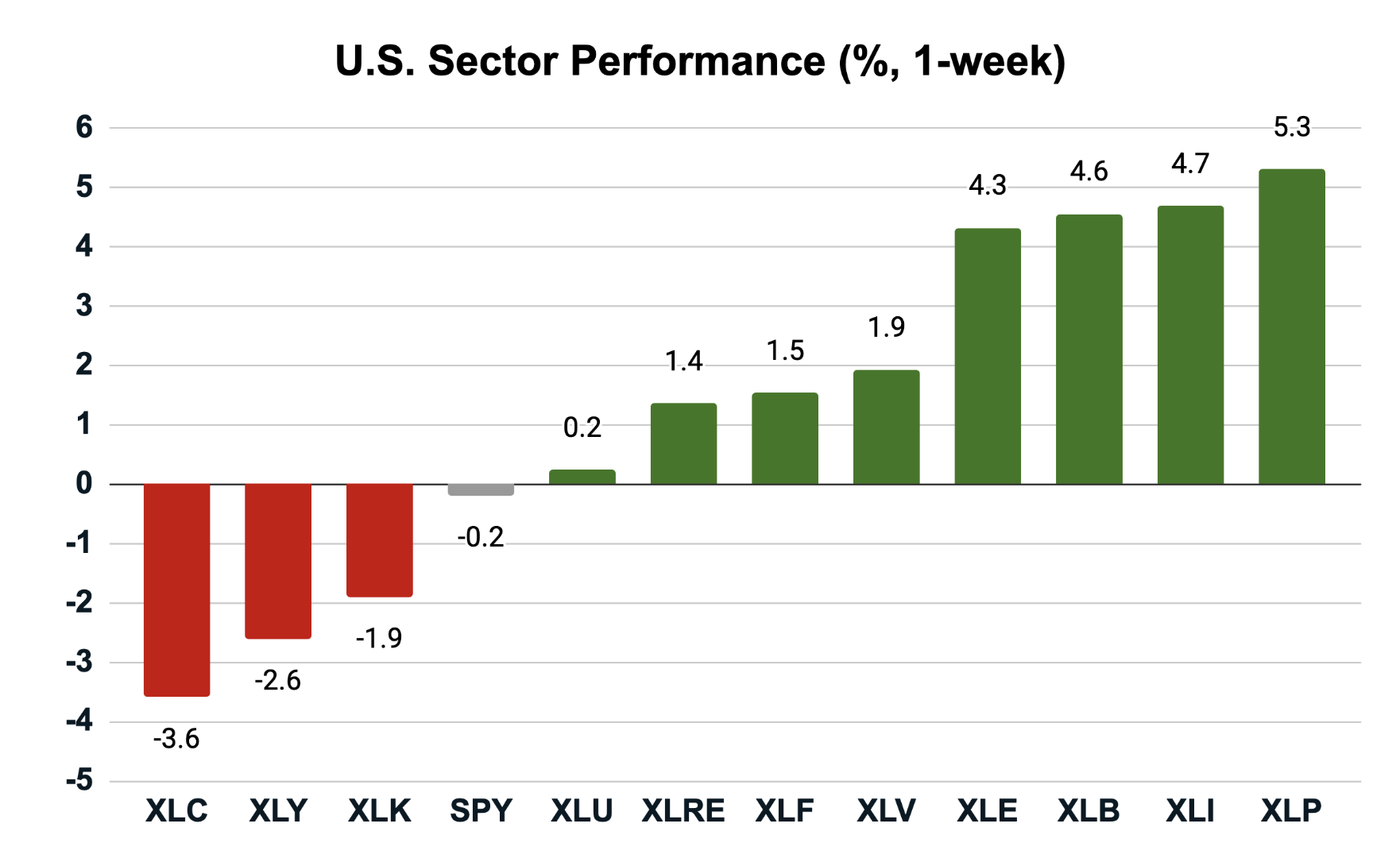

The best performing sectors were an interesting mixture of defensive and cyclical sectors. The State Street Consumer Staples Select Sector ETF (XLP) – historically one of the most conservative “haven” ETFs – was up 5.3%, followed by the State Street Industrial Select Sector ETF (XLI), the State Street Materials Select Sector ETF (XLB) and the State Street Energy Select Sector ETF (XLE), all up over 4%.
At the bottom of the heap was the State Street Communications Select Sector ETF (XLC), which was down 3.6%.
It’s always important not to draw too deep of a conclusion based on a single week of data and particularly when the data seems to be giving mixed signals. (Strength in industrials and materials generally point to an improving economy whereas strength in staples usually means investors are concerned about growth.) But there are definitely some insights to be gleaned here.
To start, energy, materials, industrials and consumer staples have been outperforming well all year. They are the four best-performing sectors of 2026.
Meanwhile, tech (and by extension communications, which has a lot of overlap with tech) has struggled.
The common tie that binds here is a valuation. Tech stocks have been massive growth machines for years, but their valuations are stretched and Wall Street is concerned that massive investment in AI infrastructure will erode their margins. Meanwhile, the “S&P 493” – the companies other than the Mag 7 tech giants – had been mostly forgotten about.
Key Insights:
- After years of dealing with inflation and cash-strapped consumers, consumer staples are showing signs of life.
- Non-tech cyclicals like energy, materials and industrials continue to perform well in 2026.
- Tech stocks are having a rough start to 2026.
Consumer Staples Back From the Dead
The past few years haven’t been kind to consumer staples. In a growth-crazed market, no one was interested in buying companies known for making basic necessities. On top of that inflation and tighter household budgets forced many consumers to trade down to cheaper white-label products.
The sector finally got cheap enough for investors to take notice. Staples caught a bid, and the sector is up a solid 13% year to date.
I ran my customary screen of the biggest movers last week that were also still within 10% of their 52-week highs. The idea is to look for strong, market-leading stocks that are getting stronger.
Here’s what I came up with:
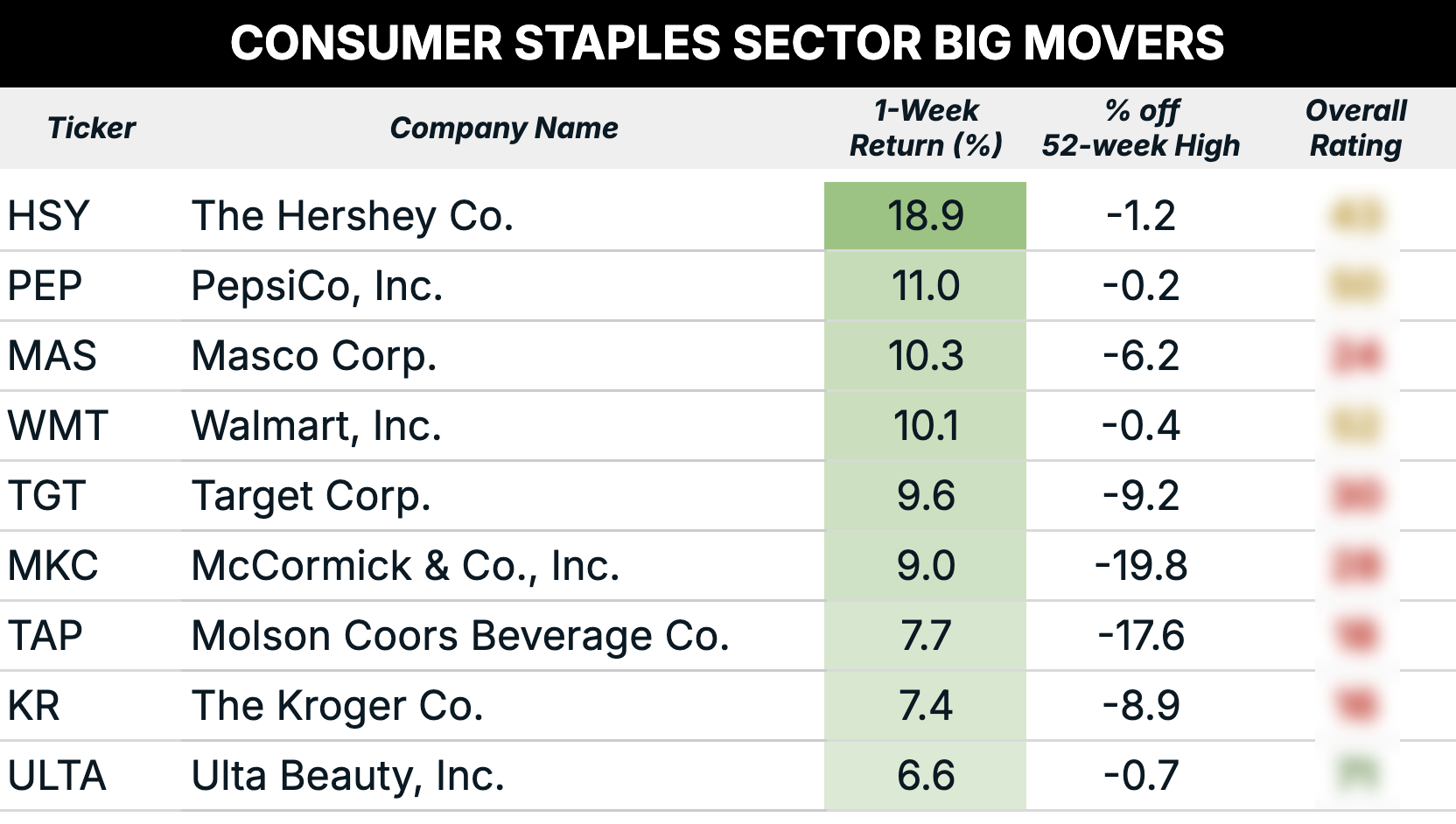

We see a familiar list of household product names, including Hershey (HSY), PepsiCo (PEP), and Molson Coors (TAP), as well as mass-market retailers like Walmart (WMT) and Target (TGT).
Walmart recently became the latest company to surpass $1 trillion in market cap, which is proof of both the company’s enduring strength as a retailer and the continued affordability crisis crimping American budgets.
So, might any of these be good buys?
I’ll do a longer deep dive into the sector tomorrow, but I can tell you that of the top performers from last week, only cosmetics company Ulta Beauty (ULTA) rates as “Bullish” on my Green Zone Power Ratings system. All the rest are either “Bearish” or “Neutral.”
Any Value in the Communications Rubble?
Venture capitalist Marc Andreessen famously said that “software is eating the world” back in 2011. Now the fear is that software is getting eaten by AI. A new update by AI firm Anthropic that showcased its coding prowess hit software stocks hard last week.
Is the selloff in software stocks overdone?
Let’s take a look.
I ran my customary screen of the sector’s biggest losers for the week that are still trading within 10% of their 52-week lows. The idea is to find a beaten-down gem that is poised to recover.
This is what popped up on my screen:
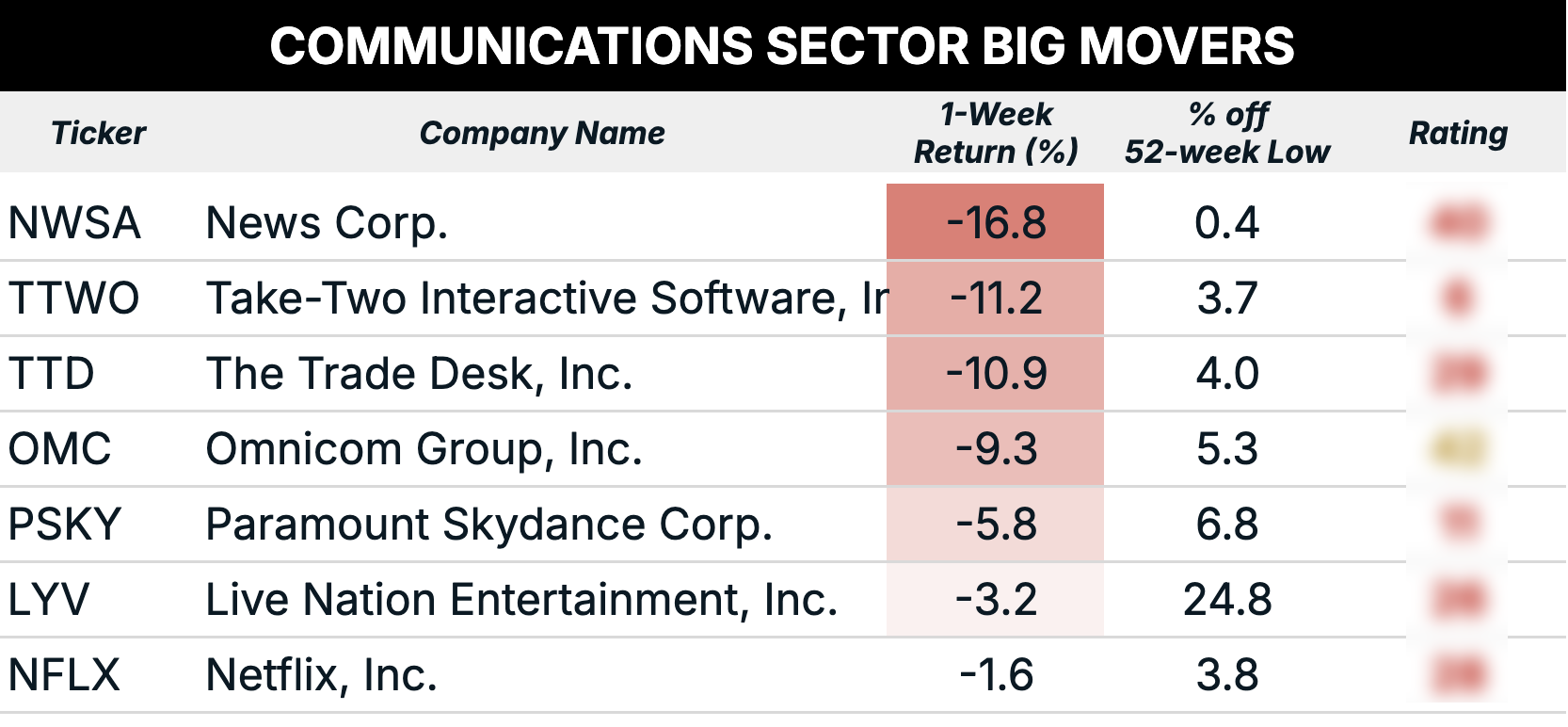

The biggest loser last week was News Corp (NWSA), the owner of Fox News, the Wall Street Journal and a host of other media properties. The woes facing traditional media are well known and not specifically tied to AI. But the damage across most of the rest was directly due to fears of AI cannibalizing their businesses. For example, video game maker Take-Two Interactive Software (TTWO) was down over 11% as investors fear the sustainability of a businesses in which gamers can effectively build their own games for free.
So, are any of these worth a look?
Not for now.
Every stock on the list is rated “Bearish” or “Neutral” on my Green Zone Power Ratings system. So, for now a little patience is warranted.
To good profits,

Adam O’Dell
Editor, What My System Says Today
