



What do we make of last week’s market action?
Only two sectors finished the week in the green – and they’re not sectors we’d normally expect to move together: technology and health care.
The State Street Health Care Select SPDR ETF (XLV) finished 1.8% higher, followed by the State Street Technology Select SPDR ETF (XLK) at 1%.
Every other sector finished in the red, with the State Street Utilities Select SPDR ETF (XLU) down a full 3%.
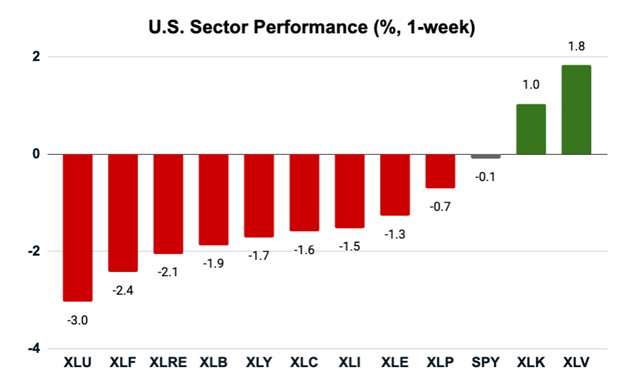

You’ve heard me say all year that as goes tech, so goes the S&P 500 Index. That certainly held true last week.
A strong performance in tech was enough to offset a nasty week across most of the market. And the S&P 500 finished the week essentially flat.
So, what are we to make of this?
The pop in health care seems to be a snapback from the previous week, when the sector was absolutely crushed. Tech’s continued strength also seems to be the result of investors getting comfortable with the AI trade again.
As for the weakness across the other sectors, take your pick of reasons…
The Federal Reserve just executed its first interest-rate hike since 2023 and indicated that more would be coming. Not surprisingly, rate-sensitive sectors like utilities, financials and real estate took the biggest hits last week.
Meanwhile, the Iran war is still dragging on, and global supplies of crude oil remain dangerously low.
So, what should we do as investors?
Let’s see what my system says.
Does Health Care Have Legs?
As I do every week, I ran my customary screen of the biggest movers in the sector that were still within 10% of their 52-week highs. The idea is to look for solid, market-leading stocks that are getting stronger.
Here’s what I came up with:
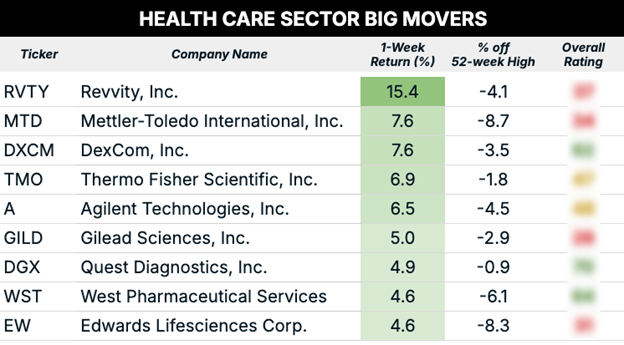

Health care has been the best-performing sector over the past several months. But my system is suggesting that a little caution is warranted here.
Only three of the nine stocks making the list rate as “Bullish” overall.
Just for grins, let’s take a look at those three to see if there are any common ties that bind them.
Dexcom (DXCM) is a medical device company known for continuous glucose monitoring systems that allow patients with diabetes to monitor their blood sugar without constant finger pricks.
Quest Diagnostics (DGX) is one of the largest clinical laboratory testing companies in the U.S. When your doctor or nurse sends your bloodwork to the lab, there’s a good chance Quest is the one receiving it.
Finally, West Pharmaceutical Services (WST) is a manufacturer of packaging components and delivery systems for injectable drugs — think vial stoppers, syringe components, etc.
What might all of these have in common?
To start, they’re all defensive stocks with very little sensitivity to the broader economy. Come what may, diabetics will still need to monitor their blood sugar, basic lab work will need to get done and syringes will need to be replaced.
All of these are also “AI proof.” Breakthroughs in medicine using AI aren’t likely to disrupt their businesses anytime soon.
And finally, none of these has execution risk. There’s no pending U.S. Food and Drug Administration (FDA) approval or clinical trials we need to worry about.
These are low-risk, established businesses providing basic medical necessities.
In a world in which AI is disrupting myriad industries, that makes them worth a longer look.
Buy the Dip in Utilities?
Utilities have a reputation for being particularly sensitive to interest rates. Many retirees use them the same way they use bonds: as a consistent source of income. When bond yields rise, bond prices fall… as do the prices of bond substitutes like utilities.
But utilities aren’t bonds. They’re businesses. And increasingly, they are businesses with major exposure to AI.
Increased electricity needs from data centers are forcing utilities to build out new capacity… and pressure from ordinary Americans struggling to pay higher bills makes it difficult for regulated utilities to raise prices enough to cover these higher expenses.
Still, after last week’s sell-off, might there be some opportunities to buy the dip?
Let’s take a look.
I ran my customary screen of the sector’s biggest losers for the week that are still trading within 10% of their 52-week lows. The idea is to find beaten-down gems that look poised to recover.
Here’s what I found:
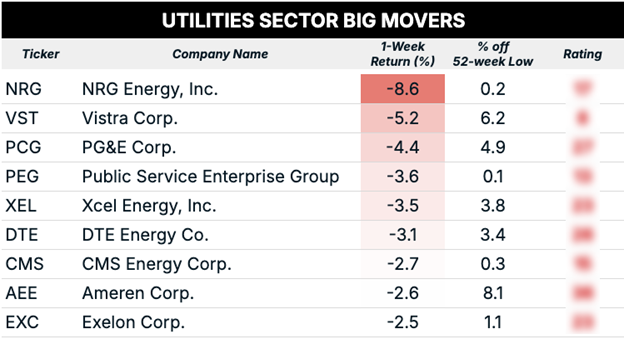

My system is sending a message loud and clear: Stay away from utilities for now.
Every single stock on the list rates as “Bearish” on my Green Zone Power Ratings.
This is a tough macro environment for the sector.
Structural forces outside the industry’s control are driving expensive new investment, even as political forces make it hard for the industry to actually profit from it.
And it’s all happening against the headwind of rising interest rates.
Utilities will have their day in the sun again. But it’s not today.
To good profits,

Adam O’Dell
Editor, What My System Says Today

P.S. The closer you look, the stranger this story gets. What appears to be a simple golf-course business is tied to a proposed defense merger, a little-known Nasdaq ticker and a connection to the Trump family.
Moneyball Economist Editor Andrew Zatlin has been following the trail — and he thinks the details point to something investors shouldn’t overlook.
That’s why tomorrow, Zatlin will host a presentation to reveal the ticker at the center of the proposed backdoor IPO, break down how the pieces fit together and explain why the September 30 transaction could be an important catalyst.