



Picture two guys having coffee this morning.
The first is a residential solar salesman in Phoenix.
He used to close deals almost by knocking on doors — the federal tax credit practically sold the system for him.
Now, he’s got a stack of leads that went cold when Congress let that credit die, and BloombergNEF is forecasting 15% fewer installations this year than last.
Business is rough.
The second guy is a portfolio manager who loaded up on solar stocks last summer. He’s up 115% in the past 12 months.
Same sector. Two completely different stories.
Today, I’m going to get to the bottom of why their results were so dissimilar.
The Stocks Are Flying — Just Not for the Reasons You Think
If you’ve been watching solar stocks rip higher this past year and are scratching your head, here’s the thing: this rally isn’t really about saving the planet or even energy policy.
It’s about data centers.
The AI buildout has a dirty secret — it needs a staggering amount of electricity. Every graphics processing unit (GPU) cluster spinning up to run large language models is essentially a small city in terms of power consumption.
When hyperscalers like Microsoft (MSFT), Alphabet (GOOGL) and Amazon (AMZN) sit down to figure out how to power their next hundred facilities, they’re signing long-term power purchase agreements for utility-scale solar at a furious pace.
Not rooftop. Not residential. Grid-scale.
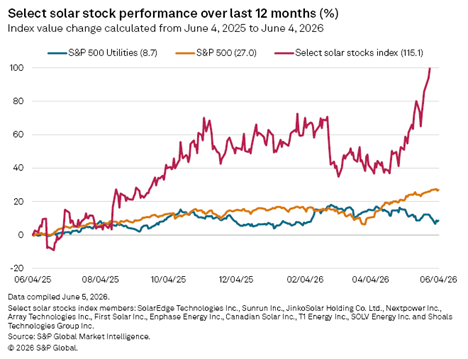

That’s what’s driving the 115.1% run in select solar stocks over the past 12 months — nearly quadruple the S&P 500 Index’s already-strong 27% gain.
The names leading this charge (First Solar, Array Technologies, Shoals, SOLV Energy) are almost entirely commercial and utility-scale players.
When a hyperscaler signs a 20-year power purchase agreement for a gigawatt of solar capacity, these are the companies that build, equip and connect it. They’re riding the AI energy wave, whether or not a single new rooftop panel gets installed.
The chart on stock performance tells the story. After a rough patch through early 2026 — when markets got spooked about interest-rate policy and the broader AI trade wobbled — solar stocks exploded higher.
We’re talking a near-vertical move into June that dwarfs both the S&P 500 and utilities.
This wasn’t a slow grind. Something clicked.
Meanwhile, the Rooftop Market Is Getting Killed
Back to our salesman in Phoenix.
After peaking at roughly 8.5 gigawatts of new residential installations in 2023 — a boom fueled by Inflation Reduction Act (IRA) credits — the home solar market has been losing altitude.
With the key residential tax credit now dead, BloombergNEF projects a 15% drop in new home installations for 2026. That’s not a blip. That’s a policy-driven reversal hitting a market that was already decelerating after the peak.
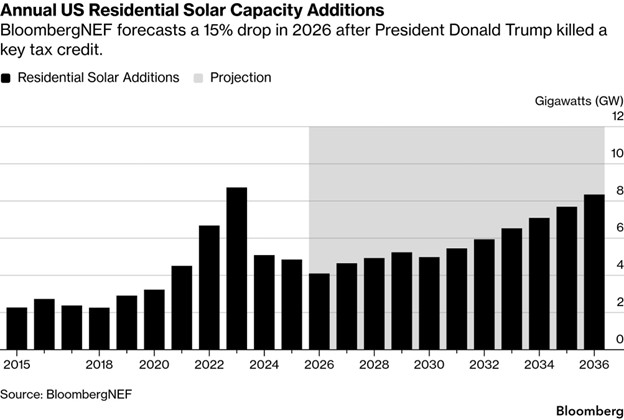

The long-term picture isn’t hopeless — projections show the residential market recovering through the 2030s as installation costs keep falling and battery storage becomes table stakes for homeowners.
But the near term is a genuine hangover, and the residential-heavy names in the solar universe have been the laggards even as their utility-scale cousins printed new highs.
It’s two solar markets living inside the same ETF ticker, and right now, the AI-commercial side is eating the rooftop side for lunch.
What My System Says: The X-Ray on TAN
So, with solar stocks up 115% in a year, what does Adam’s Green Zone Power Ratings system actually say?
Well, I conducted an X-ray of the Invesco Solar ETF (TAN), and the results weren’t unexpected.
TAN Rates Bearish
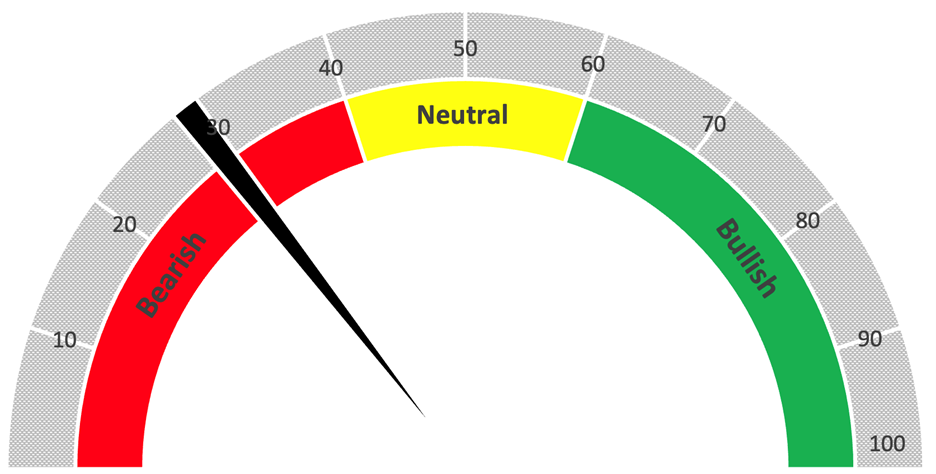

I know — counterintuitive. But this is exactly what the sentiment gauge is designed to catch: the moment when everyone already knows the good news.
Solar’s AI demand story is dominating headlines. The stocks have priced in a lot of optimism, and a 28 reading tells me the easy money has been made and the risk-reward balance has shifted.
This doesn’t mean the long-term thesis is broken — it isn’t.
The AI power demand story is real and durable, and the 10-year outlook for utility-scale solar is genuinely compelling.
But chasing a 115% move when sentiment is sitting at 28 isn’t how you build positions. That’s how you become exit liquidity for the portfolio manager on his second cup.
My read: watch the names that lagged the most recent surge — specifically the residential-adjacent players that didn’t fully participate in the spring rally.
If the broader AI trade gets a meaningful correction (and my system is watching that closely, too), solar will hand you a far better entry than what you see today.
The coffee’s great. I’d just rather wait for it to cool down a little before I drink it.
Safe trading,


Matt Clark, CMSA®
Chief Research Analyst, Money & Markets