


One of the most fascinating things about studying the job market is its constant evolution…
It’s not static.
New consumer tastes, new trends, and new technological breakthroughs are always driving the market incrementally forward into the future. So while we tend to compare results “year-over-year,” we also have to be aware that things are constantly in flux.
Sometimes, the changes are relatively small and they happen around the margins. Other times, we’ll see a singular breakthrough (like the introduction of the internet) with a far-reaching and transformative impact.
And that’s specifically the kind of breakthrough I’d like to talk to you about today…
Video transcript:
Welcome to Moneyball Economics. I’m your host, Andrew Zatlin.
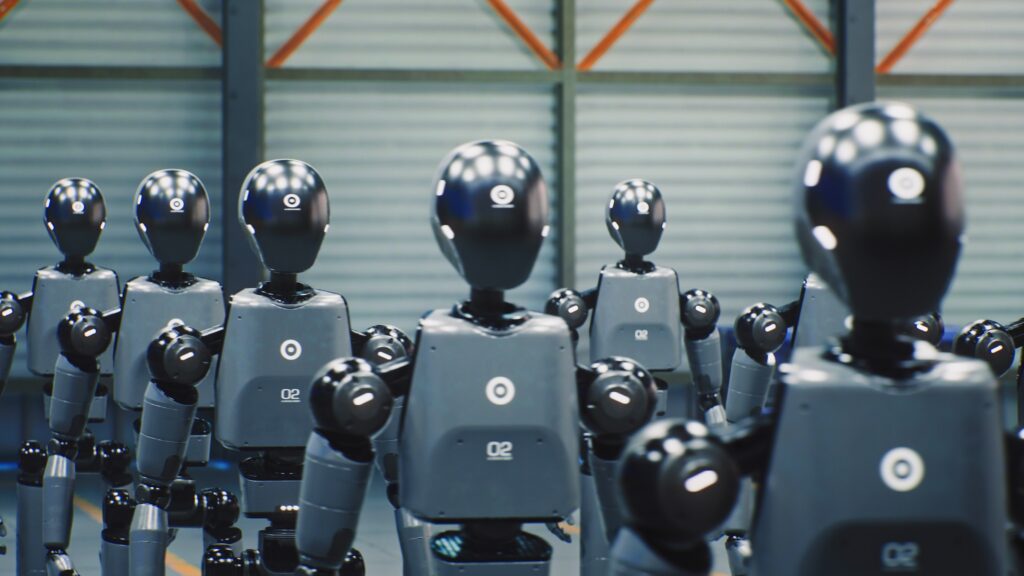
Today I would like to introduce you to the next trillion-dollar business opportunity.
I’m talking about humanoid robots, have a look at this video that comes out of Shenzhen China. This is a mixed martial arts competition for robots, and this happened last week. Take a look at the balance, at the dexterity. Look at how they can perfectly duplicate human movement.
Now, how do I go from a humanoid robot to a trillion-dollar business opportunity?
Well, the answer’s pretty straightforward.
Consider Amazon.com as one example from the business side of life. Amazon employs over 900,000 people around the world, most of whom are working in the warehouse. They’re sorting packages, they’re stacking boxes, they’re unstacking boxes, they’re moving boxes. And these are people who need breaks. They go on vacation, you have shifts, you have injuries and on and on and on.
Well, guess what?
A robot doesn’t need to take a break. A robot can work 24 hours a day, seven days a week. You could even dim the lights a little bit and save on electricity because robots have better vision. So you can see the appeal to companies.
I mean, this is replicating the history of the Industrial Revolution.
Eli Whitney, when he introduced the cotton gin in 1793, the cotton gin could get 50 pounds of cotton a day, whereas a human could only pick one pound a day. There is so much appeal to business, but the real market is household, a household domestic robot.
Consider this. All right, let’s use car washing as an example. Americans spend $20 billion a year roughly having their cars washed. The average American goes out and washes the car about once a month and a little bit more. Some do it more often, some do it less often, but about 600 bucks a year being spent on washing a car.
Okay. Well, what if Lexus gave you the following option? If you had one of these humanoid robots, you could download instructions on washing your Lexus. So Lexus could say, “Look, I know your exact model. In fact, I know any kind of customizations that you’ve done on it. I’m going to download instructions, digital instructions to your robot so that they know exactly how to wash that car. It’s going to look better than any person or machine did. Guess what? For another 10 bucks a month, I’ll throw in the interior instructions.”
So Lexus could say, “Hey, I’m going to make 25, 30 bucks a month off of every Lexus owner who is subscribing. And the Lexus owner is saving 25, 30 bucks a month as well, if not more.” See, what I’m describing with a humanoid robot is you’ve got the hardware platform and now you’ve got software subscription services.
Where have we seen this before?
Well, we’ve seen it on every other platform that’s come into existence.
Start with the TVs. TVs came out, there was free programming paid by advertising, and then you got cable channel companies coming out. Simple, the hardware, the software. Then you’ve got the PC coming out as a new platform. The PC, you’ve got the computer hardware, and then you’ve got an operating system, some of the software, and then you’ve got programs and other things. And then you eventually have the internet connectivity on down the line, lots and lots of money.
And then you’ve got the first trillion-dollar market, the smartphone. The smartphone’s combining a lot of the previous platforms with new stuff. You still get your TV, you get your infotainment and movies. Oh, you also get your ability to do whatever you need to do on the PC with being on the internet with tools, whatever you want.
And now you’ve got mobility and other things that the phone can do that is just fantastic. It’s the first trillion-dollar platform. Now, there’s an attempt right now to turn your car into a platform. I mean, you’ve got self-driving vehicles and you’ve got subscription services to cars in those vehicles. Let’s call it a living room on wheels. It’s taken off in fits and starts because let’s face it, a lot of liability, a lot of potential deaths associated with an auto-driving car, especially if you’re busy watching a movie when you should be driving.
What the humanoid robot does though is it’s a natural trillion-dollar market.
Right now, this robot’s only 25 grand or so. At scale, robots can come quickly down to $5,000. And you’ve got hundreds of millions of households out there that would look at this and say, “Wait, I’m paying Jimmy down the street to cut my gras 25, 50 bucks a week.
Why can’t I come up with some kind of methodology where my robot can cut the grass or clean the windows outside or vacuum and even dust or even clean my dishes? Go down the list of various menial tasks around the house that we are spending money on and you will find that we are spending roughly $100 billion a year, if not more, maintaining homes.
With a domestic robot, you no longer pay most of that money. It gets converted largely into subscription dollars, but there’s a win-win here. The hardware providers give you the robot. The software providers, well, they’re going to convert all these human actions and menial tasks into some kind of digital instructions. They’re going to make money and then you’re going to end up saving money because this robot’s going to pay for itself in two to three years at a price point of $5,000.
And imagine that price point continues to go down.
Now the operating system, well, right now the leaders are in China, but there’s room for stuff to happen here. Overall, this is a trillion, possibly $2 trillion market. The future is now. Everything that science fiction has predicted has arrived. We have a mobile robot. You just have to tell that robot what to do and that’s where it suddenly hits its stride. This isn’t going to be easy.
We’ve seen this before that it causes social disruption because we’re talking about the eradication of jobs in the millions. Consider how many people are employed cleaning. Almost a million people in the United States. Consider how many people are employed landscaping. Again, we are talking about almost three million people who are doing menial tasks in the United States and their jobs are now very much under threat in the next five years.
Why do I say five years? Well, because the business model has to emerge. The prices have to get down. We have to start seeing these subscription services and on and on and on. But these are low risk type of things. We’re talking three million jobs at risk.
Consider trucking and delivery services. You don’t necessarily need a humanoid robot. You could have a drone drop ship a lot of the packages. Or you could have a humanoid driver in a truck that comes in, moves the box to your front door and back. There are roughly, I think the number’s 3.2 million drivers and couriers right now in the United States. You’ve got two and a half million of them are long-haul truckers. You don’t necessarily need a humanoid driver here. You just need an automatic self-driving truck. I think those are a little bit further out, but it’s inevitable.
If you add it all up, there’s at least six million jobs in the United States that are likely to disappear in 10 years. This is hugely disruptive. These are people who are working who suddenly won’t have jobs. And it’s hugely disruptive because, well, let’s face it, they’re out of work. What are we going to do?
This is a large portion of our working base and of our economy. And the speed with which humanoid robots are going to be deployed is going to be a lot faster than we adjust to the speed of lost jobs. A trillion dollars is probably underselling the potential here in terms of dollars and windfalls, but there is a price to be paid.
Keep your eyes focused. I do not have at this time target companies that could leverage this opportunity, but they’re out there. This is like buying Nvidia at a dollar in my mind.
We’re in it to win, folks. Zatlin out.
Zatlin out.


Andrew Zatlin
Editor, Moneyball Economics