


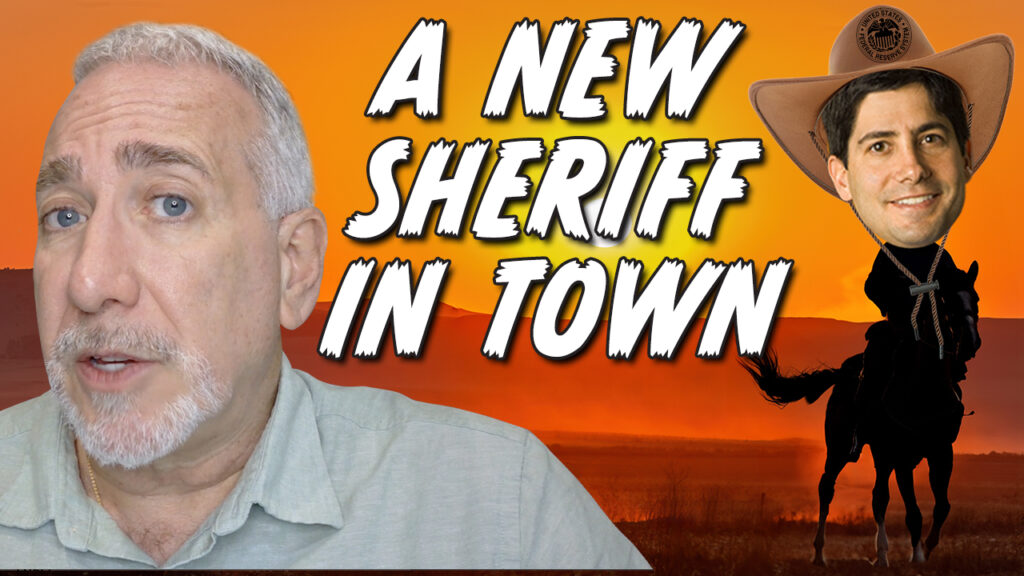
Hello, and welcome back to Moneyball Economics!
If you’ve been keeping up with me for any amount of time, you may have noticed a recurring topic that we keep coming back to from month to month:
I’m talking about interest rates.
Now, I realize that for most people, discussing Federal Reserve policy isn’t exactly exciting.
But speaking as a macroeconomist, that’s precisely what keeps so many investors from being more successful…
Because Fed policy is one of the most powerful, most fundamental forces driving the global economy. The Fed Chair’s words carry immense, immense power. Interest rate decisions can ripple throughout the economy — just like we saw in 2022, when Powell’s rapid rate hike cycle sent the market plunging.
To put it simply; few factors have contributed more to my success as Bloomberg’s #1 jobs market predictor than a close and studied understanding of Fed policy.
But keeping a close eye on Fed policy isn’t just an easy way to “take the market’s temperature.” It’s also a critical tool for decoding how those in power (both in Washington D.C. and in the halls of the Fed) currently feel about the economy, and what they’re planning to do next.
So let’s turn our attention back to the Fed ahead of Kevin Warsh’s official signing-in this Friday. Will he change Fed policy? Are we more likely to see rate cuts in 2026?
Hit the video below to find out:
Video transcript:
Welcome to Moneyball Economics.
I’m Andrew Zatlin and guess what? Got a new sheriff in town.
That’s right. We have a new chairman of the Federal Reserve Board, a guy named Kevin Warsh. He hasn’t been sworn in yet, but he’s the new sheriff.
And as the sheriff, he’s got to deal with some troublemakers in town.
Most specifically, he’s got to deal with what the macroeconomic data is saying about where we should be going with interest rates.
See, Warsh is coming in, he’s dovish. He wants to cut interest rates, but right now the data says it’s not the time to cut interest rates. You see, we’ve got not just a firm and firming up labor market, inflation’s back. Okay, the macroeconomic data is something he’s got to deal with.
He also has to deal with political pressure from Donald Trump. Look, there’s no doubt that Warsh and Trump came to some kind of mutual understanding about what the Fed should be doing and where interest rates should be going.
Yeah, during his hearing, Warsh was asked point blank, will you be a Trump sock puppet? In other words, will you just do whatever Trump says? And of course he says no, independent Fed, but it doesn’t matter. He’s a dove. Trump wants interest rates to be cut and you know there was some kind of understanding and agreement.
Well, another troublemaker he’s got to deal with, not just with the macroeconomic data and then the political pressure is, well, he’s got to deal with the markets and their expectations. That’s always tricky because the Fed likes to signal where they’re going without revealing their hand.
So he’s got to communicate quite clearly with the markets. And if the markets don’t like what they’re hearing, they tend to let you know. They tend to react pretty strongly.
And last but not least, he also has to deal with his own board of governors…
There are 12 voters that are governors and right now we have a House divided. See, in the last vote of the 12 voters, eight kind of agreed that interest rate cuts might be something worth talking about. Then you had one say, “Absolutely. We should be doing interest rate cut now. Now, now, now!” And then you had three saying, “Absolutely not. There’s no reason to do an interest rate cut. We shouldn’t even be thinking about it. It shouldn’t even be on the horizon.”
In other words, wink, wink, the time is coming for an interest rate hike.
So we have a house divided and he’s got to navigate that.
Well, why do we care about interest rate cuts? Well, quite frankly, interest rate cuts create economic boom times. Think of it this way. We have a lot of consumer and private sector debt. If you cut interest rates, well, you reduce the amount of money people have to pay to service that debt load and that frees up money that goes into the broader economy.
That’s one way it stimulates the economy.
Another is, well, when you cut the interest rates, you make the dollar less valuable.
That leads to a weaker dollar, which means your exports, well, they’re more competitive on the world’s stage and imports are a little bit costlier, which means people tend to buy more domestically. And then of course, if you do stimulate the economy and you do lower interest rates, the stock markets love that. They love, love, love that, especially the tech sector.
In any case, the equity markets take off, 401ks grow and a lot of people use their 401ks to borrow against to do things like buy cars, down payments on homes, home projects, you name it.
There are many ways that an interest rate cut ripples through the economy and stimulates it.
But the charter of the Fed is to not necessarily stimulate the economy because that can also create inflation, which eats away at people’s take home pay and what they can buy. It’s a balancing act. Well, this is where it gets interesting.
The traditional way we measure inflation is someone goes out and basically takes a look at this massive basket of goods and services and they track what’s the price of eggs this month versus last month. How much does an airplane ticket cost this month versus last month? And they take all this data, they crunch it and say, “This is inflation. This is how prices overall in this basket have changed.”
During his hearing, Governor Warsh introduced a new approach and guess what? It’s not coincidence that that new approach says the time has come to cut interest rates because inflation’s going down.
Let me explain the math because what you have is really a bunch of academics and statisticians fighting over the ball. So the traditional measurement, CPI, consumer inflation, this whole basket, but even then we recognize that some goods are more volatile month to month with price.
For example, food and gas tend to jump up and down a lot. And so the step that’s been taken with consumer inflation to date is to remove those components and talk about core inflation. If we take out the volatile elements of gas and food, which is about 20% of inflation calculations, we’re left with what should reflect the core trend of inflation.
Except even there, there are some problems.
For example, fuel prices, while fuel prices aren’t just entering the CPI calculation in one line item, gas prices at the pump, it enters in other ways. For example, airplane tickets go up or transportation fees go up because they got to pay more for their diesel fuel.
So it’s not entirely clean. You can’t sit here and say CPI calculations, boom, that is truth. There’s an alternative approach that has been taken by many of the Federal Reserve banks, like the Federal Reserve Bank of Dallas and Cleveland and so forth.
And they do what’s called a trimmed inflation calculation…
What they do is they stack rank every bit of the services and goods and they rank from the top the ones that had the biggest price moves all the way down to the bottom, the ones that had the biggest price drops.
In other words, they’re trying to rank and identify at the tail ends what things are throwing off that are just suddenly this month they shot up or they suddenly collapsed and it’s unrelated to the core trend because that’s where you want to go is what’s really going on.
Now this sounds good in theory. Take out the more volatile stuff that’s probably going to disappear next month and you’re left with the core. Each bank does it differently. Dallas, they trim about 24% off Cleveland about 9%. How much do you trim? How much of this volatility do you remove to get to the core? Hey, econometrics and all those statisticians out there can work on that. The idea though is to remove the volatility to get to core trend. That sounds reasonable, right? But there’s an aha thing here.
See, a lot of the things that have been moving up in price sharply are tied to one of two things.
Tariffs, because again, we slapped 50% and 100% tariffs on China. So that’s a lot of stuff we import. A lot of higher end goods like furniture, they rocketed up in price. HVAC systems, air conditioning units, things like that. They rocketed up in price pretty quickly.
Well, if you do trimmed, guess what? That goes away.
You no longer see the tariff impact in moving prices up. Same thing with gasoline. A lot of things that moved up like airplane tickets or transportation costs and services, those go away because again, they’re very volatile because the idea is the gas stuff that’s transitory.
The tariff stuff may or may not be transitory, but it’s bubbly and at some point in time it’s going to disappear. So we kind of want to ignore this. And so by doing a trend inflation, we get to the core inflationary trend because we’re ignoring all these little side events that are bubbling up.
And guess what? Trimed inflation is pretty low right now. It’s hovering around two 2.3%, pretty far removed from that 3% we saw last month. And that is where Warsh is going.
He’s going to move the goalposts. He’s going to say, going forward, we already use trimmed inflation at the various banks. We just don’t make it as high a priority. Going forward, I, the new chairman, am going to push for this new measurement. Oh, and look, it says inflation is flat and going down. Looks like we could do a rate cut.
Stay tuned folks, because if he gets his way and gets a rate cut, this stock market is going to go up that much further. And this is the kind of stuff that happens maybe by September or so.
Stay tuned because we’re in it to win it.
Zatlin out.

Andrew Zatlin
Editor, Moneyball Economics