



For the S&P 500 Index to sustain a move higher, it needs technology and communications stocks to participate.
This isn’t my opinion or preference for what I’d like to see.
It’s basic math.
As I pointed out in yesterday’s issue, tech and communications make up 43% of the index.
If you throw in Amazon (AMZN) and Tesla (TSLA) (which are currently classified as consumer discretionary companies despite their sprawling tech businesses), you’re within rounding error of half the index.
Meanwhile, energy and materials account for 6% combined.
So, as phenomenal as the returns have been this year in energy and materials (up 38% and 8%, respectively), weakness in tech and communications has pulled the broader market lower.
We’ve profited from that handsomely, of course, as my Green Zone Fortunes model portfolio is heavily invested in energy stocks (and was long before the Iran war started).
But for the millions of investors out there who depend on broad index funds that track the S&P 500 (or any cap-weighted index that owns American large-cap stocks), their returns are going to live or die on the performance of tech and communications.
So… how are they looking?
Let’s do a sector X-ray to find out.
Last week, I did a deep dive into the tech sector. Today, we’re going to do the same for the communications sector.
One thing to keep in mind is that these aren’t your grandfather’s communications stocks.
Not long ago, the biggest names would have been lumbering utilities like A&T (T) or Verizon Communications (VZ).
Today, the sector is dominated by some of the most innovative names in tech and social media. Google’s parent company, Alphabet (GOOGL), and Facebook and Instagram parent Meta Platforms (META) together make up close to 40% of the communications sector.
So, with that in mind, let’s dive in!
A Peek Under the Hood
2026 hasn’t been a strong year for communications, as reflected in the Green Zone Power Ratings.
Only two stocks in the entire sector rate as “Bullish,” meaning they have a score of 60 or higher. Eight more rate as “Neutral.” And fully half, at 10, rate as “Bearish.”
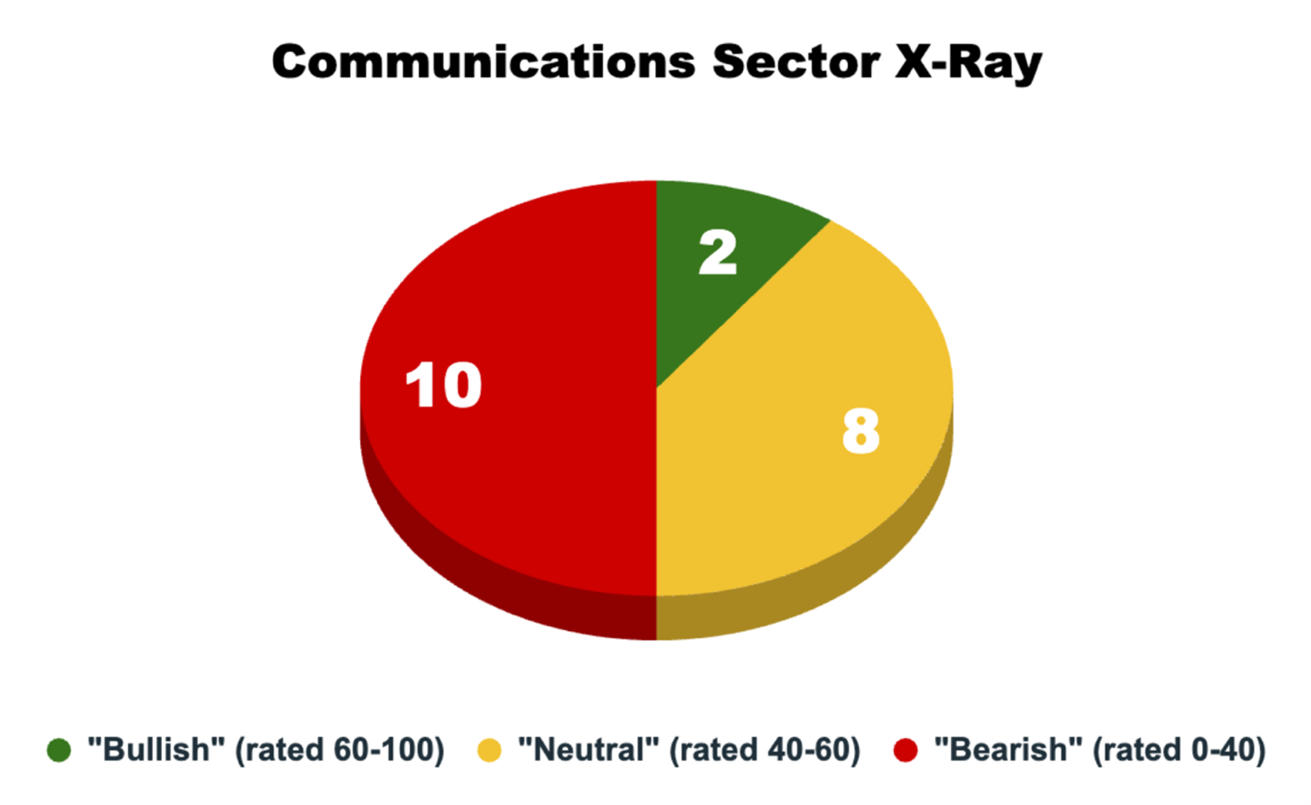

Overall, my Green Zone Power Ratings system suggests this isn’t a time for broad exposure. As was the case with tech stocks last week, we really need to pick and choose carefully.
Where Do Communications Stocks Pick Up Points?
Let’s keep digging for insights.
The Green Zone Power Rating is a composite score based on six primary factors: momentum, size volatility, value, quality and growth, each of which is composed of several sub-factors. (As we are looking at large-cap constituents of the S&P 500, I don’t consider size when doing the sector X-ray.)
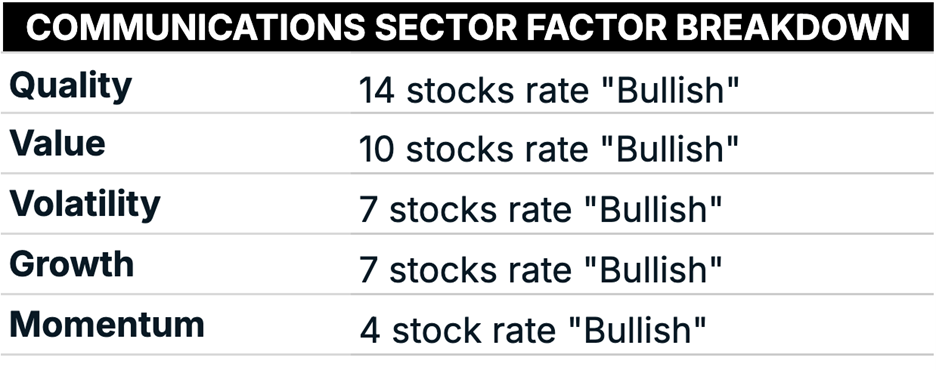

Interestingly, quality is the most “Bullish” factor, with 14 out of the 20 stocks posting factor ratings of 60 or higher.
This demonstrates how this sector has evolved over the years.
My quality score is a combination of profitability, balance sheet strength and capital efficiency. It tends to favor “asset light” businesses that don’t require a lot of ongoing physical investment, like software, services or consumer brands. “Asset-heavy” businesses like utilities generally rate poorly on quality.
The exceptionally high number of stocks rated “Bullish” on quality shows how the communications sector has shifted from an asset-heavy one to an asset-light one. (If you scroll below to the next chart, you can see that AT&T and Verizon are two of the lowest rated in terms of quality, whereas Alphabet and Meta both have incredible quality ratings of 99.)
Half of the stocks in the sector rate as “Bullish” on value, and seven each rate as “Bullish” on volatility and growth. But only four out of 20 rate as “Bullish” on momentum… an indication of how poorly communications stocks have performed this year.
Looking for Gems in the Rough
I screened for the 10 communications stocks with the highest Green Zone Power Ratings. Let’s see what information we can glean from the list.
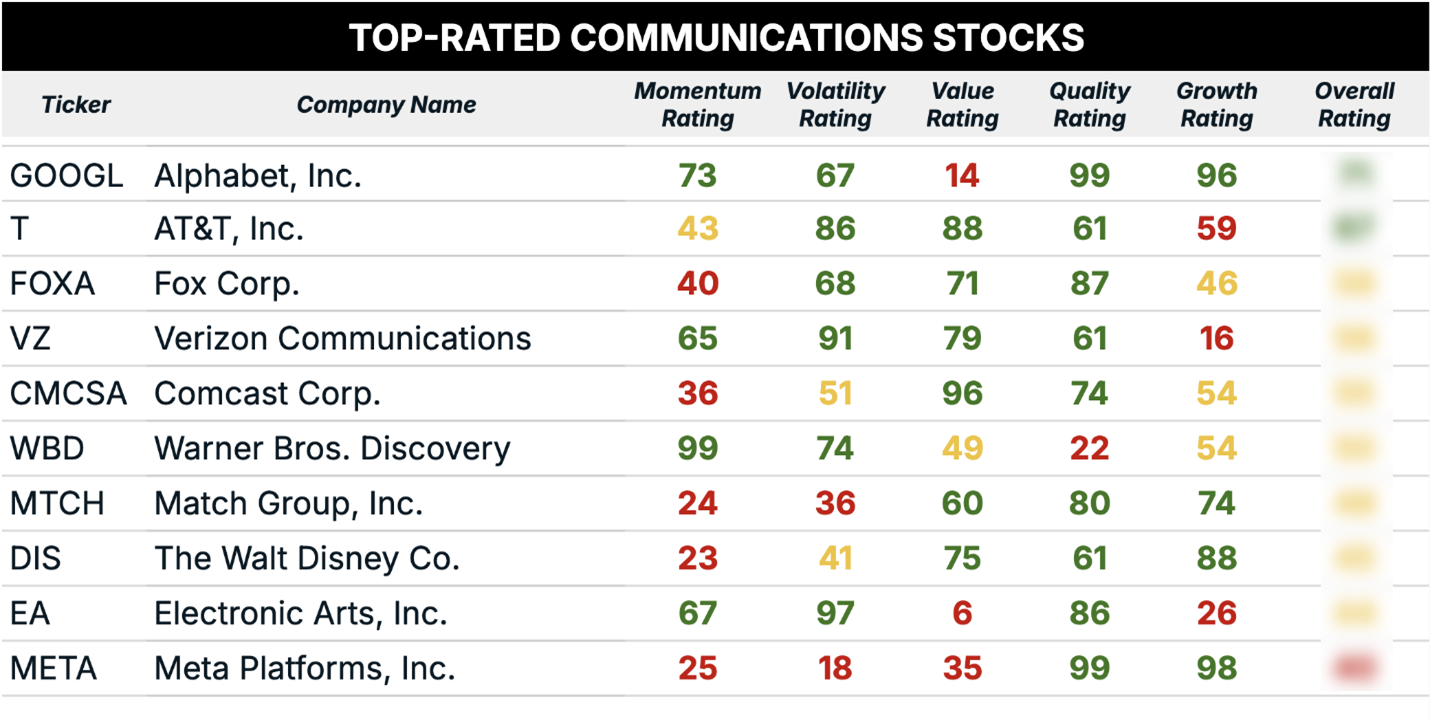

As I mentioned yesterday, Alphabet rates as “Bullish.” But it’s been a rough year for AAPL shares. They’re down 10% year to date and about 20% from their recent highs.
There may also be some headline risk in the shares due to ongoing litigation. A Los Angeles jury recently found Alphabet and Meta liable for $3 million in damages in a landmark social media addiction case.
While $3 million is the equivalent of loose change in the couch cushions for these tech giants, there is mounting risk that the legal cases snowball into something like the 1990s Big Tobacco settlement.
Given the company’s strong position in AI – and its “Bullish” Green Zone rating – I would view any lawsuit-related dips as a possible buying opportunity.
On a side note, Alphabet was in the news this week for another reason. Google unveiled TurboQuant, a compression algorithm that reduces AI memory usage by up to sixfold without sacrificing accuracy.
This was bad news for memory chipmakers, of course. But it’s fantastic news for the AI revolution.
The high cost and limited availability of memory chips were bottlenecks slowing development. Anything that makes AI training and usage more efficient is another reason to be bullish.
Interestingly, the only other “Bullish” rated stock in the communications sector is stodgy, old AT&T.
You’re not going to get much in the way of growth from AT&T, as its internet and mobile businesses are mature. But the stock is cheap – with a value factor rating of 88 – and conservative. Its volatility rating of 86 means that it tends not to move all that much relative to the market. It also pays a dividend of close to 4%.
So if the Iran war continues to drag on, a stodgy utility like AT&T might be some nice, low-risk ballast for your portfolio.
To good profits,

Adam O’Dell
Editor, What My System Says Today

P.S. The biggest opportunities don’t show up when everything looks strong. They appear when leadership quietly rotates… and most people are still looking the other way.
But by the time this trend is obvious, the easy gains will already be gone. That’s why I’ve designed a unique system that shows where capital is quietly moving — and signals when to position for the next big shift, long before it hits the headlines.
And in a recent LIVE presentation, I detailed exactly how you can use it to navigate today’s market turmoil. Click here to catch up on the full details…