


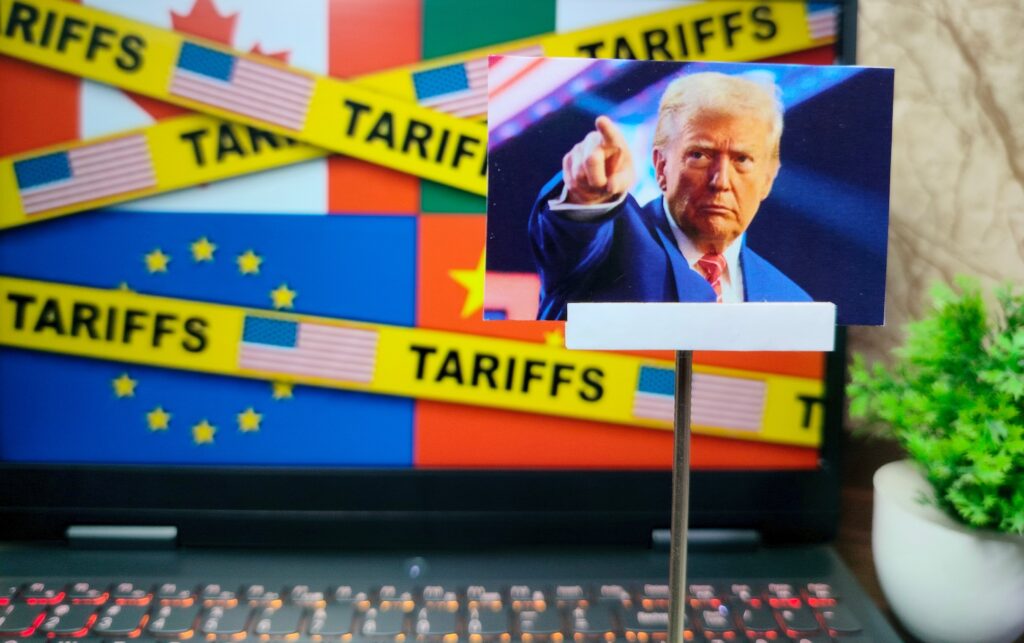
In our last episode of Moneyball Economics, we talked about the surprising success of Trump’s “Liberation Day” tariffs — transforming America’s balance of trade practically overnight.
This is a truly massive story, not just in terms of headlines but also the sweeping macroeconomic impact it’s going to have.
So today, I wanted to follow up with more details on exactly how this all happened … and where we’re headed next…
Click the video below to get started:
Video transcript:
Welcome to Moneyball Economics.
I’m your host, Andrew Zatlin, and today I’m going to take us into some taboo waters…
See, today I want to share with you some good news. I want to share with you some uplifting economic data. And I call that taboo because in today’s world, aren’t we supposed to only see doom and gloom? I mean, aren’t we supposed to be outraged 24-7?
Well, my problem with that is I can’t trade outrage and doom and gloom is not going to help me get a better return on my investments, but you know what will? Having good finger on the pulse of the economy, knowing what’s really going on and trading it accordingly.
So with that in mind today, I would like to focus on something foundational, the US balance of trade…
The balance of trade is basically taking how much we’re exporting, how much we’re importing, and that’s basically where we are. If we are in a positive territory like China, we’re building wealth and that wealth helps to make our currency stronger and helps us to build for the future.
Unfortunately, for exactly 50 years since 1976, the US has been running a deficit.
We basically buy a lot more than we sell. So that’s a perennial problem because historically speaking, this is where nations and empires collapse when they can’t service the debt. Right now we’re servicing the debt by basically pumping out loans. The US treasuries are now up to I think $26 trillion. We are borrowing against the future to maintain our lifestyle today. And historically speaking, that has never been a recipe for success. And so our adversaries are enabling it a little bit so that they can hasten our decline.
In fact, speaking of decline, this is exactly the mindset that an Obama and a Biden had. They looked at the math and said, “Well, we are an empire in decline. We just want to manage that a little bit.”
Donald Trump in his first administration and in his second one, he’s kind of pushing against that narrative. He doesn’t think we are an empire in decline, and he took action last year from a trade perspective via tariffs and from an industrial policy standpoint by enabling and subsidizing certain things to try and arrest this massive decline, to try and not just slow down, but reverse our trade deficit.
So here we are a year and a half into his second administration. How are things going? How did the tariffs help or hurt? How has industrial policy helped or hurt?
Well, it all comes down to are we selling more or less? Are we buying more or less?
And the short answer is we’re buying less and selling more.
In fact, it’s substantial…
There’s a little bit of challenge here as we go through the numbers. Remember last year with the tariffs, there was a lot of front-running. Basically companies went out and they bought a lot of stuff earlier in the year to offset what was going on with the tariffs by now at a lower cost before the tariffs jack up the prices a lot.
And so I don’t necessarily want to compare this year to last year. I want to compare this year to the pre-Trump year, 2024. So how are we doing? Well, let’s start off with the basics. We have five months of data January through May this year to compare it to January through May 2024. And this is where it gets really, really interesting.
First of all, our exports are up substantially, substantially. And a lot of that has to do with what’s going on in AI.
We’re selling a lot more computer and high-tech equipment to the rest of the world. That’s fantastic. When we look at imports, it’s flat and that’s key. We are basically buying the same amount in the first five months of this year as we did in 2024, the first five months of that year. Now, this is where it gets really important to focus in and drill below that headline number.
What you’ll be aware of is the amount of high-tech equipment we’re buying, computers, computer accessories, telecommunications equipment, semiconductors up almost $200 billion since 2024. That’s AI.
All right, so let’s take a step back.
Our exports are surging. Yes, they’re surging a lot on AI, but not just AI. It’s pure growth. Our imports are flat, but if you take out this AI impact, our imports are down almost 15, one, five, 15% since Trump came in. This is amazing.
This isn’t one or 2% because, oh, oil prices moved up or down or whatever. This is across the board almost every industrial product we are importing less. And that’s a huge positive because when you smack these two together, the deficit is slowing and reversing. It has been a little bit of a success.
And going forward throughout the year, once we get past the distortion of what happened last year with tariffs, I think we’re going to start to see a lot more magic happening. And by the way, if you want to compare to last year, we’re down 24%.
I mean, compared to last year this time, it’s ungodly how much imports have dropped. But remember, last year they were distorted. They were increased artificially. Nevertheless, what we are seeing is an industrial policy that, well, the numbers don’t lie. We are selling a lot more. We are making and selling a lot more.
We are buying a lot less. And one of the key components that we’re buying a lot less of is pharmaceuticals. Let’s focus there. Pharmaceuticals was, over the past decade, the single biggest contributor to import expansion.
We were clocking in tens of billions of dollars over the past decade of more and more pharmaceutical imports. Guess what? That number has collapsed. It’s collapsed year over year 55%. And that was not distorted by imports by the way. We are importing substantially less pharmaceuticals and we are making substantially more here.
Think about the economic activity. We’re talking almost $90 billion in five months of pharmaceuticals that we’re not bringing in, but we are making here. That massive economic activity. The factories needed to deliver that. The bodies needed to deliver that. For example, if you look at payrolls and you look at pharmaceutical payrolls, prior to Trump, you had about maybe 2,000 people add to payrolls in a given year.
Since Trump came in last year, we’ve had 8,000. He has delivered more payrolls through the pharmaceutical industry than the entire Biden administration did. And he did that in barely over a year.
So we’ve got pharmaceutical growth and that’s going to drive economic activity because you’ve got factories, you’ve got all these people being employed, you’ve got shipping, warehousing. All this stuff is happening.
And it’s not just the pharmaceutical story. It’s happening in many different places. So we have a real remarkably big and sustainable seat change in our trade relationships, and that’s going to drive stronger dollar, which is going to make it harder and harder to cut interest rates. If you’re in the bond market beware, interest rates are more likely to go up than down over the next five, 10 years.
Okay. Our balance of trade has improved. Hopefully it will continue to improve, especially as the AI spending starts to slow down and especially as we start to get some of the semiconductor equipment sold here to build more factories to make semiconductors here and so on and so on and so on.
That’s all part of Trump’s industrial policy. Net, net. The US economy is significantly improving.
You can get distracted by what’s going on with Iran. That’s fair, but that’s a short-term thing. We’re talking about long-term sustainable change in the economy.
As I said at the beginning of the year, this is the Trump cycle. This is a major bull economic cycle that will last regardless of who comes in as president 2028. The changes have been made and they are going to outlast to Trump. You should be investing very strongly.
Seize those dips. Those are buy opportunities.
We’re in it to win it, folks.
Zatlin out.

Andrew Zatlin
Editor, Moneyball Economics