



I might sound like your grandfather when I say this, but it stands to reason that buying something for less than what it’s worth is a good way to make money!
That’s the gist of value investing… and it works. Even today, in a FOMO market where the only “risk” most investors seem to appreciate is the risk of missing out on the action.
In case you missed it amidst all the AI hype, a subtle shift recently happened in the stock market. Value stocks… quietly and without fanfare… started to outperform growth stocks about three months ago. The iShares S&P 500 Value ETF (IVE) is up about 4% since the beginning of November.
And the iShares S&P 500 Growth ETF (IVW)?
Flat.
It’s gained nothing over the past three months.
Three months is a short window, of course. But I believe we’re seeing the beginning of a longstretch of outperformance from value stocks. That’s good for us.
The Infinite Momentum model is built on the idea of buying cheap stocks that are trending higher. It’s worked for us even in a market completely dominated by growth. Last year, our Tech Titans portfolio outperformed the benchmarks and the vaunted Mag 7 by around 3-to-1.
If our value-focused strategy can outperform even in a growth-dominated market, then I’m excited to see what it’s capable of when we actually have the wind in our sails and value stocks are leading.
It may sound hard to believe that value can outperform growth for any meaningful length of time, given that the opposite has happened over the past 10 years: growth is up 355%, while value has gained only 157%.
But here’s the thing.
Growth-dominated markets don’t last forever. Eventually, investor enthusiasm for growth reaches a fever pitch and valuations become unrealistic. Then the pendulum swings back toward value.
We saw this after the last great bull market in tech…
Once the 1990s tech bubble burst, the market as a whole went through a brutal three-year bear market. But once the S&P 500 found a bottom in March 2003, growth stocks were slow to recover. It was value stocks that recovered first, going on to outperform growth stocks 109% to 66% over the next four years.
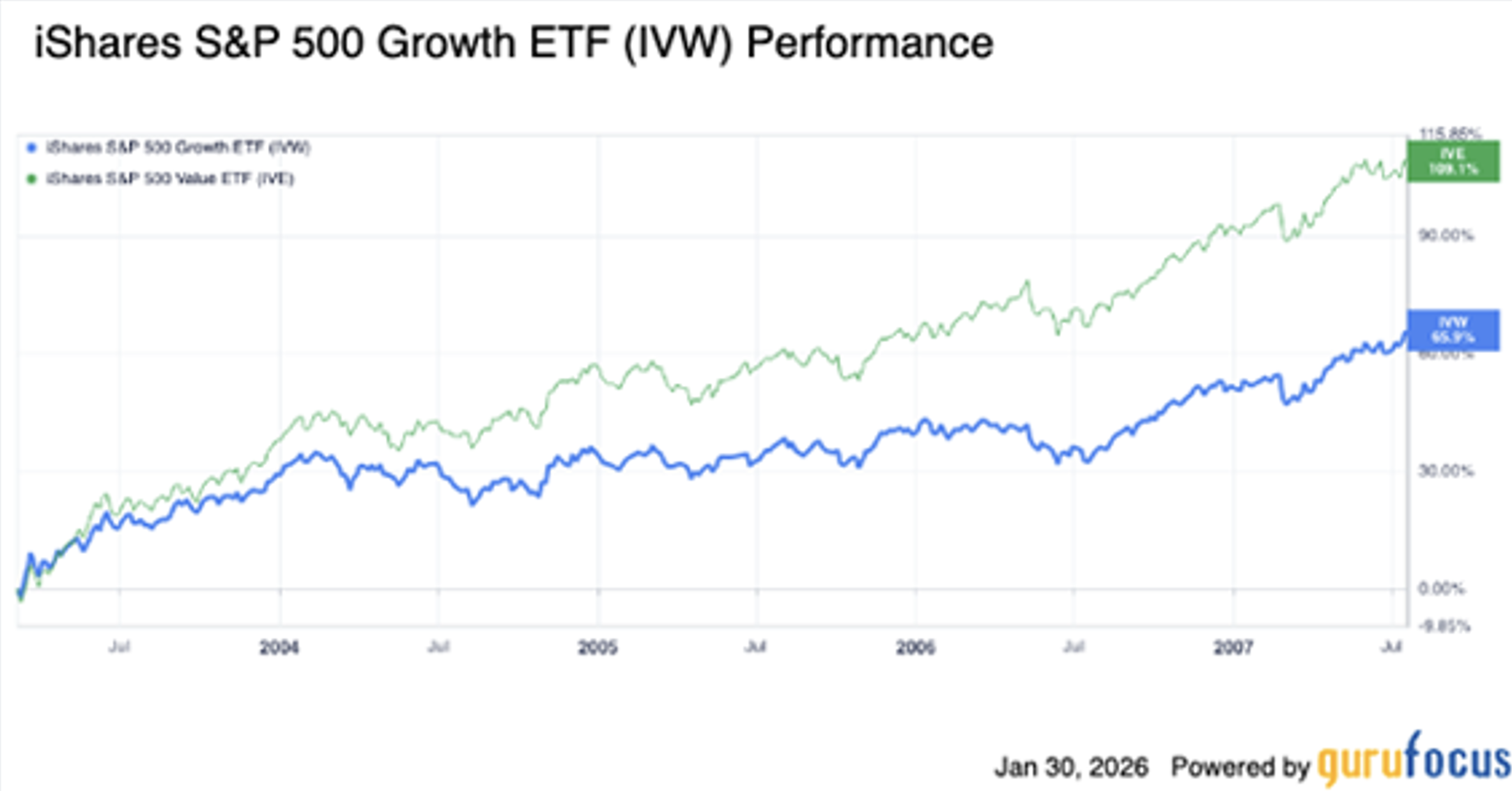

The Data Speaks for Itself
I’m not cherry-picking dates to make an argument. The data here speaks for itself, which is why value is one of the three core factors I used to build the Infinite Momentum model. Long-time readers know the other two are quality and momentum.
University of Chicago professors Eugene Fama and Kenneth French kicked off the research on the value factor in 1992, proving in their groundbreaking paper “The Cross Section of Expected Stock Returns” the existence of a premium in so-called “value” stocks. Using market data back to 1926, they found that value stocks (along with small caps) earned higher average returns than the broader market.
This paper did more than validate the real-world experience of Warren Buffett, Benjamin Graham and countless other veteran value investors. It created factor investing as we think of it today. My Infinite Momentum model wouldn’t exist without the research revolution started by Fama and French.
Now, the outperformance you get from a pure value approach is notoriously lumpy, which is why I pair the value factor with my proprietary momentum and quality factors. By focusing on cheap stocks that are also backed by high-quality businesses and that are also already trending higher, we sidestep potential value traps – or stocks that appear cheap on paper but just continue to get cheaper because their businesses are deteriorating.
Buying a stock purely because it’s cheap will probably make you decent money. But further reducing the opportunity set to good companies with healthy stock price action is really the secret sauce.
As I’m sure you can tell … I’m wildly excited about Infinite Momentum’s prospects this year. We crushed the market in 2025, and the conditions are lining up for us to have an even better 2026.
To good profits,

Adam O’Dell
Editor, What My System Says Today
