



News broke this weekend that the U.S. began a bombing campaign against Iran.
But unlike the June 12-Day War, which saw the U.S. and Israel attack Iran’s nuclear facilities, this one escalated quickly. The bombing resulted in the death of Iran’s Supreme Leader Ayatollah Ali Khamenei and a large swath of the country’s leadership.
At least three U.S. service members have been killed… and Iran has been lobbing missiles at Israel and several of the Arab states in retaliation for days now.
What comes next is anyone’s guess.
But the market reacted as you’d expect.
Gold prices spiked sharply higher – alongside crude oil. The precious metal is back over $5,300 per ounce and near new all-time highs.
Although stocks are off their lows, they’re still down as I write this.
So, how do we navigate this market chaos?
To start, if you’re following a systematic trading strategy, continue following it.
It really is that simple.
If it is a durable system built to handle volatile situations, you have nothing to worry about.
And if it’s not durable enough… then you should probably be looking for a new system.
That’s my philosophy in Green Zone Fortunes, and it’s served me well.
I’ve followed my system through some of the most volatile markets in history, and I’m still here trading.
Beyond that, you might want to keep a little extra cash on hand in the event we get a good buying opportunity. You might also want to hang on to any gold or other crisis hedges you own.
But first and foremost, stick to your system and avoid making emotional decisions because the data is very clear here.
Wars tend to have minimal impact on the stock market.
In fact, a 2022 paper by the National Bureau of Economic Research found that over the past two centuries, wars actually reduced market volatility by 25% because the outsized impact of government spending tended to smooth out earnings.
We should all hope that this war ends quickly, of course. But however it shakes out, we have a system to follow.
With that in mind, let’s see how each of the major S&P 500 Index sectors performed last week.
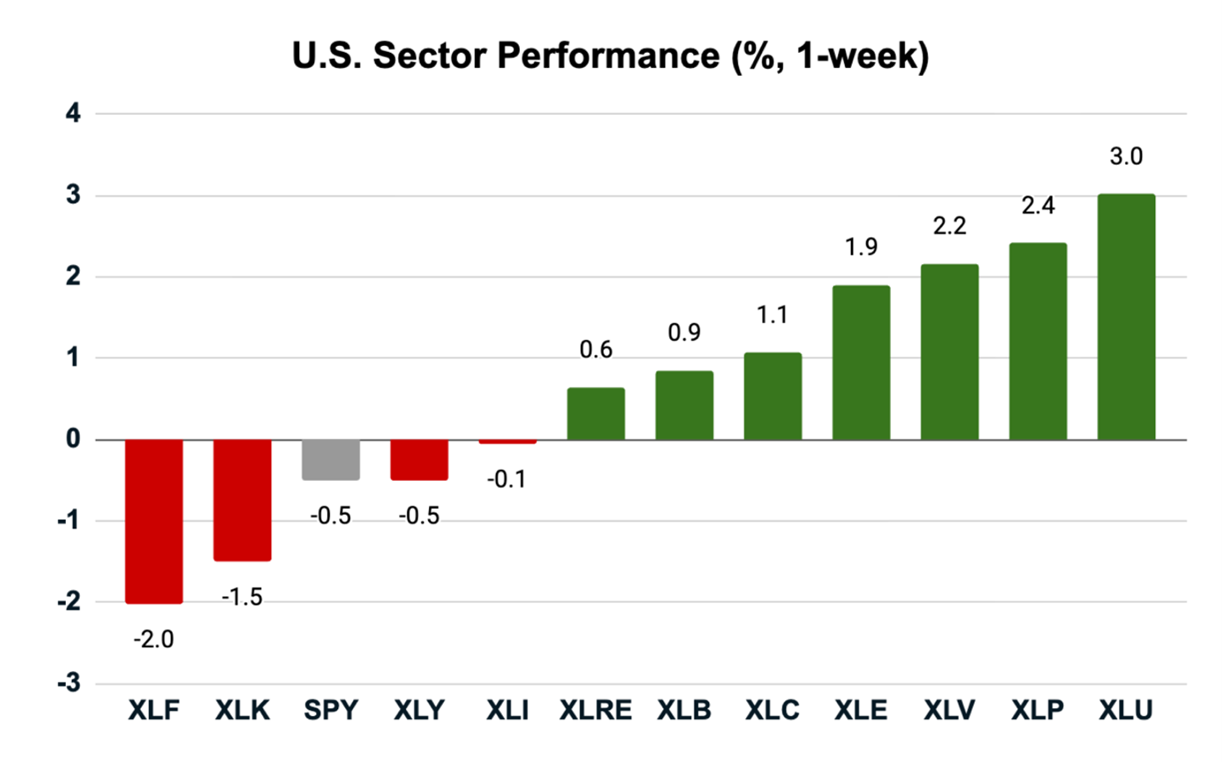

The utilities space has decoupled from its traditional role as a defensive “bond like” sector over the past several years, as investors saw increased electricity usage for AI training turning the sleepy work of electric companies into a legitimate growth sector.
As enthusiasm for AI infrastructure spending has waned, utilities are starting to look like good old-fashioned utilities again.
As stocks struggled last week, the State Street Utilities Select Sector SPDR ETF (XLU) finished 3% higher, while the conservative consumer staples and health care sectors posted strong gains.
Meanwhile, financials and technology pulled the market lower, with the State Street Financials Select Sector SPDR ETF (XLF) and State Street Technology Select Sector SPDR ETF (XLK) falling 2% and 1.5%, respectively.
Financials in particular are being dragged lower amid fears that the private credit market could be in for rough times ahead.
Key Insights:
- War is scary, but its impact on the market is almost always limited.
- Defensive sectors are outperforming right now, though this preceded the onset of the war.
- Financial stocks in particular look weak due to fears over private credit.
What’s Happening in Utilities?
Let’s dig into utilities…
I ran my customary screen of the biggest movers that were also still within 10% of their 52-week highs last week. The idea is to look for strong, market-leading stocks that are getting stronger.
Here’s what I came up with:
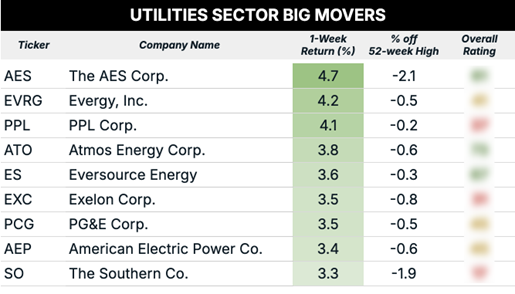

Before we get too excited, I should remind you that utilities soared last week mostly because investors were looking for a place to hide from volatility in “growthier” sectors.
Still, there were three stocks in this space that earned a “Bullish” rating on my Green Zone Power Ratings system: The AES Corp (AES), Atmos Energy Corp (ATO) and Eversource Energy (ES).
If you’re looking to round out your portfolio with some utilities exposure, you might want to start your research with these three.
What’s Affecting Financials?
As I mentioned a moment ago, there is an elephant in the room when it comes to financials.
Over the past several years, business development companies (BDCs) and private-equity (PE) firms facilitated a massive boom in private credit, with a lot of the proceeds being used to fund AI data centers and technology companies in general.
The total private credit market has ballooned to an estimated $3.5 trillion – up from just $2 trillion as recently as 2020. Private credit markets are opaque, illiquid and mostly unregulated.
So when you see growth that explosive, it raises questions about credit quality and sustainability.
What’s the risk?
No one knows yet.
There simply isn’t a lot of available information to parse. For what it’s worth, JPMorgan Chase CEO Jamie Dimon recently said he was seeing a lot of “dumb things” going on in the sector, so take that for what you will.
I don’t invest (or NOT invest) based on off-the-cuff statements by celebrity CEOs. But I’d agree that we should be selective here.
So, might there be any bargains on the list?
Let’s take a look.
I ran my customary screen of the sector’s biggest losers for the week that are still trading within 10% of their 52-week lows. The idea is to find a beaten-down gem that is poised to recover.
This is what popped up on my screen:
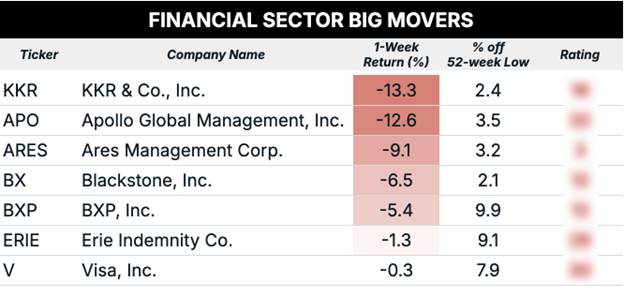

My system is advising caution.
Most of the stocks on the list are the managers of the BDCs and PE firms that are up to their eyeballs in private credit.
Not a single one rates as “Bullish” on my Green Zone Power Ratings System right now.
So, whether or not the private credit market is in for trouble, my system is advising we steer clear.
To good profits,

Adam O’Dell
Editor, What My System Says Today
