



When a company reports negative earnings for a quarter, it can raise a red flag for investors…
Negative earnings indicate that a company has incurred a loss during a given period, as total expenses exceed total revenues.
The reasons for negative earnings vary widely:
- High costs associated with producing or importing products.
- Ongoing losses due to things like increased costs in research and development.
- A business cycle in which products made by a company aren’t in as much demand as they are in other periods.
You can tell if a company has negative earnings when its price-to-earnings ratio is listed as “not applicable,” as it cannot be calculated.
While it’s not the end-all, be-all for a company, negative earnings can suggest temporary financial difficulty, high expenses or even strategic spending that may pay off in the long run.
I research earnings on a weekly basis (every Friday, you can read my analysis on “bullish” or “bearish” earnings), and I recently came across some data that points to earnings trouble for a particular sector of the market.
Let’s get into it…
The Smaller You Are, The Harder The Earnings
Smaller companies tend to have negative earnings because they are younger, growth-oriented companies focused heavily on future expansion.
These companies may also rely more on debt, which makes them more vulnerable to high interest rates.
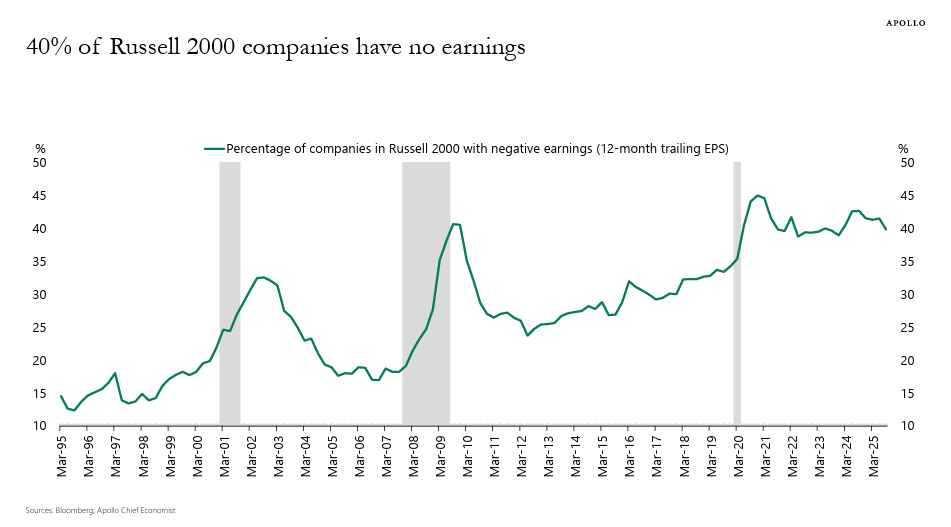

A recent study by Apollo Global Management Inc. found that 40% of companies listed in the Russell 2000 — a small-cap index — had no earnings.
What’s even more telling is that 40% has been in place since the COVID-19 stock market drop in March 2020.
These smaller companies have been struggling to raise capital as the Federal Reserve embarked on a rate-hike spree following the pandemic.
This means that debt financing for these small-cap stocks is more expensive than in previous years because the interest rates they pay are higher.
Small-cap companies are also less resilient during economic downturns or periods of uncertainty (such as inflation or recession fears) and have more volatile, cyclical revenues than larger, more established firms.
But negative earnings aren’t always a bad thing.
As I mentioned before, many small-cap companies invest heavily in future growth (such as research and development or marketing).
That’s why it’s essential to examine each company to identify the root cause of its negative earnings.
For us, we can utilize Adam’s Green Zone Power Ratings system to gain more insight…
Small-Cap Stocks Return “Neutral” Rating
For this part of the analysis, I ran an x-ray on the iShares Russell 2000 ETF (IWM), where I pulled the ratings from every stock held in the ETF to find an average in each factor.
IWM Rates “Neutral” Overall
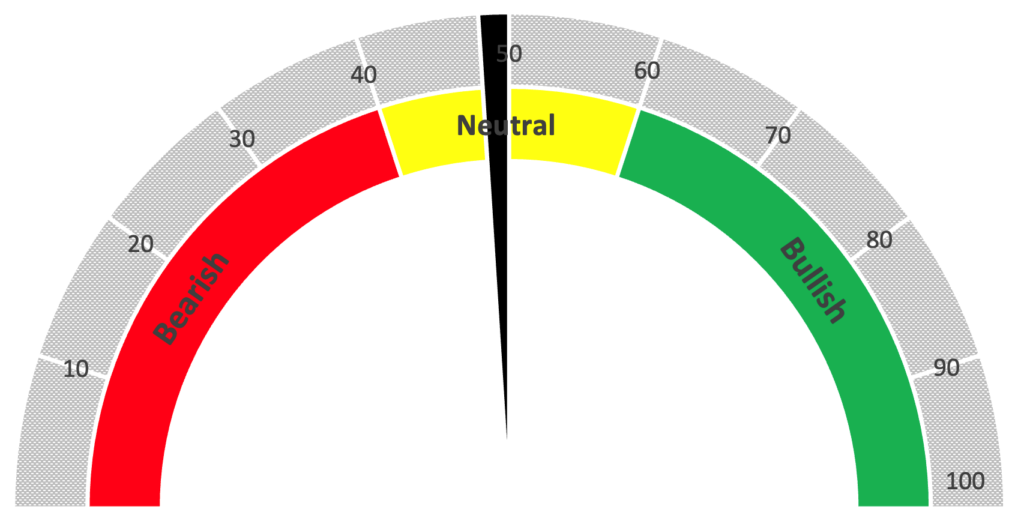

Overall, the ETF earns a “Neutral” 48 out of 100 on Adam’s Green Zone Power Ratings system.
Of the list, 344 stocks rate “Bullish” or higher, overall, while 403 rate below 30 on the system.
The average factor ratings break down like this:
- Momentum: 49.
- Size: 57.
- Volatility: 36.
- Value: 50.
- Quality: 49.
- Growth: 53.
Seeing a nearly “Bullish” 57 on Size isn’t surprising, as these are small-cap stocks. Perhaps the biggest surprise is that, while 40% of the Russell 2000 companies have negative earnings, the ETF earns an average “Neutral” rating of 50 on Value and 53 on Growth.
What this tells me is that while some stocks on the index may be struggling financially, there is an equal number of stocks with a solid reason for negative earnings, such as the strategic investment I mentioned earlier.
The best approach for investing in small-cap stocks is to utilize Adam’s Green Zone Power Ratings system to gain a comprehensive understanding of a stock, rather than just one narrow aspect.
That’s all for me today.
Until next time…
Safe trading,


Matt Clark, CMSA®
Chief Research Analyst, Money & Markets