


We’ve all seen the numbers on the signs as we pull into the station lately.
With the Iran war pushing energy markets into a frenzy, gas prices have become the most visible indicator of our current economic uncertainty.
But if you look closer, you’ll see two very different stories playing out.
On one side, you have families in late-model SUVs who barely glance at the total on the pump before heading inside to grab a premium coffee.
On the other hand, you have folks watching the price on the meter climb with genuine anxiety, calculating exactly how many shifts they need to work just to cover the commute.
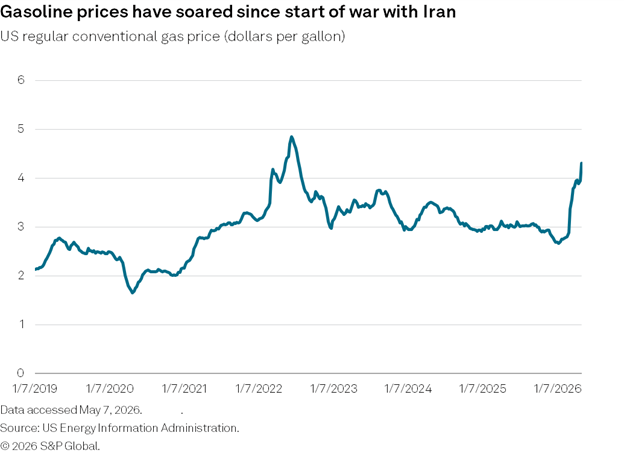

This isn’t just a “vibe” — it’s a data-driven reality that is splitting the American consumer right down the middle, creating a divergence in behavior that could redefine the next few years of economic growth.
A Regressive Tax and the K-Shaped Reality
When gas prices spike, it acts like a giant, unannounced tax hike.
But unlike a flat tax, this one hits hardest for those who have the least. For a lower-income household, every extra dollar spent on fuel is money that cannot go toward groceries, a night out or a new pair of shoes.
It is a direct siphoning of a paycheck, moving money away from discretionary goods and services and straight into the fuel tank.
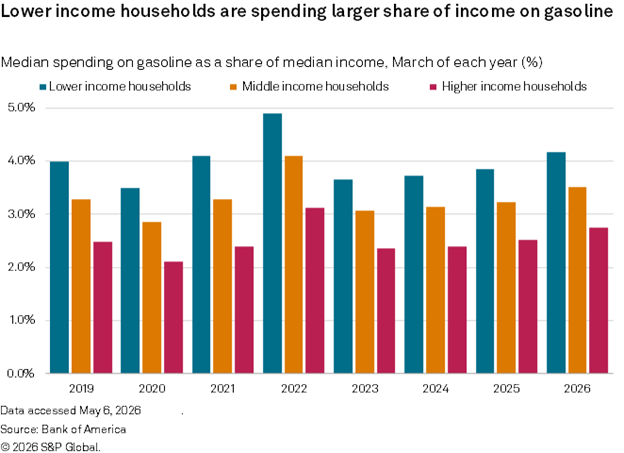
Recent data shows that families in the lower third of income are now funneling over 4% of their paychecks into their gas tanks — marking a significant jump from 2025.
Meanwhile, the top earners are seeing a much smaller dent at less than 3%. It sounds like a small difference on paper, but in the real world, that 1.5% gap represents the “margin of safety” for millions of Americans.
This is the “K-shaped” economy in action.
While one arm of the K is reaching for travel and luxury services, the other is being forced to cut back on the basics.
This isn’t just about gas; it’s about the total lack of flexibility for those at the bottom of the income ladder.
When the cost of a commute goes up, the first things to go are dining out and retail shopping.
Why aren’t the high-end malls and fancy restaurants empty yet? Because the top earners are currently insulated by a massive “wealth buffer.”
Higher-income consumers are seeing steeper wage gains and benefiting significantly more from the ongoing gains in the stock market, real estate and other investments.
To them, the price of gasoline is a minor annoyance — a rounding error on a monthly statement. Unless we see a major asset price crash or a sudden wave of white-collar layoffs, their spending behavior won’t change.
They notice the higher prices, but those elevated costs don’t change their plans for a summer vacation or a kitchen remodel.
The Ripple Effect and the Road Ahead
This creates a strange optical illusion for the economy: as long as the rich keep spending, the headline numbers look “OK,” even as a large portion of the population quietly drowns.
For everyone else, the struggle is being compounded by a “double whammy” of slower wage growth and rising costs for other essentials like utilities and food.
While some might have a few months of breathing room thanks to this year’s tax refunds, that cushion is thinning out fast. We are essentially watching a race between tax-refund buffers and the relentless climb of energy costs.
It is important to remember that gas prices don’t just affect how much it costs to drive to work; they also impact the cost of everything delivered by a truck. Diesel fuel has seen an even more dramatic increase than regular gasoline, jumping 60% year over year.
When the cost of transporting goods spikes, those costs are eventually passed on to consumers.
This is how energy inflation “bleeds” into the broader economy. If you are already struggling to fill your tank, the last thing you need is for the price of bread, milk and eggs to jump another 10% because the delivery trucks are paying more for fuel.
This is the primary risk that economists are watching: the moment when high input costs become so sticky that they push the entire inflation basket higher, forcing the Federal Reserve’s hand and further squeezing lower-income households.
The big question on everyone’s mind is whether this energy spike is the “black swan” that finally pushes the U.S. into a recession.
The short answer? Not yet.
Economists generally agree that we would need to see much higher energy prices for a sustained period to truly break the back of the economy. Sales gains are currently matching income gains across the board.
As long as the job market remains tight and people are still pulling in a paycheck, the economy has a remarkably high pain threshold.
People will grumble, cut back on vacations and switch to store-brand cereal, but they will keep moving. However, the margin for error has never been thinner.
Gasoline prices alone won’t trigger a recession, but they act as a massive drag on growth. If inflation begins to outpace wages consistently, or if the “consumer resilience” we’ve heard so much about finally reaches its breaking point, the odds of a downturn rise significantly.
Divided Resilience
For now, we are living in a divided economy.
The view from the pump depends entirely on which side of the wealth gap you’re standing on.
We are seeing a deepening divergence in confidence: the wealthy remain optimistic and active, while lower-income households are retreating into survival mode. Until energy prices stabilize or the “wealth buffer” for the top tier starts to crack, expect this K-shaped divergence to get even more pronounced.
The economy isn’t breaking — not yet — but for millions of Americans, it is certainly bending under the weight of the most expensive commute in years.
Keep a close eye on those discretionary spending sectors; they are the canary in the coal mine for when the “Two Americas” story finally reaches its climax.
The divide isn’t just about what people can afford today, but how they view their financial security tomorrow.
And right now, the gap between the two is wider than the price difference between regular and premium.
Until next time…
Safe trading,


Matt Clark, CMSA®
Chief Research Analyst, Money & Markets
P.S. The way I approach the market has continued to evolve as conditions have shifted. And this ongoing change has led me to a more practical, income-focused approach centered on consistent opportunities rather than traditional market speculation.
This transition has naturally shaped a new direction for my Max Profit Alert service, now being reintroduced as Max Income Deals, with a focus on simple, repeatable “deals” designed to help generate additional cash flow on a regular basis.
So, I’m going LIVE on May 19 at 1 p.m. ET to walk through exactly how these deals work in real time, showing the process step by step so you can see how it’s applied in practice.