



As I wrote yesterday, materials stocks took a beating last week.
Even so, the sector remains one of the market’s strongest performers in 2026, up nearly 12% and comfortably ahead of the S&P 500 Index’s 9% gain.
Today, we’re taking a closer look at the materials sector to see what’s working… and what isn’t.
Unsurprisingly, AI is a big part of the story.
Investment in AI infrastructure has been the driving force behind keeping an otherwise sluggish, inflation-riddled economy afloat.
The numbers tell the story.
By government estimates, AI-driven investment directly accounted for around a third of gross domestic product (GDP) growth last year.
First-quarter 2026 data puts the figure even higher, with AI infrastructure spending responsible for fully half of the economy’s 2% GDP growth.
And that likely understates AI’s true economic impact.
Plenty of infrastructure investment isn’t officially classified as AI spending but wouldn’t be happening without the race to build AI capacity.
Think power generation, industrial construction and mining.
You can take these precise estimates with a large grain of salt, but the underlying megatrend is obvious.
AI infrastructure spending is the proverbial rising tide that lifts all boats.
It’s fueling what could be the biggest construction boom of our lifetimes.
So, what does this mean for the materials sector?
Let’s see what my system has to say.
Sector X-Ray of Materials
We’ll start with a breakdown of the sector’s Green Zone Power Ratings.
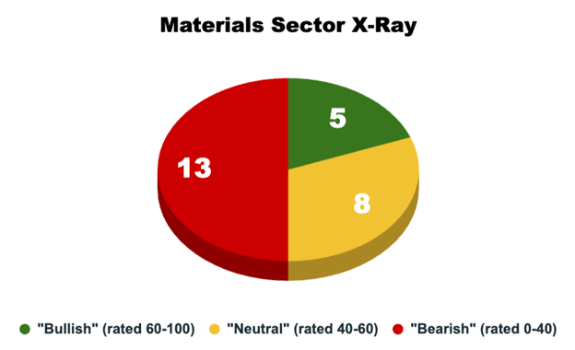

The AI infrastructure boom may be the biggest trend of our lifetimes, but my system is telling us to approach the materials sector with caution.
Of the 26 materials stocks in my coverage universe, only five rate as “Bullish,” meaning a score of 60 or higher out of 100. (For those new to my system, “Bullish” rated stocks outperform the S&P 500 by double on average over the following year.)
Another eight rate as “Neutral,” meaning my system would expect them to perform more or less in line with the broader market. And a full half, at 13, rate as “Bearish,” meaning my system would expect them to underperform the market.
Clearly, the infrastructure boom isn’t benefiting the entire sector equally.
Let’s keep digging to see where materials stocks are showing strength.
Where Do Materials Pick Up Points?
The Green Zone Power Rating system is a composite score based on six primary factors: momentum, size, volatility, value, quality and growth, each of which comprises several sub-factors. (As we are looking at large-cap constituents of the S&P 500, I don’t consider size when doing the sector X-ray.)
Let’s take a look to see where materials stocks pick up points.
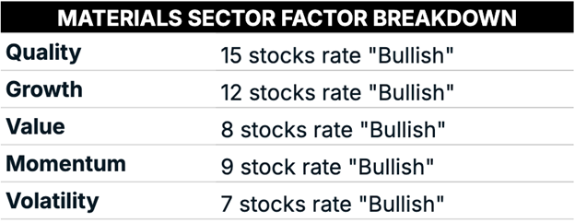

A solid majority of materials stocks rate as “Bullish” on their quality factor. Let’s talk about what that actually means.
My quality factor is a composite made up of multiple metrics that measure profitability, balance sheet strength and asset turnover. In plain English, it rewards highly profitable companies with low debt and “asset light” business models.
Materials stocks generally aren’t anyone’s idea of an asset-light business. Extracting and processing raw materials is extremely capital intensive. So, the high ratings here are a testament to high profits and conservative financing.
Nearly half of the stocks in this sector also rate as “Bullish” on growth. That is to be expected given that we’re in a massive infrastructure spending cycle.
If materials have an Achilles’ heel, it is that they tend to be cyclical. They do well when the economy is strong, but tend to see their profits evaporate during slowdowns.
That’s why they rate poorly on their volatility factor (a low volatility score means that the stock is highly volatile and its price tends to bounce around a lot).
Picking Apart the Materials Sector
Let’s get into the nitty-gritty.
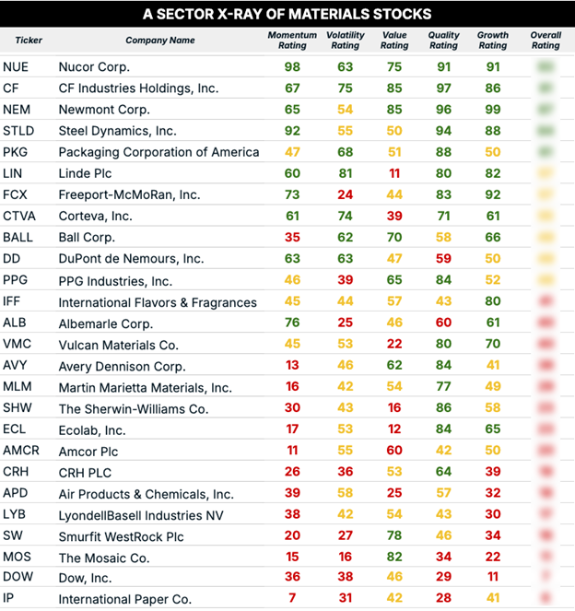
I ranked all 26 stocks in the materials sector by their Green Zone Power Rating to see if I could find any patterns.
And one trend stood out.
With precious few exceptions, the highest-rated materials stocks tend to be the ones most obviously tied to heavy infrastructure.
Steelmakers Nucor Corp (NUE) and Steel Dynamics (STLD) both rate near the top, and neither has any real identifiable weakness in my system. Both rate as “Bullish” or at least “Neutral” on all five factors and as “Bullish” or “Strong Bullish” overall.
Gold miner Newmont Corp (NEM) and industrial miner Freeport McMoRan (FCX) also rank near the top of the list.
I added Newmont to the Green Zone Fortunes portfolio last November, and we’re currently up about 10%.

Not every top-rated materials stock is tied to the AI infrastructure boom.
Take Packaging Corporation of America (PKG), which primarily makes cardboard boxes and specialty packaging. The company rates well on my Green Zone Power Ratings system, with a “Bullish” overall rating and “Bullish” or “Neutral” ratings on all five factors.
Then there’s CF Industries Holdings (CF), which may look familiar. I recommended this fertilizer giant in Green Zone Fortunes earlier this year, and we’re already sitting on a gain of roughly 20%.
Lately, headlines surrounding the Iran war have led to CF’s stock price being whipsawed.
Roughly half of the world’s nitrogen-based fertilizer moves through the Strait of Hormuz, and Iran is itself a major exporter.
So, every bend and twist in the war has an outsized impact on CF shares.
But that’s only the short-term story. In Green Zone Fortunes, my goal isn’t simply to chase the hottest AI stocks. It’s to identify second-order winners that often offer just as much upside – with far less attention. (If you’re not already a subscriber, you can learn more about the service here.)
CF is a perfect example.
You see, my investment thesis has very little to do with geopolitics or alarming headlines.
CF is a long-term bet on rising global living standards.
As countries get richer, people consume meatier, higher-protein foods, particularly meat. Producing that meat requires more livestock, which in turn requires more grain to feed those animals – and growing more grain requires more fertilizer.
If AI delivers the boost to living standards I expect over the coming decades, being long fertilizer is a no-brainer.
To good profits,

Adam O’Dell
Editor, What My System Says Today

P.S. One of the biggest mistakes investors can make is assuming the AI story begins and ends with chipmakers.
As we’ve discussed thoroughly, the ripple effects are already spreading across sectors like materials, energy and industrials. That’s why Strategic Fortunes chief strategist Ian King is hosting a free Breakthrough 2026 event on July 16 at 10 a.m. to lay out exactly what’s happening.
He’ll join four other Wall Street veterans to explain where they believe the next major opportunities are emerging – and why the coming weeks could mark a pivotal moment for investors. Click here to reserve your spot…