



Energy’s back, baby!
In an otherwise low-key week that saw the S&P 500 Index barely move, the State Street Energy Select SPDR ETF (XLE) exploded higher by 7.7%, absolutely crushing every other sector. XLE is now up 38% in 2026, beating out even the high-flying tech sector.
Iran played its part, of course. There’s been no real progress in resolving the conflict, and crossing the Strait of Hormuz remains extremely dangerous. Wall Street is pricing in a stalemate that benefits American domestic suppliers at the expense of their Middle Eastern competition.
But that’s not the only story, of course…
Wall Street has fallen back in love with the AI trade… and all of the energy it will require.
The masters of the universe have also drawn the conclusion that newly installed Fed Chair Kevin Warsh isn’t quite the inflation hawk he promised to be. Lower or stable interest rates and higher-for-longer inflation point to higher energy prices.
All of this may be true, but I also have a much simpler explanation for why energy stocks are trending higher:
They disproportionately rate as “Bullish” on my Green Zone Power Ratings system.
I’ll get to that shortly.
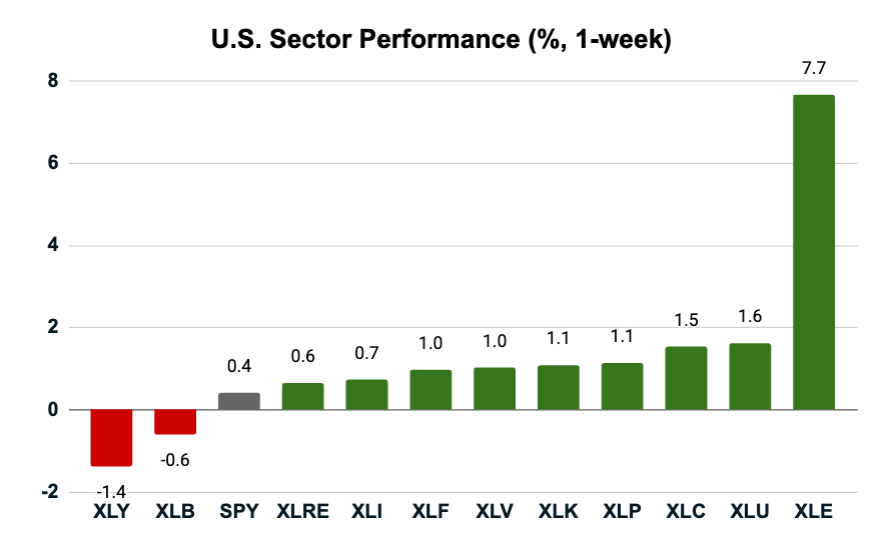

The biggest laggards last week were in consumer discretionaries. The State Street Consumer Discretionary Select SPDR ETF (XLY) dropped by 1.4%.
We should never read too deeply into a single week of data. But the U.S. consumer really is struggling right now with inflation. And you can see this in the sector’s performance this year. XLY is one of only two major industrial sectors to be negative on the year, with the other being communication services.
So, last week’s poor performance by XLY is a continuation of a running theme.
Energy Back in the Lead
Let’s get back to energy.
As I do every week, I ran my customary screen of the biggest movers in the sector that were still within 10% of their 52-week highs. The idea is to look for solid, market-leading stocks that are getting stronger.
Here’s what I came up with:
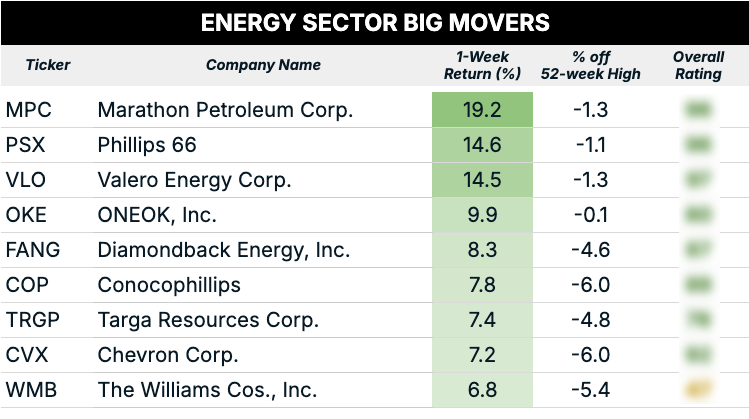

Energy seems to end up as the top-performing sector roughly every other week. But there’s been one consistent trend every time energy tops the sector chart: The strongest performers are almost all infrastructure plays.
The three top performers last week were all refiners: Marathon Petroleum (MPC), Phillips 66 (PSX) and Valero Energy (VLO).
Valero, by the way, has been in the Green Zone Fortunes portfolio for close to two years… and we’re already up 160% in the shares.
So, is the energy still investable after its monster run?
My system certainly says so. Of the nine stocks on the list, eight rate as “Bullish” or “Strong Bullish.”
We’ll continue to see some choppiness in this sector. Whenever it looks like there is a breakthrough in the Iran war, investors’ first instinct is to sell energy stocks.
But my system is clear. It identified energy as attractive long before the bombs started dropping in February. And it continues to find fantastic opportunities in the sector.
Any Value in Consumer Discretionaries?
We know the consumer is struggling. It’s not exactly a secret.
But might there be some opportunities in a beaten-down consumer discretionary sector?
Let’s see.
I ran my customary screen of the sector’s biggest losers for the week that are still trading within 10% of their 52-week lows. The idea is to find beaten-down gems that look poised to recover.
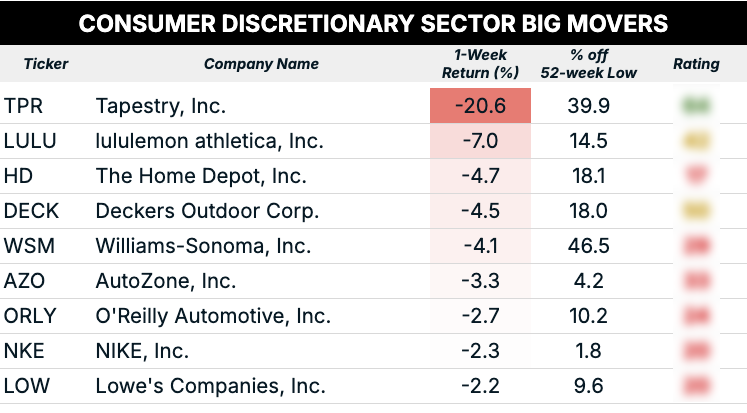

Very few of last week’s biggest losers were trading anywhere near their 52-week lows, so I loosened the criteria.
It didn’t help much…
Apart from Tapestry (TPR) – the holding company of the Coach and Kate Spade brands, among others – none of the stocks rate as “Bullish.” Most rate as “Bearish” with two “Neutrals.”
Perhaps the most interesting aspect is the breadth of the bearishness. Athletic retailers lululemon athletica (LULU) and Nike (NKE) have virtually nothing in common with home improvement retailers like Home Depot (HD) or Lowe’s (LOW) or auto parts stores like O’Reilly Automotive (ORLY) or AutoZone (AZO).
The only ties that bind them are exposure to tariffs… and exposure to a tapped-out American consumer.
Even Tapestry, which sells to a more affluent consumer, issued weaker guidance in its recent earnings release. That’s why its shares were down 20% last week.
There are pockets of opportunity in companies that help consumers beat inflation. For example, T.J. Maxx parent TJX Companies (TJX) and Ross Stores (ROST) have consistently popped up as “Bullish” throughout this year (see “Not Quite Dead Yet.”)
But for the sector as a whole, my system is clear. The consumer is in trouble. And we should largely avoid consumer discretionary stocks for now.
To good profits,

Adam O’Dell
Editor, What My System Says Today
