

I have British comedy on my mind today…
Because when I look at the U.S. shopper in 2026, I can’t help but think of the infamous “bring out your dead” scene in 1975 cult classic Monty Python and the Holy Grail.
It features a cart driver rolls through the streets collecting plague victims, a villager carries an elderly man to the cart, intending to hand him over as dead. But as he’s about to throw him on the heap, the old man protests: “I’m not dead! I feel fine! I think I’ll go for a walk!”
Anyone who’s seen the movie knows how that exchange ends…
After years of inflation, we’re seeing real stress.
Consumer debt is at all-time highs. Delinquencies are rising. And rising prices, particularly in energy and food, continue to crimp budgets.
Yet the U.S. consumer clearly isn’t dead. In fact, depending on where you look, he appears to be dancing in the street.
Consumer discretionaries were the best-performing sector last week, and Amazon.com (AMZN) in particular delivered a monster earnings report.
So, are things turning around?
Or is the consumer about to get clubbed on the head and thrown on the cart?
Let’s see what my system has to say about that, with an X-Ray of some top consumer discretionary stocks…
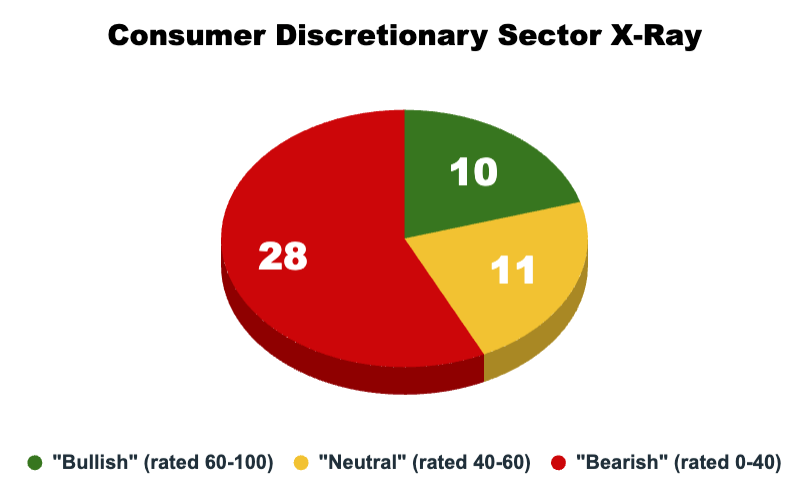
We can see quickly that it’s rough out there. Of the sector’s 49 stocks, only 10 rate as “Bullish,” meaning a score of 60 or higher out of 100. (For those new to my system, “Bullish” rated stocks outperform the S&P 500 Index by double on average over the following year.)
Another 11 rate as “Neutral,” meaning my system would expect them to perform more or less in line with the broader market. And a solid majority, at 28, rate as “Bearish,” meaning my system would expect them to significantly underperform the market.
This tells us that the consumer economy is really a mixed bag right now. For the most part, shoppers are struggling, and we’re seeing that fact manifested in the sector’s spotty Green Zone ratings.
But there are pockets of the consumer economy that still look great.
So, let’s dig into the data and see where the opportunities lie.
Where Do Consumer Discretionaries Pick Up Points?
The Green Zone Power Rating system is a composite score based on six primary factors: momentum, size, volatility, value, quality and growth, each of which comprises several sub-factors. (As we are looking at large-cap constituents of the S&P 500, I don’t consider size when doing the sector X-ray.)
So, where do consumer discretionary stocks pick up the most points?
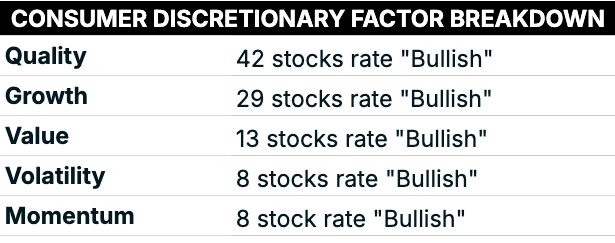
The most “Bullish” factor is quality. 42 out of the 49 rate as “Bullish” on their quality factor.
That’s not surprising.
My quality factor rewards “asset-light” businesses with fat profit margins. Consumer discretionaries are classic asset-light businesses that tend to depend heavily on intangible assets like branding. The Nike swoosh or McDonald’s golden arches are instantly recognizable all around the world. That brand recognition cost a lot of money and sweat equity to build, but today the companies get to reap the rewards via premium pricing.
The sector also rates well on its growth factor, with 29 of the stocks rating as “Bullish.”
Given the inflationary headwinds facing the sector, it’s not all that surprising that it rates poorly on momentum. Only eight of the 49 stocks rate as “Bullish” on momentum.
Today’s Highest-Rated Consumer Discretionaries
Let’s narrow our analysis to only the top-rated consumer discretionary stocks.
I ran a screen for the stocks rating as “Bullish” on their momentum factors, and here’s what my system gave me:
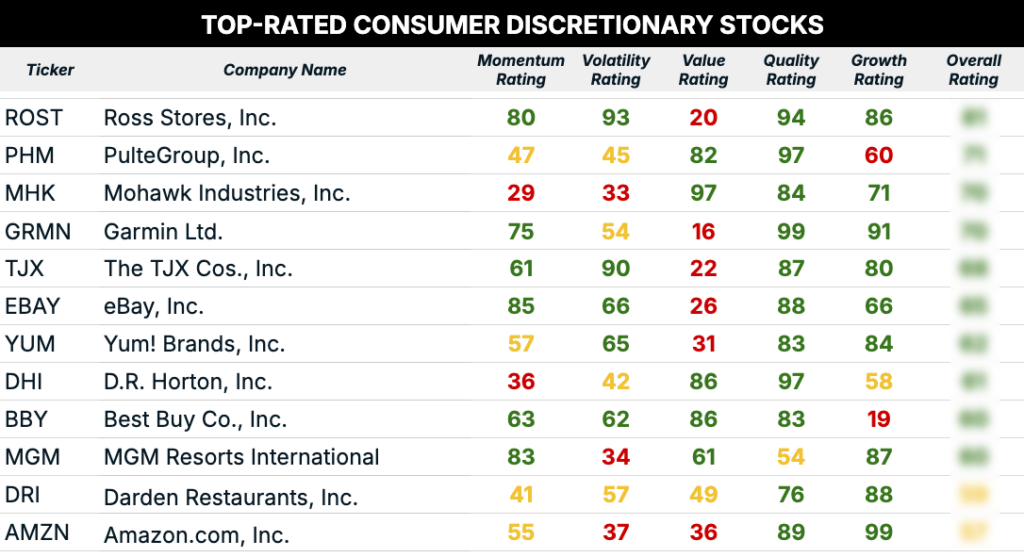
I want to immediately draw your attention to Ross Stores (ROST) and TJX Cos (TJX), the parent company of TJ Maxx and Marshalls, among others. These two “off-price” retailers have consistently rated well on my Green Zone Power Ratings over the past two years, regularly popping up on “Bullish” screens.
I get it.
At a time when our dollars are getting stretched thin, discount stores are a lifesaver. And the worse things get for the consumer, the more likely they are to trade-down to off-price retailers. The high-inflation environment might be hard on retailers as a whole, but it’s an ideal environment for ROST and TJX.
Both ROST and TJX rate strongly across every factor but value. The companies are growing like weeds, and Wall Street has priced them accordingly.
Of course, we can’t ignore the biggest stock in the sector, Amazon.com. This company alone accounts for nearly a quarter of the market cap of the entire sector.
It’s debatable whether Amazon is really a “consumer discretionary” today. Yes, they run the world’s largest online store and have a logistical empire that rivals the U.S. Army. But Amazon’s real growth engine has long been its cloud computing business, and the company is an AI hyperscaler and a core member of the Mag 7.
In the short term, Amazon’s stock will live or die based on investor enthusiasm for the AI trade. And following last week’s monster earnings release, it seems that the wind is in Amazon’s sails.
What does my system have to say about Amazon?
The stock doesn’t rate as “Bullish” today on my Green Zone Power Ratings system due mostly to its low scores on volatility, value and size. But its exceptionally high factor scores on quality and growth help to give an overall “Neutral” rating. That suggests that Amazon should deliver returns roughly in line with the S&P 500.
To good profits,

Adam O’Dell
Editor, What My System Says Today