
In the late 1990s, traders kept two sets of books.
There was the published estimate. That was the one that went out on the wire. The one the financial news anchors read aloud during that evening’s market recap.
Then there was the other number.
Traders quietly passed it from desk to desk in the days before a report. They called it the whisper number.
The whisper existed for one reason;
Everyone already knew the published estimate was soft.
Companies had learned to walk analysts down in the weeks leading up to a print. Analysts had learned to take the hint. By the time the report hit, the “estimate” wasn’t a forecast at all. It was a hurdle set at ankle height.
The SEC finally wrote a rule about it. Regulation FD, October 2000. No more selective tips.
That was 26 years ago. The impact? See for yourself…
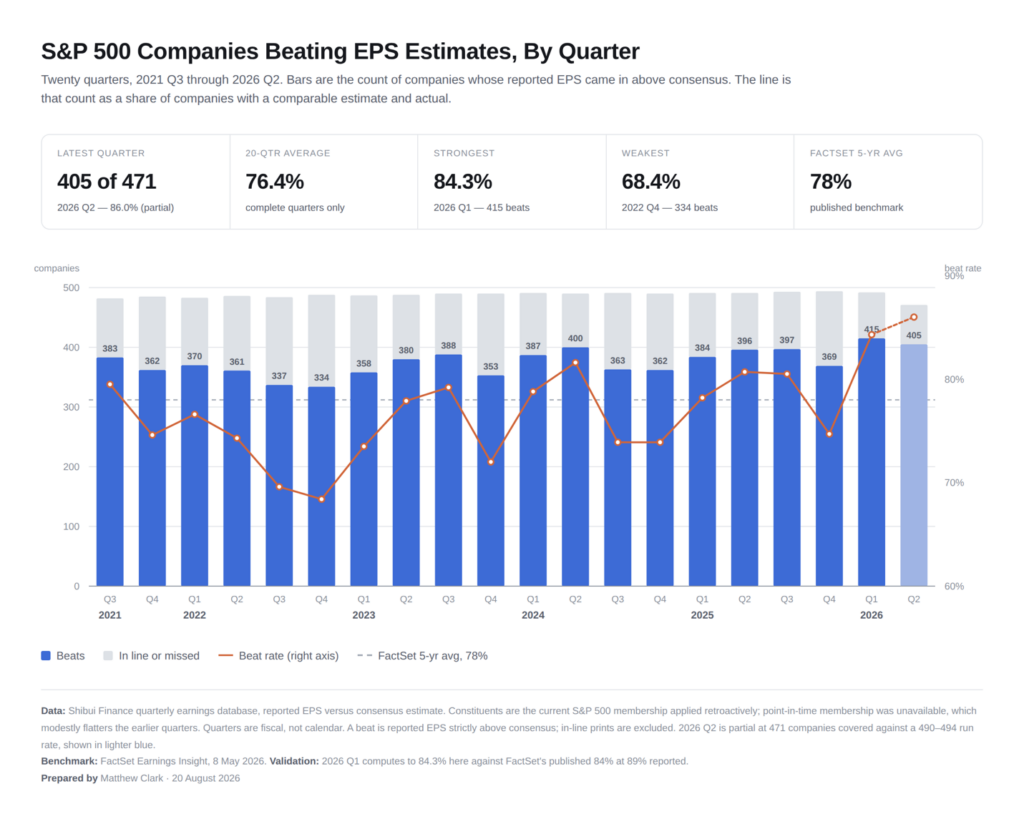
Last quarter, 405 of 471 companies beat.
That’s a whopping 86% landing on the right side of the forecast, with a few stragglers still to report.
Now find the ugliest bar on that chart. Fourth quarter of 2022. The S&P had just finished its worst year since 2008. Every strategist on the street was calling for a recession. Layoffs were front-page news.
Even then, 334 companies beat. Sixty-eight percent.
In the worst earnings season in five years, more than two out of three companies still “surprised to the upside.”
The five-year average is 76.4%. FactSet puts its own benchmark at 78%.
Corporate America did not suddenly get three times better at forecasting. The bar got easier to clear.
A friend of mine learned this the expensive way…
He bought a mid-cap software name two days before its report. The setup looked perfect to him. The company beat by four cents.
He was right!
But the stock opened down 11% anyway.
He sold into the hole and called me that afternoon, still trying to work out what he’d missed. The beat was never the story. In reality, it was all about the guidance.
He hadn’t misread the company. He’d just bet on the wrong number.
Here’s what I mean…
The Beat Tells You Nothing… The Bar Tells You Everything
The way Adam set up the Green Zone Power Ratings system, it doesn’t really care whether a company will beat.
Instead, it asks a different question: how far did the bar move?
Specifically, it measures the gap between what Wall Street expects a company to earn this quarter and what that company actually earned last quarter.
That gap is harder to game. An analyst can shave a nickel off a forecast in the final week before a print. He cannot go back and change what the company has already booked.
One side of that comparison is opinion. The other side is a filed number. When those two pull apart, something real is happening inside the business.
Eighteen names cleared that filter for next week. I want to walk you through four of them — two on each side — because they teach the whole lesson.
“Bullish” Earnings to Watch
These stocks are expected to beat their earnings per share (EPS) from the previous quarter. And if those expectations are met or exceeded, they could potentially trade higher.
For this screen, stocks must meet four criteria:
- 10 or more analysts cover the stock.
- The average analyst recommendation is a “Buy.”
- It BEAT analysts’ EPS estimates for the previous quarter.
- The average analyst estimate for the current quarter’s EPS is greater than the previous one.
Here are 10 companies that made this week’s list:
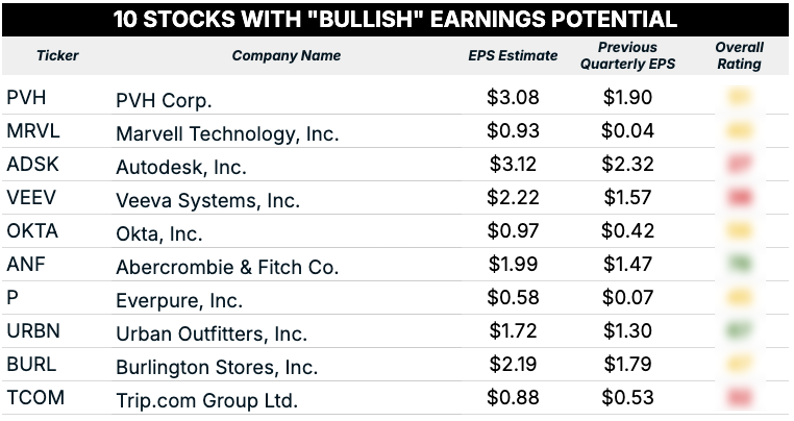
Marvell Technology (MRVL) reports after the close on Thursday. Wall Street wants $0.93 a share. Last quarter, Marvell earned four cents.
That’s a 23-fold jump in 90 days. Nothing else on either table comes close.
So why am I not buying it?
Because the price is already known. Marvell trades near $242 a share against forward earnings of about $6.25.
That’s roughly 39 times next year’s profits. The market has done this math. Everyone can see the ramp coming. You are not being paid to take the risk by Thursday afternoon.
Now hold that next to a stock nobody is excited about.
Abercrombie & Fitch (ANF) reports on Wednesday morning. Analysts want $1.99 against $1.47 last quarter — a 35% sequential jump. Smaller than Marvell’s, but still one of the biggest on the list.
Abercrombie trades at $103.75. Forward earnings are around $11.80 a share. That works out to 8.8 times.
Read those two numbers together. The market is pricing Abercrombie as a declining retailer, while estimates suggest its profits are about to grow by a third in a single quarter. Both things cannot be true.
Same signal. Wildly different price. That’s the trade.
The other six names — Autodesk Inc. (ADSK), Veeva Systems (VEEV), Okta Inc. (OKTA), Everpure Inc. (P), Urban Outfitters Inc. (URBN) and Burlington Stores (BURL) — all show real jumps too. But Veeva is trading near $252 with an RSI of 73, and I don’t buy anything that hot into a catalyst.
Now, let’s look at potentially bearish earnings next week…
“Bearish” Earnings to Watch
For our “bearish” earnings screen, we’re only looking for two things:
- 10 or more analysts must cover the stock.
- The average analyst estimate for the current quarter’s EPS is less than the previous quarter’s.
We want companies that are covered by a sufficiently large group of Wall Street analysts who collectively expect the company to report a QOQ decline in earnings.
Here are eight companies that passed this screen:
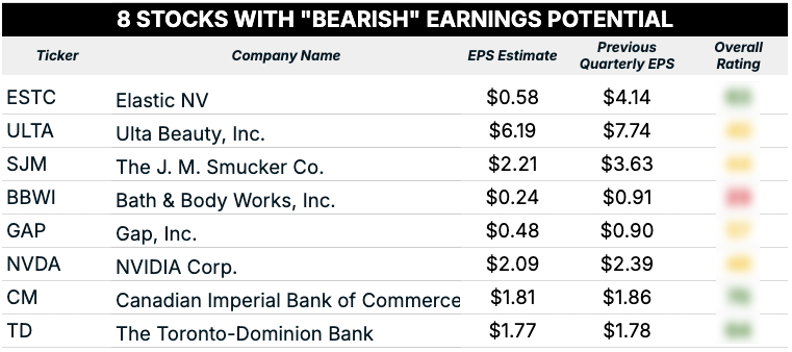
Elastic NV (ESTC) tops the list with a $3.56 collapse. That $4.14 last quarter was not a business result — it was a $435 million tax accounting entry.
Elastic’s real operating number was $0.61, so a $0.58 estimate is flat, not falling. NVIDIA has the same problem: its $2.39 included $15.9 billion of gains on stock investments. Strip those out, and it earned $1.87, which makes a $2.09 estimate an increase.
Check what was actually made last quarter before you trust the gap. Two minutes in a press release saves you from shorting the best business in the world by mistake.
Which brings me to the two names worth your attention.
Ulta Beauty (ULTA) shows a $1.55 drop — $6.19 expected Thursday against $7.74 last quarter. Second-worst on the table.
It’s the calendar. Ulta earned that $7.74 in its spring quarter, up more than 15% from a year earlier, and it raised full-year guidance on the way out the door. Summer is simply a lighter season for beauty retail. The estimate isn’t a warning. It’s a season.
Canadian Imperial Bank (CM) and Toronto-Dominion Bank (TD) are in the same bucket, with expected declines of $0.05 and $0.01, respectively. That’s noise.
Bath & Body Works (BBWI) is the real one.
Analysts expect $0.24 on Wednesday morning, down from $0.91 last quarter. That’s a 74% drop with no tax entry and no seasonal excuse to back it up.
Here’s the part that decides it for me. Bath & Body Works earned $3.52 over the last 12 months. Analysts expect about $2.87 over the next 12 months. The forward number sits below the trailing number.
That’s not a soft quarter. That’s a curve bending the wrong way.
At $19 a share, the stock looks cheap. Cheap and getting cheaper is not a trade.
The most attractive here appears to be Abercrombie & Fitch (ANF).
The earnings math says a 35% sequential jump on Wednesday. The price says the market expects a dying retailer. At 8.8 times forward earnings, you are being paid to find out which one is right.
On the other hand, Bath & Body Works (BBWI) is the most concerning… and one I would stay away from.
Not a short. Just don’t own it into Wednesday. When next year’s earnings estimate drops below last year’s, the bar isn’t being reset — it’s being lowered, and lowered bars keep going lower.
Eighteen names. Two accounting mirages. Three calendar artifacts. One strong potential.
That’s what happens when you stop counting beats and start measuring the bar.
That’s all from me. Have a great weekend!
Until next time…
Safe trading,

Matt Clark, CMSA®
Chief Research Analyst, What My System Says Today