


Today is Thursday, and you know what that means…
We’ll be covering stocks that have been newly rated as “Bullish” on my Green Zone Power Ratings system, meaning their ratings just crossed the 60 out of 100 threshold.
Historically, stocks with a “Bullish” rating have outperformed the market by double on average.
It’s an eclectic group this week, really running the gamut of sectors.
But there is one major tie that binds them…
None are AI plays.
Of course, the AI boom isn’t ending anytime soon.
If anything, the launch of Meta Platform’s (META) new Muse AI agent shows that it’s just now going mainstream.
Still, there are definitely changes happening under the surface.
The ongoing massive data center buildout is facing major political pushback… and both Claude and ChatGPT recently released cheaper versions of their models, opting for the first time to compete on price rather than pure power.
It’s unclear where exactly this is going… or who the ultimate winners and losers will be.
And it’s precisely that uncertainty that makes diversification away from AI more important than ever.
So, let’s explore those opportunities today, starting with the newest additions from the S&P 500 Index.
S&P 500 New Bulls
I ran my usual screen for S&P 500 companies that popped up as “Bullish” this week, and this is what I came up with:
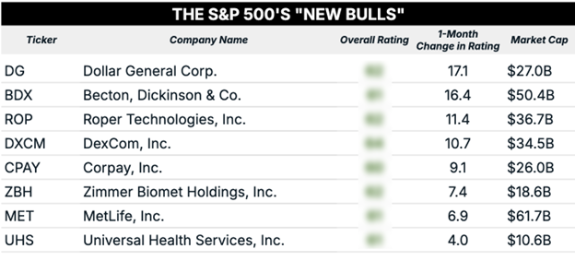
A few stocks on this list caught my eye…
First, Dollar General (DG) took the top spot after its Green Zone Power Rating jumped 17 points. This isn’t the first time in recent months that Dollar General has popped up as “Bullish,” and it fits a pattern I’ve been observing all year.
Regular Americans are struggling to make ends meet after years of high inflation. As a result, discount “dollar stores” are helping them cope.
Moving on, medical device company DexCom (DXCM) is one that I mentioned in Monday’s breakdown of the health care sector.
It’s known for its continuous glucose monitoring systems that allow patients with diabetes to monitor their blood sugar without constant finger pricks.
Along the same lines, Becton, Dickinson & Co (BDX) made the list. The company makes disposable medical essentials like needles, syringes and catheters.
Apart from having no connection to the AI buildout, DexCom and Becton Dickinson are also both extremely recession-resistant.
Boom or bust, diabetes patients still need to monitor their glucose… and hospitals need high-quality basic supplies.
Lastly, Roper Technologies (ROP) is an interesting addition. As a software company, it was a casualty of the “SaaSpocalypse” earlier this year.
Concerned that AI tools would make customized software obsolete or, at the very least, massively bite into their high profit margins, Wall Street absolutely hammered software stocks like Roper in the first half of the year.
But it seems that Mr. Market might have overreacted.
Roper specializes in niche markets like law, government and health care. Its users aren’t in a hurry to replace its products… and growth remains robust. Roper rates a “Strong Bullish” 88 on its growth factor and a “Bullish” 79 on quality.
New Bulls Outside the S&P 500
Now, let’s look at the newly “Bullish” stocks outside of the S&P 500. I ran a screen for the top 20 stocks with the largest score increases over the past month, and this is what popped up:
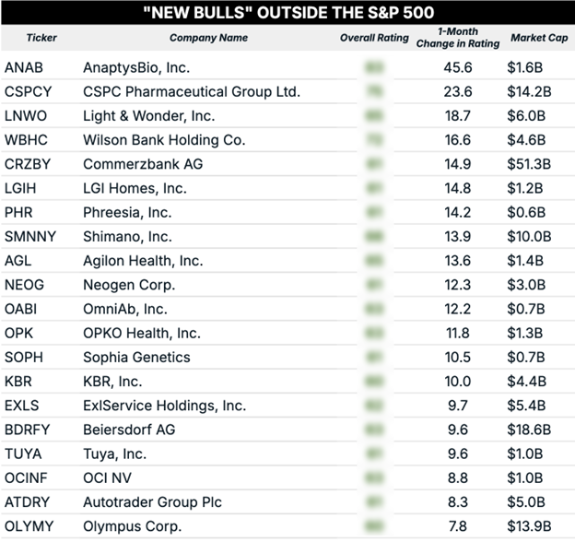
There are a few names on this list I’d like to highlight.
At the very top sits prescription drug royalty company AnaptysBio (ANAB).
What exactly does that mean?
AnaptysBio developed therapies years ago and then licensed them to larger companies to produce and sell them.
The company has very few employees and virtually no overhead. It doesn’t really “do” anything. It just sits back and collects the checks.
Not surprisingly, the company generates fat profits and anticipates ongoing EBIT margins of 95%.
Moving on, cycling enthusiasts will recognize Shimano (SMNNY). This Japanese company is one of the most popular names in the business and makes components that major bike brands like Trek, Specialized and Giant rely on.
Gear shifters, derailleurs (the parts that move the chain between gears), brakes, cranks, chains, wheel hubs… Shimano makes them all. And in the midrange segment, the company has a virtual monopoly with around 70% to 80% of the market.
Of course, the company has the same problem most manufacturers do… It competes with China on the low end… and its Chinese competitors are gradually moving upscale.
Still, the shares are down by nearly two-thirds in dollar terms from their old pandemic-era highs and have been trending higher throughout 2026.
Tariff uncertainty remains a major issue, at least in the American market. But with the post-pandemic inventory glut mostly worked off now, the biggest headwinds that had been holding the stock back are dissipating.
Finally, let’s take a look at Tuya (TUYA).
Tuya is a Chinese tech company that makes cheap gadgets “smart.” It’s the hidden software and chip layer behind a huge number of off-brand and store-brand smart-home devices.
Let’s say a factory in Shenzhen makes a plug, light bulb or robot vacuum and wants it to connect to Wi-Fi and a phone app. That’s expensive to build in-house and time-consuming to maintain.
So, Tuya sells the factory a ready-made kit instead. That kit has three parts: a small connectivity module (the chip), cloud servers to run the device and a phone app that the brand can put its own name and logo on.
Tuya is a small company with a size rating of 99. It’s safe to say that it isn’t on most investors’ radars. But it’s still growing like a weed with a growth factor rating of 87.
To good profits,

Adam O’Dell
Editor, What My System Says Toda