


The sell-off in bonds has been brutal.
An asset class that most investors consider a “safe” alternative to risky stocks has been anything but.
The S&P 500 Index is up 14% this year. Meanwhile, the iShares 20+ Year Treasury Bond ETF (TLT) is down 11% this year on a price basis and nearly 50% over the past five years.
And when bond prices fall, other income-producing investments often take a hit, too.
That’s certainly been the case with utilities, as I wrote yesterday.
But what about real estate stocks?
Like utilities, real estate investment trusts (REITs) are traditionally viewed as income stocks. REITs pay no corporate income taxes so long as they pay out at least 90% of their income as dividends.
This focus on income tends to make REITs sensitive to changes in bond yields. But the interactions are more complex.
REITs also tend to have inflation-adjusted rent escalators. This ensures that their rents – and the dividends that those rents fund – keep pace with rising prices. And hard assets like real estate tend to be natural inflation hedges when investors are seeking protection against declining purchasing power.
In other words, REITs have some of the same vulnerabilities as other income stocks, but also a few unique advantages.
There are a lot of moving parts with this sector. But what does my system say?
Today, we’ll do a sector X-ray of the real estate sector to find out.
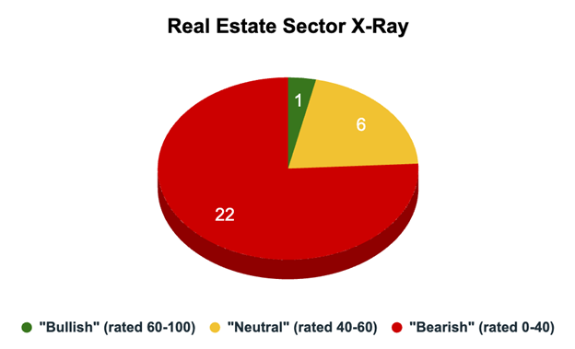
At first glance, the picture isn’t pretty.
Of the 29 REITs in the sector, just one earns a “Bullish” rating from my system, meaning a score of 60 or higher out of 100. (For those new to my system, “Bullish” rated stocks outperform the S&P 500 by double on average over the following year.)
Another six rate as “Neutral,” meaning my system would expect them to perform more or less in line with the broader market.
And the rest – 22 out of 29 – rate as “Bearish,” meaning my system would expect them to significantly underperform the market.
That’s a pretty lopsided scorecard.
But before we write off the entire sector, there’s an important wrinkle to consider: REITs have some unusual accounting characteristics that can distort the numbers behind conventional stock ratings.
And that’s where things get interesting…
Where Do Real Estate Stocks Pick Up Points?
The Green Zone Power Rating system is a composite score based on six primary factors: momentum, size, volatility, value, quality and growth, each of which comprises several sub-factors. (As we are looking today at only large-cap constituents of the S&P 500, I don’t consider size when doing the sector X-ray.)
Let’s talk about some of those REIT accounting quirks…
The momentum, size and volatility factors are based on price action. These factors are purely objective and work equally well across market sectors. It doesn’t matter if we’re looking at a tech stock or a warehouse REIT; price movements are price movements.
It’s the fundamental factors – quality, growth and value – we need to watch.
To start, real estate is often highly leveraged. The vast majority of properties, be they single-family homes or 100-story office towers, are mortgaged.
There’s nothing wrong with that, of course. The regular income thrown off from rents makes it perfectly reasonable to use leverage. But it tends to weigh on my quality factor rating.
My quality factor favors “asset light” businesses with low debt. So, it’s normal and expected that REITs tend to rate poorly on quality.
Similarly, real estate tends to generate many non-cash expenses, such as depreciation.
That’s a good thing and one of the greatest selling points of real estate. “Phantom” expenses, like depreciation, offset real cash profits and allow investors to reduce or defer their tax bills indefinitely.
But they also tend to punish REITs on their growth and value factors.
So, with all of that context in mind, where do REITs pick up the most points?
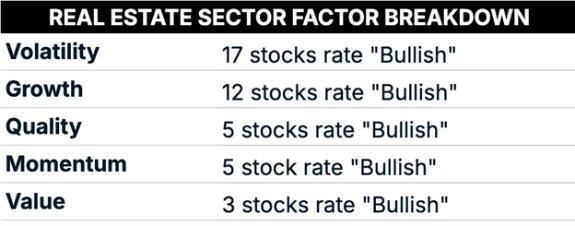
REITs rate well on volatility, with 17 out of 29 REITs rated as “Bullish” on their volatility factor. Given the emphasis on steady income, that shouldn’t come as a surprise.
Interestingly, despite being somewhat hobbled by their quirky accounting, REITs rate surprisingly well on growth, with 12 rated “Bullish.”
After that, it really drops off. Only five rate “Bullish” on quality and momentum and three on value.
Bonds are in correction mode, so it’s not surprising that bond substitutes like REITs rate poorly on momentum.
But a few are doing just fine, bucking the trend with market-beating momentum.
Let’s give those a deeper look.
What’s Working in REITs?
I ranked our REITs by their momentum factor and included all that rated “Neutral” or better on that factor.
Let’s see if there are any insights we can glean.
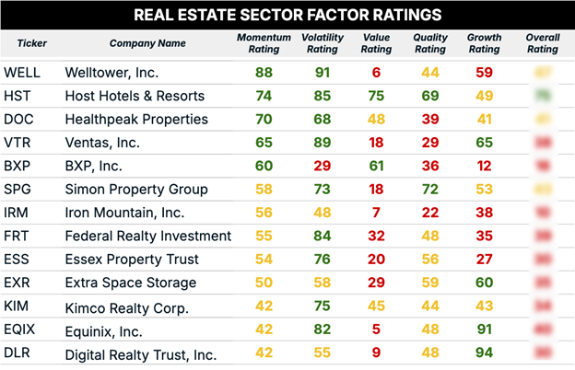
It’s immediately obvious that investors are flocking to health and senior living REITs. Three of the five “Bullish” REITs are in that space.
Welltower (WELL), Healthpeak Properties (DOC) and Ventas (VTR) are the three largest U.S. health care REITs, but each has a slightly different center of gravity.
Welltower is the most focused on senior housing, and its portfolio is specifically positioned to benefit from an aging population. Ventas is a little more balanced, as it also has exposure to medical office space and life sciences facilities. But its primary focus is senior housing.
Healthpeak is the most balanced of the three. Its business spans outpatient medical office buildings, life-science lab space in hubs like Boston and the San Francisco Bay Area and senior housing communities.
All three REITs are betting on the same long-term trend: an aging population that will need more senior housing and more health care.
The only REIT rated “Bullish” overall is Host Hotels & Resorts (HST), an owner of high-end hotel properties. But I’m more interested in what’s not “Bullish.”
Equinix (EQIX) and Digital Realty (DLR) are pure plays on data centers. Both rate as “Bearish,” and this despite their “Strong Bullish” growth ratings over 90. And they both lose plenty of points on their value factors.
As I mentioned earlier, we should recognize that the value factor is somewhat skewed due to the quirks of REIT accounting.
But all the same, neither stock pays a particularly high dividend. Both yield less than 3%, which is low for a REIT.
This suggests that investors wanting to ride the AI infrastructure wave should look elsewhere.
To good profits,

Adam O’Dell
Editor, What My System Says Today