

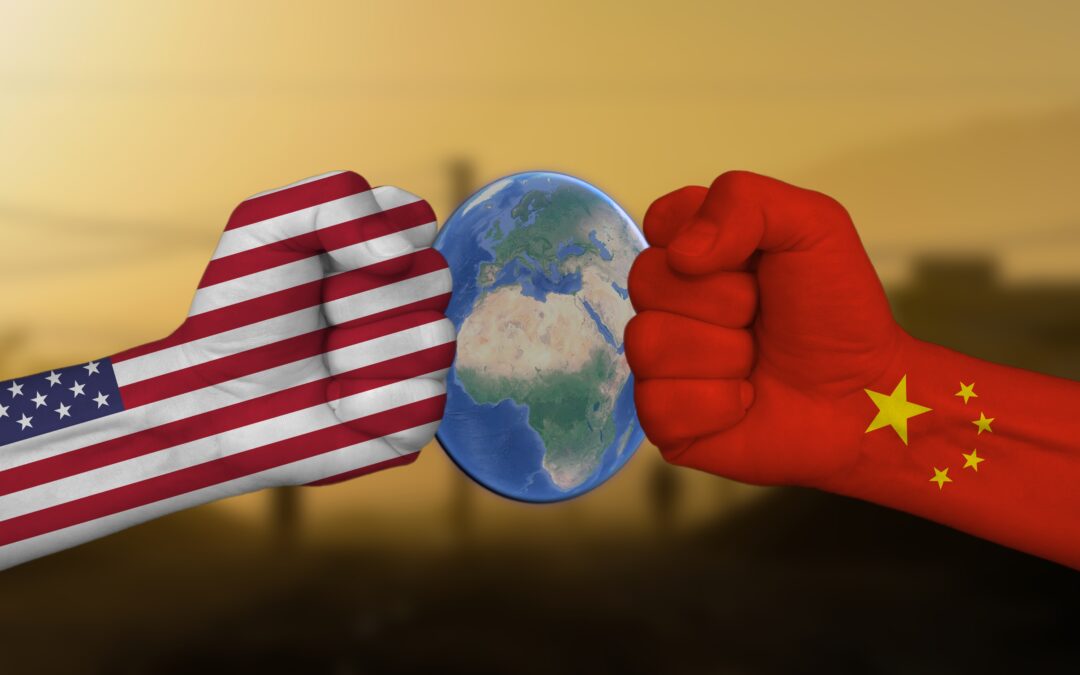
China has been a bit of a “boogeyman” for the US these past few decades…
And with good reason.
Starting all the way back in the 1970s, China’s economy has been on a real hot streak — quickly growing into the second-largest national economy in the world behind the US.
But after years of stellar outperformance, the Chinese Miracle is slowing down. Some are attributing it to clever “demand destruction” amid rising oil prices. But the Moneyball reality is that there’s a much deeper story playing out in the data.
In short, we’ve reached Peak China.
Click the video below for the full story:
Video transcript:
Welcome to Moneyball Economics. I’m Andrew Zatlin.
And speaking of economics, the latest data coming out of China continues to paint the same picture, that the Chinese economy is slowing down.
On the one hand, this is totally normal. It’s what we would expect as their economy has matured, that growth is going to start downshifting. However, on the other hand, there are some things unique to the Chinese economy such that there is a ticking time bomb that’s going to go off in the next 10, 15 years.
This is not a guess. This is not a supposition. This is a definite.
China’s economy is going to not just stumble, but partially implode.
And the question is, what does the US do about it?
Because it presents some interesting opportunities.
Let’s start by looking at what the economic data is telling us, beginning with the latest GDP information that just came out…
In the second quarter, China’s GDP year over year was 4.3%. Now, if you’re sitting in America or Europe, that’s good. That’s a robust level of growth for those economies. But for China, it’s kind of weak. It’s actually technically the weakest in three years, but it’s part of an ongoing downtrend starting about 20 years ago. Remember, China was welcomed back into the world economy in the ’90s by Clinton. And by the 2000s, 2010s, they were really embracing capitalism.
At that time, go back about 20 years ago, every year the China GDP [growth] was in the double digits, 14%, 12%. Even 10 years ago, it was 9%. It was really high single digits. Over the past few years though, it’s been steadily slowing down. And as I said, this is totally normal. Every maturing economy goes through this. And that’s because when you go from an underdeveloped to a developed economy, there’s a lot of infrastructure opportunities that you can build out and juice up your GDP.
I remember being in Shanghai in the 1980s and looking out at night and I saw everyone huddled up at the base of these lampposts in the roads because that was the only place you could get electricity. That was the only source of light. And people would huddle up right below there and play Mahjong and talk. Fast-forward, totally different, but it wasn’t always this way. Let’s talk about how things were say 20 years ago and how that growth has slowed. Let’s look at what a developed economy has in the form of their infrastructure, because it really is all about initially getting electricity, plumbing, roads, and so forth created. So let’s start with some numbers. China, 2008, 50,000 miles of railroad. Almost a decade later, it’s 90,000. So you’ve almost doubled in 10 years. Now from 2020 to 2026, the next decade, it’s been 10,000 miles. So maybe at the end of the year, China might see 20% growth versus the previous decade of 100%.
Same thing with highways. So again, go back, let’s say 2009, there’s 40,000 miles of highway. Fast-forward a decade, it’s 100,000. So you’ve gone over 150% of growth in 10 years. What’s happened since 2020? About 24,000 miles or 25% growth. You’ve still got a couple more years in this decade, but you get the point. What happens is eventually there’s only so many highways that need to be built, so much rail lines, so many ports and so forth.
And so the big infrastructure play, the easy ways to goose the economy, go away. And China’s left right now with an interesting set of conditions. Every economy has their own set of conditions that they have to wrestle with over the near term and long term.
So for example, China’s very export driven. And so if exports slow down, they’ve got problems. And that’s right now where they are. They’ve got problems in that. In the cities, anyone in their 20s, unemployment’s now 20% because demand for Chinese goods is slowing down. And like I said, the opportunities for growth is slowing down as well.
But that’s not the ticking time bomb I referenced. It’s the demographics.
Historically, if you looked at any society’s demographics and you built at the base, the youngest all the way up to the peak, which was the oldest, if you looked at their proportion of any given community, historically you’d see kind of a triangle. At the bottom, lots of kids at the top, a few old people. And that’s the way we were.
Over time, it has shifted a little bit less pyramidal and more cylindrical. Every economy, every society has a little variation. So the US a little bit of a bulge because of the baby boomers. But by and large, what you need to keep your society going is you need younger people coming in because they’re working.
And as people age, they drop out of the economic activity life, they stop producing, you need to replace them. So the US has more of a cylindrical thing where we’re able to replace our aging demographics, our old people with immigrants and birth rate.
China has an incredibly unique circumstance. They’ve got an inverted pyramid. There are so many more old people than there are young people. Today, about 15, 20% of the population of China is 65 or older. Same with the US.
Of course, nominally a lot more people in China are old. But the problem is in the next 15, 20 years, it’s not 15 or 19% of the population that’s old and no longer working, it’s 30%. One third of Chinese will not be working in about 15, 20 years.
All right, but what about that replacement rate? What about the birth rate? Well, that’s again, is where China has problems.
They don’t have a lot of young people. That’s because of the one child, one family Mao Zedong tradition that he put in place. But you also have a low fertility rate. It’s at one, which means there’s not a lot of replacement of people coming in.
So you’ve got this huge impact on the society. One third of Chinese workers are out of the workforce in 10, 15 years and they’re not able to replace them. And this is a country that does not like immigrants per se. They are set up for economic collapse. They don’t have a welfare system, which is kind of funny because don’t they put the communism in the Chinese Communism Party? They don’t have a welfare system. They do not have the ability to support one third of the population aging out, much less maintaining the ability to be a manufacturing economy.
This isn’t just stumbling.
This is economic collapse. And it’s inevitable.
There’s nothing you can do about this. You can’t paper over it. You can’t offer people money to have kids because they’re looking out and they see problems in the economy. Chinese society is not growing. It’s shrinking. 3.3 million fewer Chinese last year than in the prior year. They have a major fundamental problem. It is a ticking time bomb and it is going to go off.
What isn’t certain, however, is how the US responds. We could sit back and watch it happen. Hell, we could accelerate it or we can reach out with a helping hand. So this is where I think the Trump administration has been watching and has come to China because the Chinese response when they’re peaking and growing is going to be different from when they’re stumbling.
When they’re stumbling, they need help. And I think Donald Trump has been going out to them and he’s been, on the one hand, accelerating their collapse, putting that export squeeze on them, reducing their ability to export all the manufactured goods that they want to export, reducing access to oil, and so on and so forth.
That’s the stick.
The carrot that he’s laying out is, hey, all around the world, China are opportunities for economic growth.
Markets could emerge in the Middle East if only we didn’t have a lot of the violence there. What can you China do in partnering with the US to bring market forces to the Middle East? They’ve got trillions of dollars that they can spend. Massive oil revenue, massive gas, lots of money to spend.
If we can bring them to a market economy that’s thriving, you China will benefit. You China need growth because you are set to implode. We can help you achieve that growth if you help us. Is that what Trump is saying? I don’t know. There are opportunities here for a carrot and stick, but the reality is China’s set to implode. And that is going to make some very interesting situations and circumstances.
US companies stand poised to take advantage of that implosion.
We’re in it to win it, folks. Zatlin out.

Andrew Zatlin
Editor, Moneyball Economics