

Editor’s Note:
Dear reader,
Before you read today’s issue, there’s something else you should see.
My colleague just went live with an urgent broadcast about something he discovered buried in the Texas government statutes…
Something that could impact anyone with money in the markets.
He’s LIVE now. You should tune in and see what he has to say. Click here.
And then check out today’s issue below…
Could a cure for cancer really be at hand?
Maybe.
Imagine the economic impact…
The American Medical Association estimates the economic cost of cancer could exceed $25 trillion between 2020 and 2050. That estimate includes direct costs like health care spending, as well as indirect costs from lost income among patients and family members who care for them.
Cancer is effectively a global tax.
So, eliminating it – apart from saving lives and alleviating incalculable suffering – could be one of the biggest economic breakthroughs of our lifetimes.
Recent news that Moderna (MRNA) and Merck (MRK) may have found a cure was enough to send the State Street Health Care Select SPDR ETF (XLV) sharply higher.
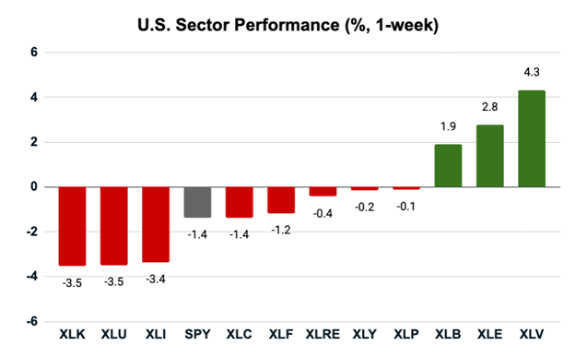
But fears over nagging inflation and rising bond yields weighed on tech stocks, sending the State Street Technology Select SPDR ETF (XLK) down 3.5%.
Let’s dig into both sectors to see where the opportunities are.
A Cure for Cancer?
Moderna and Merck announced last week what might have been the biggest health breakthrough in decades: a personalized cancer vaccine!
In a joint press release, the companies announced that their intismeran vaccine, given alongside Merck’s Keytruda immunotherapy drug, succeeded in its Phase 3 trial.
The combination meaningfully delayed cancer from spreading or returning in patients who participated in the study.
And that’s what makes intismeran revolutionary.
The vaccine is built from a patient’s own tumor sample and designed to train the immune system to recognize and attack residual cancer cells before they have a chance to come roaring back. It may be too early to declare cancer officially “beaten.”
The results still need to undergo peer review, and the treatment hasn’t been approved by the U.S. Food and Drug Administration.
But the news was enough to send both stocks soaring…
And it helped propel the health care sector into the market’s top spot. As I do every week, I ran my customary screen of the biggest movers in the sector that were still within 10% of their 52-week highs. The idea is to look for solid, market-leading stocks that are getting stronger.
Here’s what I came up with:
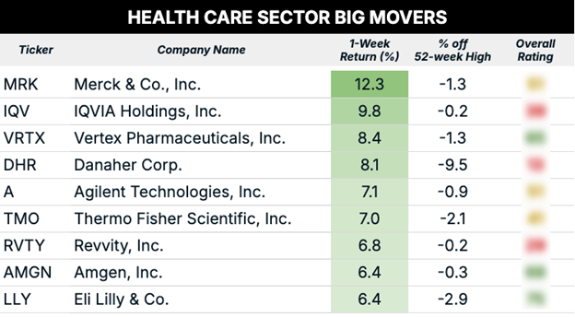
Moderna didn’t make the list because, even after its massive 129% run-up last week, it’s still down more than 10% from its 52-week highs.
But its partner Merck certainly made the cut, gaining 12% last week.
Unfortunately, there’s not a lot of “green” on this list.
Only three of the stocks rate “Bullish” on my Green Zone Power Ratings, meaning they score at least 60 out of 100. “Bullish” rated stocks generate returns that are double the S&P 500 Index’s on average, based on years of actual results and decades of backtesting.
One of the three standouts, Vertex Pharmaceuticals (VRTX), might look familiar.
I recommended the shares back in June in Infinite Momentum. We sold the shares just last week for a quick 13% profit.
The other two “Bullish” standouts were Amgen (AMGN) and Eli Lilly (LLY).
Lilly has benefited from the boom in weight loss medications. Its Zepbound weight management treatment competes head-to-head with Novo Nordisk’s Ozempic and is the company’s biggest growth driver.
Any Discarded Gems in Tech?
Tech had a rough week, but it’s still the second-best-performing sector in 2026 – up over 27%. While Wall Street is getting a little skittish about the sustainability of the AI infrastructure boom, there hasn’t been any real sign that it’s slowing down any time soon.
So, after last week’s declines, might there be some opportunities?
Let’s take a look.
I ran my customary screen of the sector’s biggest losers for the week that are still trading within 10% of their 52-week lows. The idea is to find beaten-down gems that look poised to recover.
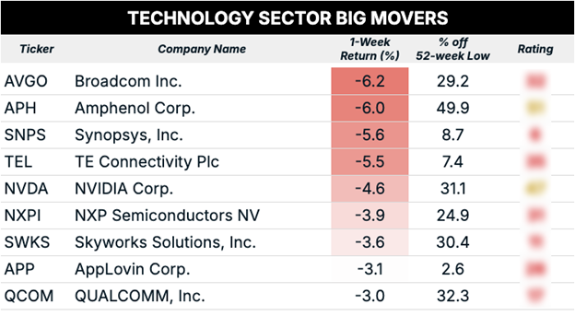
After the monster run in tech this year, very few of last week’s biggest losers were trading anywhere near their 52-week lows.
So, I loosened the criteria. Unfortunately, it didn’t help much.
There isn’t a single “Bullish” rated stock on the list. Only two rate as highly as “Neutral,” Amphenol (APH) and Nvidia (NVDA).
This doesn’t mean that all tech stocks should be avoided, of course.
But it does mean that timing is critically important.
When a sector has already enjoyed a massive run, simply buying the biggest names after a pullback isn’t necessarily a winning strategy.
The better approach is to let the data tell us where the strength is – and wait for the right setup before putting new money to work.
Right now, that means being a little more selective with tech and keeping an eye on where the next wave of strength begins to emerge.
To good profits,

Adam O’Dell
Editor, What My System Says Today