

A magician doesn’t fool you with speed. He fools you with your own eyes.
He gives his right hand a big, showy flourish, and your gaze follows it like a dog chasing a tossed ball. All the while, his left hand — the one actually doing the trick — works in plain sight. You never catch it. The whole illusion lives in where you’re told to look.
Wall Street runs the same act every earnings season.
And this quarter, it’s giving you a real flourish, as shown in the chart below…
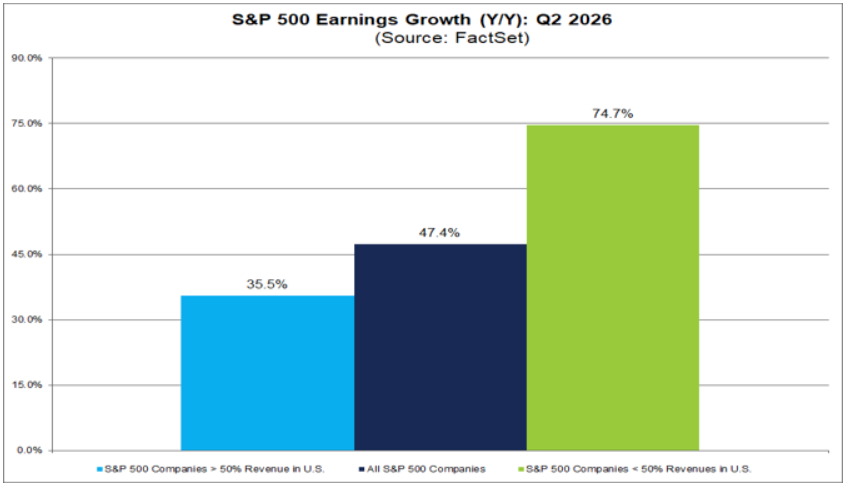
The flashy hand tells a clean story. The companies that sell most of their goods overseas are growing profits more than twice as fast as the ones that stay home this quarter. Go global, the chart whispers, or get left behind.
Now watch the other hand.
That whole overseas “advantage” is really just three names doing the heavy lifting: Alphabet, Exxon Mobil, and Chevron.
Pull those three out of the group, and the edge falls apart. Strip them away, and the international crowd grows earnings at 27.5% — below the stay-at-home bunch you were just told to avoid.
The chart isn’t lying. It’s just pointing at the wrong hand.
And that’s the whole game with a big, tidy headline: it flattens a hundred different companies into one neat story, and the story is almost always wrong at the edges. “Global” is a tailwind for Chevron and a headwind for some software outfit eating currency losses on every overseas invoice. It’s not the overall theme that pays you. The individual company does.
Which brings me to why you’re here.
Every week, I run the calendar of companies reporting next week through Adam’s system and let the ratings do the talking. No themes. No hot takes. Just one read on each name — Bullish, Neutral, or Bearish — and a look at where the earnings are actually heading.
Here’s what it’s telling me today.
“Bullish” Earnings to Watch
These stocks are expected to beat their earnings per share (EPS) from the previous quarter. And if those expectations are met or exceeded, they could potentially trade higher.
For this screen, stocks must meet four criteria:
- 10 or more analysts cover the stock.
- The average analyst recommendation is a “Buy.”
- It BEAT analysts’ EPS estimates for the previous quarter.
- The average analyst estimate for the current quarter’s EPS is greater than the previous one.
Here are 10 companies that made this week’s list:
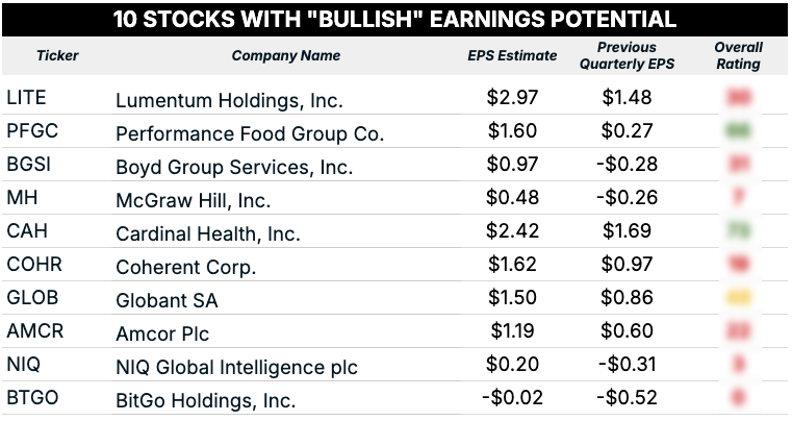
These 10 names are all set up for a sharp year-over-year earnings pop when they report next week.
Some are swinging from a loss to a profit. Some are nearly doubling last quarter’s number. On the earnings line alone, they look like fireworks.
But watch what happens when you lay my system’s rating side by side with the earnings estimate. The two don’t always agree — and that gap is the whole point.
Take Lumentum Holdings (LITE). The Street sees EPS doubling from $1.48 to $2.97. Exciting on paper. Adam’s system still tags it Bearish.
Coherent Corp. (COHR) is another one dressed up for the party — earnings jumping from $0.97 to $1.62 — and Adam’s system rates it Bearish, too. A big earnings jump off a beaten-down base is not the same thing as a healthy company. Often it’s the opposite.
Two names in this group actually clear the bar on both counts.
Cardinal Health Inc. (CAH) pairs a jump from $1.69 to $2.42 with a Bullish rating — the strongest signal on the list. Performance Food Group Co. (PFGC) is right behind it: earnings exploding from $0.27 to $1.60, and a Bullish rating to back it up.
Earnings beats from any of these companies could either elevate the stocks from the bottom or push them higher to the top.
When the earnings momentum and the system point in the same direction, I pay attention. Those are the two I’d circle here.
The rest? The earnings estimate is throwing a party; the fundamentals didn’t get invited.
Now, let’s look at the potentially “bearish” earnings calls for next week…
“Bearish” Earnings to Watch
For our “bearish” earnings screen, we’re only looking for two things:
- 10 or more analysts must cover the stock.
- The average analyst estimate for the current quarter’s EPS is less than the previous quarter’s.
We want companies that are covered by a sufficiently large group of Wall Street analysts who collectively expect the company to report a QOQ decline in earnings.
Here are 10 companies that passed this screen:
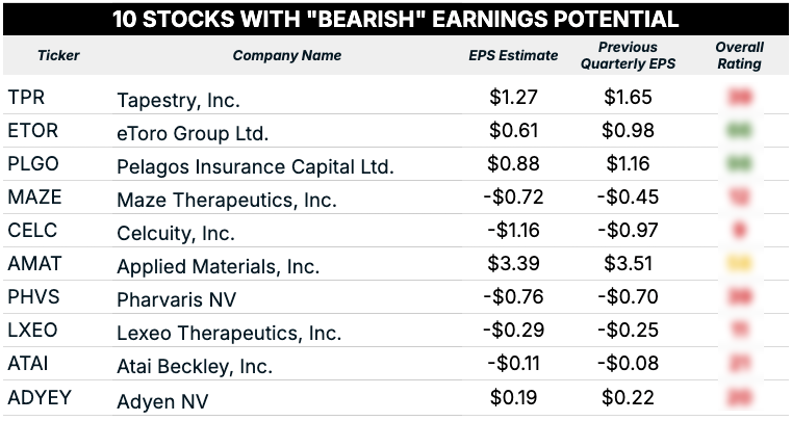
Now, the other end of the field. These 10 are pointed the wrong way on earnings — falling profits, deepening losses, or a beat that’s shrinking quarter over quarter.
The obvious read is “avoid the whole list.”
But the system won’t let me be that lazy — and neither should you.
Look at Pelagos Insurance Capital Ltd. (PLGO). Yes, EPS is easing from $1.16 to $0.88. But Adam’s system still tags it Bullish — the strongest read across both of today’s lists.
And eToro Group Ltd. (ETOR), even with earnings sliding from $0.98 to $0.61, still comes up Bullish. When a stock’s earnings dip but the system stays positive, that’s often just a soft quarter inside a good story — the kind of noise that scares weak hands out at exactly the wrong time.
Applied Materials Inc. (AMAT) is the household name in this bunch. Earnings barely budge, $3.51 down to $3.39, and Adam’s system reads it Neutral.
Not a screaming buy, not a run-for-the-hills sell. The system says “fine” — and sometimes “fine” is the most honest thing you can say about a stock.
The names to actually worry about are the ones where the earnings are sinking and the system reads Bearish — the Maze Therapeutics Inc. (MAZE) and Celcuity Inc. (CELC) types.
That’s not a dip. That’s a direction.
The takeaway here is that the market wants to sell you a theme this week — “international is where the growth is.”
Adam’s system doesn’t trade themes. It trades on individual companies’ merits, and today it’s telling me the same thing it always does: the label on the box tells you almost nothing about what’s inside.
So don’t buy the “global earnings” headline. Buy — or avoid — the specific names, on the specific numbers. On the bullish side, CAH and PFGC are the two that earn it. On the bearish side, PLGO and ETOR are worth a second look before you write them off.
Next week, we’ll see how many of these prints actually match the setup.
Until next time…

Matt Clark, CMSA®
Chief Research Analyst, What My System Says Today