

Six weeks.
That’s how long U.S. bank stocks have been winning — quietly, consistently and almost entirely under the radar.
Last week told the same story we’ve seen for over a month now: inflation fears, AI volatility, geopolitical tension, a retreating S&P 500 Index and plenty of other reasons to be nervous.
That version of the market isn’t wrong. It’s just incomplete.
You see, while that drama played out in the foreground, the KBW Nasdaq Bank Index rose for the sixth straight week, outpacing the S&P 500 for the fourth consecutive time.
At some point, a streak like that stops being a coincidence and starts being a trend worth paying attention to.
KBW Nasdaq Bank Index Up 17% Since April
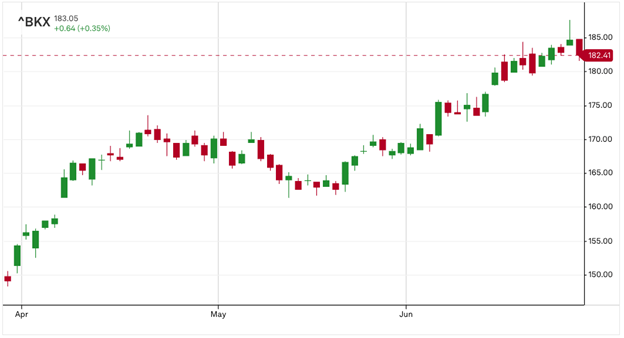
The numbers back it up. The KBW index climbed 2.05% between June 17 and June 25, while the S&P 500 fell 0.84% over the same period. And the gap between the two is widening.
Bank stocks have been outperforming on a year-to-date basis, merger and acquisition (M&A) activity has slowed because banks simply don’t need to sell from a position of weakness and the macro concerns dominating headlines have, if anything, pushed investors toward the relative predictability of financials.
The leaders of this stealth rally cut across the banking landscape.
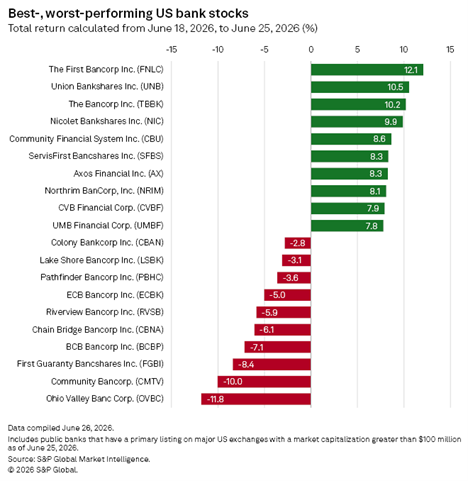
The First Bancorp (FNLC) topped the charts with a 12.1% total return for the week ending June 25, followed by Union Bankshares (UNB) at 10.5% and The Bancorp (TBBK) at 10.2%.
Community and regional names dominated the leaderboard — Nicolet Bankshares, CVB Financial, UMB Financial — each quietly compounding gains while the financial media chased other stories.
But not every name participated in the uptrend.
Ohio Valley Banc Corp. (OVBC) shed 11.8% on the week, and Community Bancorp (CMTV) fell 10.0%. First Guaranty Bancshares dropped 8.4%, and BCB Bancorp gave back 7.1%.
The divergence between winners and losers was sharp, which means stock selection here matters as much as the sector tailwind.
The broader trend, though, is hard to ignore.
The question now isn’t whether banks have had a good run. It’s whether the stocks doing the heavy lifting are actually worth owning at these levels.
A Tale Of Two Types Of Banks
So what does Adam’s Green Zone Power Ratings system say about the rally’s staying power?
The picture is nuanced.
I ran an X-ray of both the KBW Nasdaq Bank Index, which includes 24 of the largest U.S. banks.
However, since many of the top performers on the list above are regional banks, I also included the KBE Nasdaq Regional Bank Index.
KBW Nasdaq Bank Index Rates Neutral… Barely
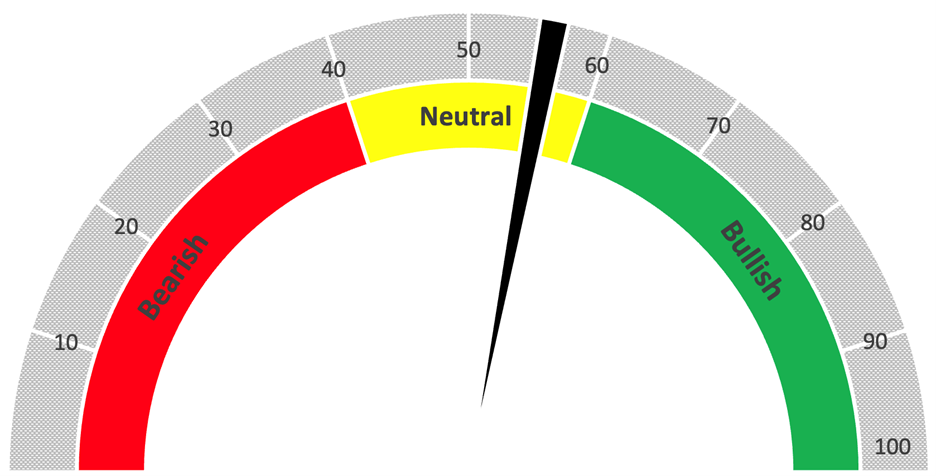
When you plot the overall ratings across KBW Nasdaq Bank Index constituents, the needle lands right at the edge of neutral — just barely crossing into bullish territory, around 55.
The momentum is real, but the index as a whole isn’t flashing a strong buy signal. It’s a market telling you to be selective, not to pile in wholesale.
Meanwhile, the Regional Bank Index tells a more encouraging story.
Regional Banks Skew Bullish
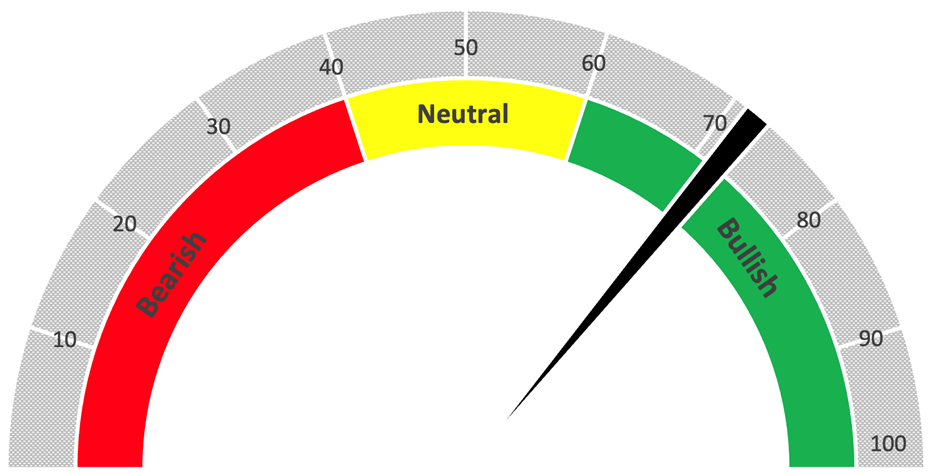
That needle sits firmly in bullish territory, closer to 70 — a meaningful distinction.
Regional banks, the same community and mid-size names that dominated last week’s best-performers list, are where the underlying strength is concentrated.
Both indexes score a 60 on Momentum, in the mid-60s on Volatility and around 70 on Growth.
The sector tailwind is real, but it’s blowing harder for regionals than for the broader banking universe.
This means the six-week streak is not a fluke, but it’s also not a green light to buy everything with “bank” in the name.
Our Green Zone Power Ratings system confirms what the weekly performance chart already suggested — there’s genuine dispersion here.
The regionals showing up at the top of the leaderboard aren’t just riding a wave. They’re being rewarded for it by the fundamentals. That’s where the opportunity lives.
Until next time…
Safe trading,

Matt Clark, CMSA®
Chief Research Analyst, Money & Markets
P.S. One theme is becoming even clearer: the AI buildout isn’t slowing down — it’s broadening. What began as a software-driven narrative is rapidly expanding into infrastructure, especially power and grid capacity.
As demand from data centers intensifies, the constraint is shifting from chips to electricity, and the companies positioned at that intersection are starting to draw attention from both markets and policymakers.
That’s why What My System Says Today editor Adam O’Dell went LIVE yesterday to detail how you can position yourself to capitalize on this lucrative setup. Click here to catch up on the full details…